

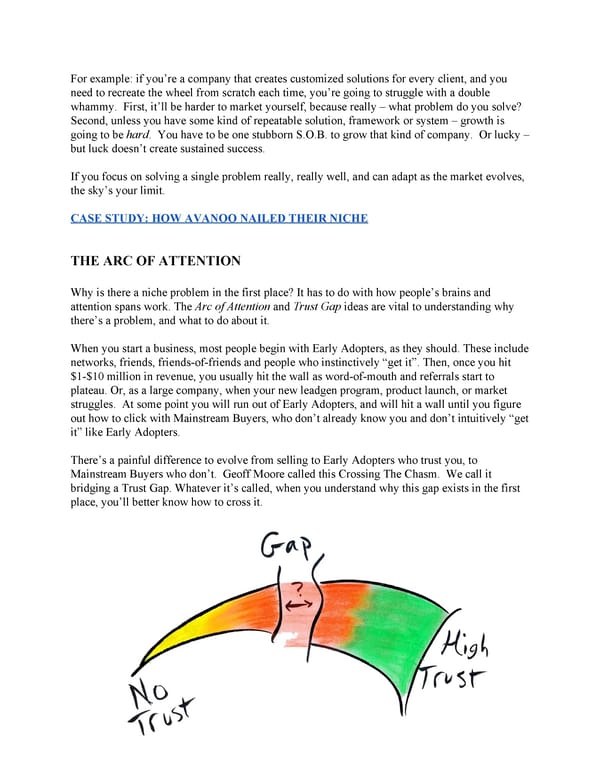
For example: if you’re a company that creates customized solutions for every client, and you need to recreate the wheel from scratch each time, you’re going to struggle with a double whammy. First, it’ll be harder to market yourself, because really – what problem do you solve? Second, unless you have some kind of repeatable solution, framework or system – growth is going to be hard. You have to be one stubborn S.O.B. to grow that kind of company. Or lucky – but luck doesn’t create sustained success. If you focus on solving a single problem really, really well, and can adapt as the market evolves, the sky’s your limit. CASE STUDY: HOW AVANOO NAILED THEIR NICHE THE ARC OF ATTENTION Why is there a niche problem in the first place? It has to do with how people’s brains and attention spans work. The Arc of Attention and Trust Gap ideas are vital to understanding why there’s a problem, and what to do about it. When you start a business, most people begin with Early Adopters, as they should. These include networks, friends, friendsoffriends and people who instinctively “get it”. Then, once you hit $1$10 million in revenue, you usually hit the wall as wordofmouth and referrals start to plateau. Or, as a large company, when your new leadgen program, product launch, or market struggles. At some point you will run out of Early Adopters, and will hit a wall until you figure out how to click with Mainstream Buyers, who don’t already know you and don’t intuitively “get it” like Early Adopters. There’s a painful difference to evolve from selling to Early Adopters who trust you, to Mainstream Buyers who don’t. Geoff Moore called this Crossing The Chasm. We call it bridging a Trust Gap. Whatever it’s called, when you understand why this gap exists in the first place, you’ll better know how to cross it.
 From Impossible to Inevitable: How Hypergrowth Companies Create Predictable Revenue Page 6 Page 8