

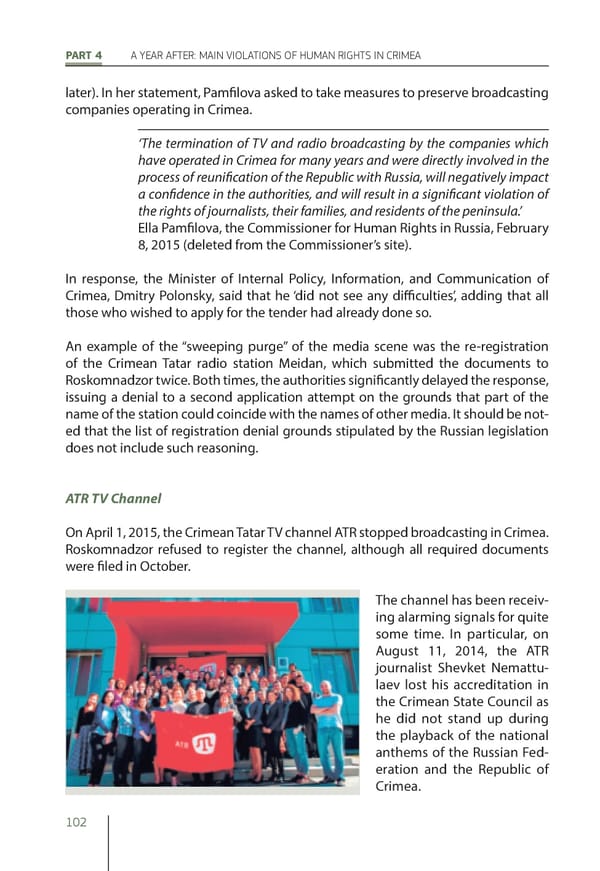
PART 4 A YEAR AFTER: MAIN VIOLATIONS OF HUMAN RIGHTS IN CRIMEA later). In her statement, PamR lova asked to take measures to preserve broadcasting companies operating in Crimea. ‘The termination of TV and radio broadcasting by the companies which have operated in Crimea for many years and were directly involved in the process of reuni+ cation of the Republic with Russia, will negatively impact a con+ dence in the authorities, and will result in a signi+ cant violation of the rights of journalists, their families, and residents of the peninsula.’ Ella PamR lova, the Commissioner for Human Rights in Russia, February 8, 2015 (deleted from the Commissioner’s site). In response, the Minister of Internal Policy, Information, and Communication of Crimea, Dmitry Polonsky, said that he ‘did not see any di7 culties’, adding that all those who wished to apply for the tender had already done so. An example of the “sweeping purge” of the media scene was the re-registration of the Crimean Tatar radio station Meidan, which submitted the documents to Roskomnadzor twice. Both times, the authorities signiR cantly delayed the response, issuing a denial to a second application attempt on the grounds that part of the name of the station could coincide with the names of other media. It should be not- ed that the list of registration denial grounds stipulated by the Russian legislation does not include such reasoning. ATR TV Channel On April 1, 2015, the Crimean Tatar TV channel ATR stopped broadcasting in Crimea. Roskomnadzor refused to register the channel, although all required documents were R led in October. The channel has been receiv- ing alarming signals for quite some time. In particular, on August 11, 2014, the ATR journalist Shevket Nemattu- laev lost his accreditation in the Crimean State Council as he did not stand up during the playback of the national anthems of the Russian Fed- eration and the Republic of Crimea. 102
 The Peninsula of Fear: Chronicle of Occupation and Violation of Human Rights in Crimea Page 101 Page 103