

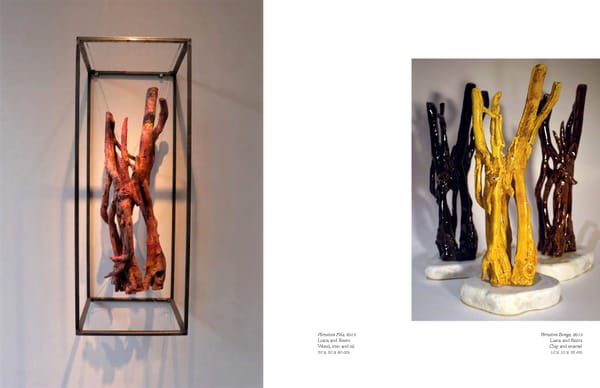
27 26 Variations around a found object Variazioni attorno a un oggetto trovato It begins with an insignificant finding: a piece of failed tree on a beach in Italy where David Cohen spends his summers since adolescence. The end of the tree is entwined with a kind of floating wood liana. Waited by the appearance of dry, thirsty, long-limbed stems, he removes the trunk. They have almost a human form, entangled, clinging to each other in a desperate round so as not to fall into the abyss of disappearance. David Cohen is an autodidact artist with an atypical ca- reer since he is also a child psychiatrist. He cannot resist the temptation to heal the sick object in order to bring him back to life. Not related to a specific artistic movement, although strongly influenced by Kandinsky›s compositions and Miro›s colors, David Cohen continues his work mainly with paintings that incorporate plants, textiles and car- casses with a predilection for the branches of olive trees. Driven by a quest for reincarnation, he will raise from these vines that are one, a real altar to the memory of what remains of the tree, reproducing it as much as possible in a multitude of textures. Instead of diverting, the object returns it in the direction of the return to life. It transforms the thing while leaving it recognizable, it will have no other use than to be there, to be alive again and to be venerated. Even if the remainder remains inanimate, his life will be revealed by the sparkle and brilliance of the colors. First, he makes an impression of the object imagining variations from the positive and the negative of the wood found. Then he produces a first work: his branch is skinned alive, suspended on metal bars as exposed for an anatomy lesson, it is the backbone of what will become an astonishing variation around the found object, assur- ing him thus a survival. The sick object will be healed, (re) incarnated and multiplied into various materials. The bloody wounds that are distinguished in the first piece will heal to leave room for the sap of life on the series of sculptures that will be performed. From the crystalline stone, the bronze that oxidizes and whose patina is allied with the vegetable color, through his burned clay of ocher tones, saffron, faded roses, to the ceramics that dyes cobalt blue, yellow golden button, tender green pigments, it perpetuates what remains of the plant. The structures are made either of a block like that in pink travertine, or are erected on beautiful marble pebbles with the roundness of pebbles coming from the river which flows in the village – Pietrasanta – which overhangs the place where David Cohen lives in summer. The saturation and the luminance of the colors on the sculptures are chosen according to the chromatic percep- tion of the artist who thinks in bright colors and would undoubtedly have wished that there is still more tones than cannot offer a color chart. He goes so far as to give an ultimate new breath to the initial piece by integrating it, as he is accustomed to doing in his artistic production, on a canvas by rendering it his original «form»; that of a tree of life on a background of orange, a predominant, warm and stimulating color that often collects the favors of the artist in his work and whose famous painter Vassily Kandinsky writes of orange that he «looks like a man sure of its strengths and consequently gives an impression of health». David Cohen in making such a canvas with a generous lyric flight takes up the theme of the tree that has staked his work for many years, branch- es stretch all their splendor, arise as if by magic from a mail bag, a marble trunk or even here a tree remains thunderstruck and found. Mikaela Zyss Inizia con una scoperta insignificante: un pezzo di albero appogiato su una spiaggia in Italia dove David Cohen trascorre le sue estati sin dall'adolescenza. La fine dell'albero è intrecciata con una specie di liana di legno galleggiante. Commosso dall’aspetto di steli secchi, as- setati, lunghi, rimuove il tronco. Hanno una forma quasi umana, impigliati, aggrappati l'uno l'altro in un giro disperato per non cadere nell’abisso della scomparsa. David Cohen, artista autodidatta con una carriera atipica poiché è anche un psichiatra del bambino, non può resistere alla tentazione di guarire l'oggetto malato per riportarlo in vita. Non correlato a uno specifico movimento artistico, sebbene fortemente influenzato dalle composizioni di Kandinsky e dai colori di Miro, David Cohen continua il suo lavoro principalmente con dipinti che incorpora- no piante, tessuti e carcasse con una predilezione per i rami dell'olivo. Spinto da una ricerca per la reincarnazi- one, solleverà da questi liane che dinventano uno solo, un vero altare al ricordo di ciò che rimane dell'albero, riproducendolo il più possibile in una moltitudine di tessiture. Invece di deviare, l'oggetto lo restituisce nella direzione del ritorno alla vita. Trasforma la cosa las- ciandola riconoscibile, non avrà altro scopo che essere lì per essere di nuovo viva e per essere venerata. Anche se il resto rimane inanimato, la sua vita sarà rivelata dallo splendore e dalla brillantezza dei colori. In primo luogo, realizza un'impronta dell'oggetto che immagina variazioni dal positivo e dal negativo del legno trovato. Quindi produce una prima opera: il suo ramo è scolpito vivo, sospeso su barre di metallo come esposto per una lezione di anatomia, è la spina dorsale di quel- la che diventerà una sorprendente variazione intorno all'oggetto trovato, assicurandolo quindi una soprav- vivenza.L'oggetto malato sarà guarito, (re) incarnato e moltiplicato in vari materiali. Le ferite insanguinate che si distinguono nel primo pez- zo guariranno per lasciare spazio alla linfa vitale della serie di sculture che verranno eseguite. Dalla pietra cristallina, il bronzo che si ossida e la cui patina si combina con il colore vegetale, attraverso la sua terra bruciata da toni ocra, zafferano, rose appassite, alla ceramica che tinge i pigmenti blu cobalto, bottone giallo dorato, verde tenero, perpetua ciò che rimane della pi- anta. Le strutture sono fatte di un blocco simile a quello del travertino rosa, o sono erette su bellissimi ciottoli di marmo con la rotondità di ciottoli provenienti dal fiume che scorre nel villaggio – Pietrasanta – che sovrasta il luogo in cui David Cohen vive in estate. La saturazione e la luminosita dei colori sulle sculture sono scelte in base alla percezione cromatica dell'artista che pensa in colori vivaci e senza dubbio avrebbe volu- to che ci fossero ancora più toni di quanti non possano offrire una cartella colori. Si spinge così lontano da dare un ultimo respiro nuovo al pezzo iniziale integrandolo, come è abituato a fare nella sua produzione artistica, su una tela rendendola sua «forma» originale; quello di un albero della vita su uno sfondo di colore arancione predominante, caldo e stimolante che spesso raccoglie i favori dell’artista nella sua opera e il cui famoso pittore Vassily Kandinsky scrive di arancio che «sembra un uomo sicuro dei suoi punti di forza e di conseguenza dà un’impressione di salute» 1 . David Cohen nel fare una tale tela con un generoso volo lirico riprende il tema dell'albero che accomagna il suo lavoro da molti anni, i rami allungano tutto il loro splendore, sorgano come per magia da uno sacco postale, un tronco di marmo o anche qui un albero rimane folgorato e trovato. Mikaela Zyss Mikaela Zyss is photo editor and curator. Among others, she organized the large 2017 retrospective of Gilles Caron’s photographer in Israel and collaborated to the last two Dakar’s Biennale of African Art. The following text was written for the 2017 exhibition that David Cohen had at Galerie XXI in Paris presenting the series Sculptural Variations also called by Art Absolument review Vegetal Partitions. Mikaela Zyss è editore di foto e curatrice. Tra l’altro, ha or- ganizzato la grande retrospettiva del foto-grafo Gilles Caron nel 2017 in Israele e ha collaborato alle due ultime Biennale di Arte Africana di Dakar. Il testo seguente è stato scritto per la mostra 2017 che David Cohen ha consegnato alla Galerie XXI di Parigi presentando la serie Variazioni Scultoree, anche chiamata dalla rivista Art Absolument Partizione Vege- tale. 1. Du spirituel dans l’art , Paris, Denoël, coll. « Folio essais » (no 72), 1989, p. 162. 1. Du spirituel dans l›art , Paris, Denoël, coll. « Folio essais » (no 72), 1989, p. 162.
 In Your Head Page 11 Page 13