

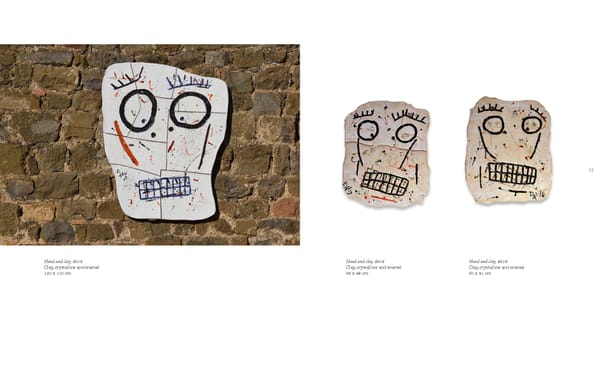
51 50 In his heads Closed eyes Wide eyes Closed wide eyes - Paul Eluard “From the Earth grew many heads but without a neck. And bare arms without shoulders wandered, and eyes that floated, not moored to the foreheads. You do not see them” says Oreste in Furies, “but I do see them, these heads chase me” . Why do David Cohen’s heads hypnotize us? What do they see? What do they tell? These heads try to say things that cannot be said. But shall we not one day stop saying things to start seeing these things? Heads in clay, leather, bronze, marble show the trace, the imprint, the language of the origins, yes, presence and absence, the power of passing time. These heads see invisible things that men no longer see. And without a doubt, something irreversible, terrible, unspeakable, that cannot be represented happened. We know it, we talk about it mechanically, next to it. Families, religions, philosophies, financial markets are there to distract us from this black presence. These heads give a representa- tion of the what cannot be represented. The heads of David Cohen irrigate a territory, a geog- raphy, tell a novel, a music, how women died without a dream, lost children. They also print and read poems of love, but no one to listen to them except animals, flowers, rocks that cannot yet read. Heads upside down, world upside down that never stops walking on our heads. But David Cohen guides us to other possibilities to put back Arthur Rimbaud’s paradise: “The material world will only be a means to evoke aesthetic expres- sions. We will have feelings through lines, colors and patterns taken from the outside world, simplified and tamed, a real magic”. The work of David Cohen is still moving, in opposition to the finished work. “The finish is the admiration of imbeciles” Cezanne writes to his mother. Experimenta- tion motivates him, and ceramics itself is a metaphysical question for David Cohen. Enamel and engobes give a balance to his heads, but that’s not an idea anymore, but a thought that takes shape as a material captures and transforms light. The primitive past comes out of Earth with the earth to better occupy the space. He is a mu- tant, a messenger of matter who invites us also by his look, his relation to the world and to the other, but also to the same, to celebrate life in the face of disenchant- ment and human madness. Listen to Jacques Lacan: ‘The being of man, not only cannot be understood without madness, but it would not be the being of man if he did not carry in himself madness as limit of his freedom‘. And the heads of David Cohen cross the wall of seeing. It is a struggle, a battlefield, they try to overcome our ontological blindness; they see the visible but also the invisible, the hidden, death. They tried to suppress art in the twentieth century by fields, wars, money but the act of creating was even stronger. “To create is to resist, it is to harm stupidity”. The bursting of the heads of David Cohen in the landscape is so incarnated, luminous and powerful that it moves us infinitely, at once a tender- ness and a disenchantment. This tenderness, linked to the fright we feel in adulthood after having understood with anguish that the world of childhood was moving away; and this disenchantment to seize life, only life, life alone, what there is between men, space, forms, colors, matter, thought. We must simply be carried away by the diversity of materials used and the perceptions that his works make us share, voices and ancestral ways, imper- ceptible, mysterious, we hear the murmur of flowers and the silence of God. The eye is listening, but the sky is empty. The work is here rebellion, insubordination, interrogation, it is not the missing link of a society of convenience. David Cohen reminds us that a work of art is a human creation, a meditation, a contemplation; an access to a multiple dimension in a historical complexity that also corresponds to his past, and today to his life as a Professor of Psychiatry. He tells us about the human adventure as an adventurer and speaks to everyone. David Cohen is a colorist, color also becomes material, it is a song that connects men, but nothing religious, sim- ply a spirituality that allows men to say, write and share the poetic. Listen to Roland Barthes: “ Intelligence is about thinking of others”. The work of David Cohen is part of this thought, this story where the relationship to the world, to the other, to his double, real or imaginary, questions him. The ‘I is another’ of Rimbaud. I think to be the one who thinks - I am - otherwise, I would be an- other, I am precisely, not me, but this other. Who am I? Who am I really? What am I doing here? Where is the stake? The heads of David Cohen answer our questions, it’s not only the eye that looks, it’s the being – We are there. What do they hear, the heads of David Cohen? Michel Blachère They hear the cries of martyrs and hungry people, for- gotten beings. Why in history, humans have forgotten? We massacre, we kill, we terrorize, we kill and we open the bellies of women to kill their children. Women are raped, incests are many; society is sick. We sell children, those who are too weak, we exterminate them. Organs are taken from abandoned, poor children to give them to the richest. Horror, prostitution, homophobia, racism, neuroses, psychoses. Governments, governments do nothing. They are cowards. They expect the savages to kill and the civilized to commit their crimes. The trains were leaving for Dachau, Ravensbruck, Auschwitz, they did nothing, they made us believe they did not know, and like today, they pretended to ignore history. Red sky, it’s raining blood. Hell is here, we cannot stop the course of history. The dawns are always heartbreaking, the being is forgotten. The heads of David Cohen speak of a lost world with an illuminated look on the world of tomorrow and that of the day after tomorrow. As diviners predict destiny. Listen to Albert Einstein: “What if we were wrong? If we called blue, green? Who can show a blue tree? Who’s talking about fresh watercress?” writer, Arthur Rimbaud. A sculp- tor, David Cohen. Michel Blachère is a writer and a curator. He is the director of the Galerie XXI in Paris that has been showing contemporary ceramics for more than two decades. He has presented David Cohen’s work twice in his gallery. He recently curated several exhibits: Re-sources at the Dêvres museum on contemporary ceramics (October 2017 - March 2018) and Vallauris, the beautiful story at the Sarreguemines museum (June 2017 - January 2018).
 In Your Head Page 22 Page 24