

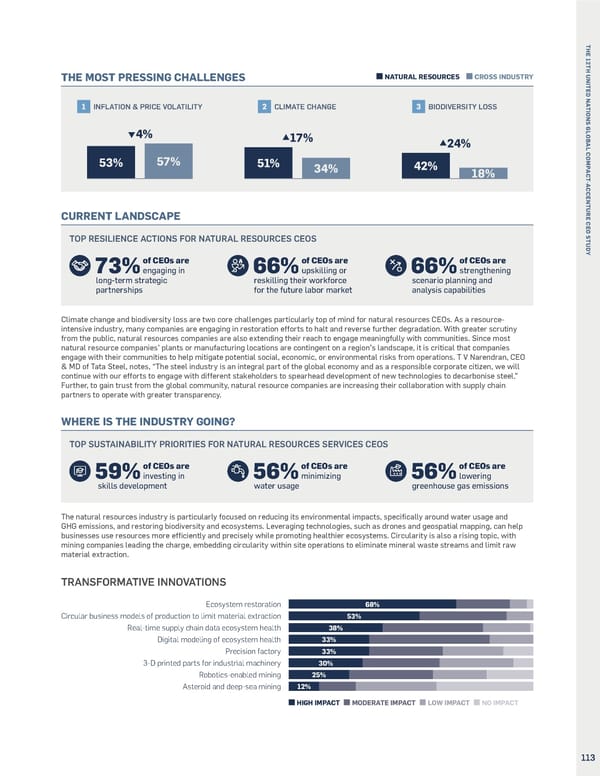
T H E 1 2 T H U THE MOST PRESSING CHALLENGES NATURAL RESOURCES CROSS INDUSTRY N I T E D N A 1 INFLATION & PRICE VOLATILITY 2 CLIMATE CHANGE 3 BIODIVERSITY LOSS T I O N S G L 4% O 17% B R A L 24% L C O 57% M 53% 51% P 34% 42% A 18% C T - A C C E N E T U R A CURRENT LANDSCAPE E C E The natural resources industry is O S TOP RESILIENCE ACTIONS FOR NATURAL RESOURCES CEOS T U facing a massive transformation D Y – once a historically human-S of CEOs are of CEOs are of CEOs are engaging in upskilling or strengthening intensive industry, the industry is R73% 66% 66% now rapidly embracing technology. long-term strategic reskilling their workforce scenario planning and partnerships for the future labor market analysis capabilities The adoption of drones, robotics, and data analytics are radically OU Climate change and biodiversity loss are two core challenges particularly top of mind for natural resources CEOs. As a resource- changing the way the industry can intensive industry, many companies are engaging in restoration efforts to halt and reverse further degradation. With greater scrutiny manage raw materials in real time. Ufrom the public, natural resources companies are also extending their reach to engage meaningfully with communities. Since most natural resource companies’ plants or manufacturing locations are contingent on a region’s landscape, it is critical that companies engage with their communities to help mitigate potential social, economic, or environmental risks from operations. T V Narendran, CEO & MD of Tata Steel, notes, “The steel industry is an integral part of the global economy and as a responsible corporate citizen, we will continue with our efforts to engage with different stakeholders to spearhead development of new technologies to decarbonise steel.” Further, to gain trust from the global community, natural resource companies are increasing their collaboration with supply chain partners to operate with greater transparency. WHERE IS THE INDUSTRY GOING? ATR TOP SUSTAINABILITY PRIORITIES FOR NATURAL RESOURCES SERVICES CEOS “It’s important that geopolitics of CEOs are of CEOs are of CEOs are investing in minimizing lowering doesn’t stall the climate agenda. 59% 56% 56% As companies, we need to keep skills development water usage greenhouse gas emissions climate change front and center as an issue that we all must address.” CThe natural resources industry is particularly focused on reducing its environmental impacts, specifically around water usage and N GHG emissions, and restoring biodiversity and ecosystems. Leveraging technologies, such as drones and geospatial mapping, can help Praveen Singhavi, businesses use resources more efficiently and precisely while promoting healthier ecosystems. Circularity is also a rising topic, with President of APRIL Groupmining companies leading the charge, embedding circularity within site operations to eliminate mineral waste streams and limit raw material extraction. E TRANSFORMATIVE INNOVATIONS 68% Ecosystem restoration Circular business models of production to limit material extraction 53% S Real-time supply chain data ecosystem health 38% Digital modeling of ecosystem health 33% Precision factory 33% 3-D printed parts for industrial machinery 30% Robotics-enabled mining 25% Asteroid and deep-sea mining 12% HIGH IMPACT MODERATE IMPACT LOW IMPACT NO IMPACT 112 113
 Accenture CEO Study United Nations Global Compact Page 112 Page 114