

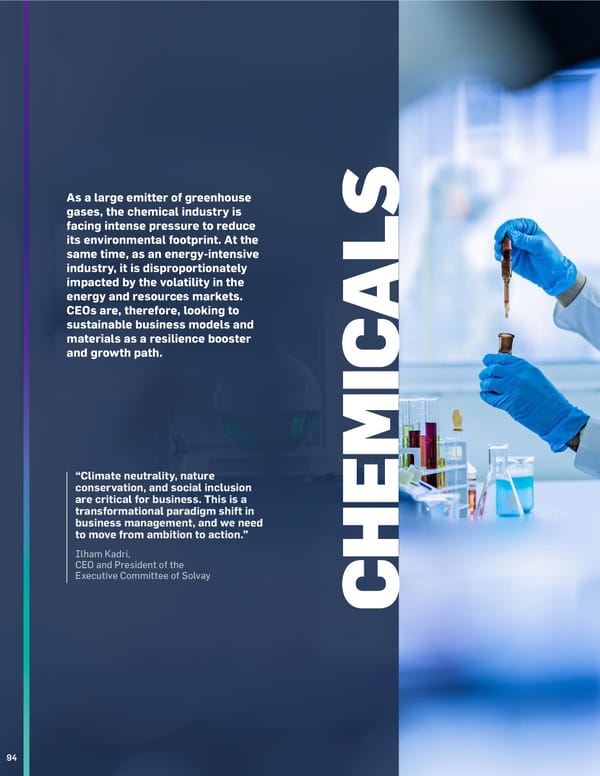
T H E 1 2 T H U THE MOST PRESSING CHALLENGES CHEMICALS CROSS INDUSTRY N I T E D N A 1 INFLATION & PRICE VOLATILITY 2 TRADE REGULATION 3 CLIMATE CHANGE T I O N S G 8% L O B A 10% 7% L C O 65% 57% M P 41% 31% 41% 34% A C T - A C C E As a large emitter of greenhouse N T U gases, the chemical industry is S R CURRENT LANDSCAPE E C facing intense pressure to reduce E O S T its environmental footprint. At the TOP RESILIENCE ACTIONS FOR CHEMICALS CEOS U D same time, as an energy-intensive L Y industry, it is disproportionately of CEOs are of CEOs are of CEOs are upskilling or engaging in digitizing 79% 73% 69% impacted by the volatility in the reskilling their workforce for long-term strategic business processes energy and resources markets. the future labor market partnerships CEOs are, therefore, looking to A sustainable business models and Digitization, new technologies, and innovations across the sector are at the heart of the sustainable transformation of the chemicals materials as a resilience booster industry. Actions such as embedding software-connected components into the manufacturing system help to better identify risks and decrease material waste, while investing in new materials with lower-emission footprints helps the industry decarbonize.. In particular, and growth path. plastics producers are developing new reusable and recyclable materials, addressing public scrutiny over plastic pollution. To enable C these industry shifts, chemical CEOs are taking a people-first approach, upskilling and reskilling employees to develop expertise in I sustainable production processes to ensure that their R&D and technology investments are implemented quickly and effectively. WHERE IS THE INDUSTRY GOING? TOP SUSTAINABILITY PRIORITIES FOR CHEMICALS CEOS of CEOs are of CEOs are of CEOs are lowering introducing new reducing waste M 72% 59% 53% GHG emissions and sustainable business models from products and operations “Climate neutrality, nature conservation, and social inclusion are critical for business. This is a The demand for green alternatives to traditional chemical products will continue to grow, as companies face increasing consumer transformational paradigm shift in and regulatory pressure. As Sarfaraz Ahmed Rehman, Managing Director and Chief Executive Officer of Fauji Fertilizer Company Limited, business management, and we need (FFC), states, “The reality is we don’t know if our industry will exist in 30 years’ time. We need to pursue a path of adaptability in a rapidly changing world.” To contend with this shift, chemicals CEOs are exploring new ways to harness renewable energy to fuel chemical to move from ambition to action.” processes for the short term, while looking towards larger-scale shifts, such as advanced recycling and circular business models, for the long-term. Not only will this unlock new avenues of sustainable growth for the chemicals industry, but will also accelerate overall Ilham Kadri, sustainability transformation in other industries as chemicals are a core component of most materials. CEO and President of the Executive Committee of Solvay CHE TRANSFORMATIVE INNOVATIONS Emerging fossil fuel alternatives to power chemical processes 58% Advanced recycling 57% Shift toward circular business models of production to limit virgin inputs 52% Carbon capture, utilization, and storage (CCUS) 46% iodegradable materials 35% HIGH IMPACT MODERATE IMPACT LOW IMPACT NO IMPACT 94 95
 Accenture CEO Study United Nations Global Compact Page 93 Page 95