

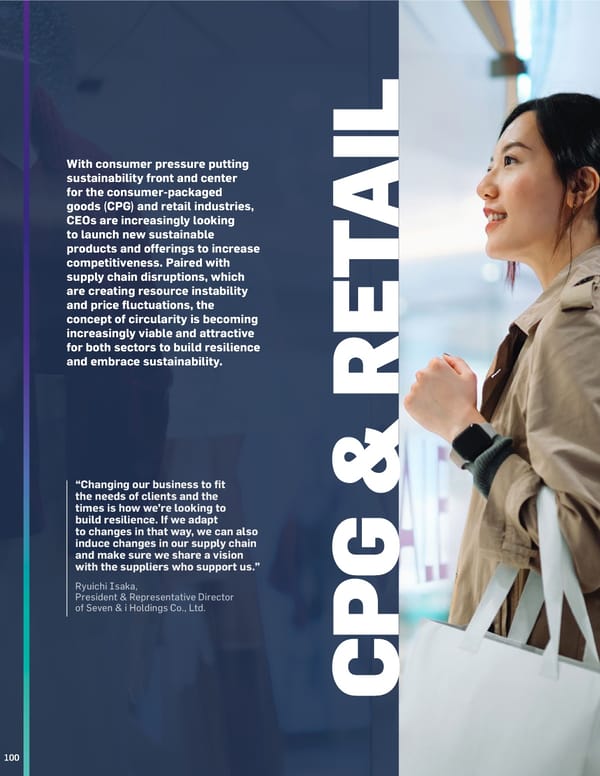
THE MOST PRESSING CHALLENGES CPG RETAIL CROSS INDUSTRY T H 1 INFLATION & PRICE VOLATILITY 2 THREATS TO PUBLIC HEALTH 3 TRADE REGULATION E 1 2 T 10% H U N I T 4% E 6% D N CPG 67% A 57% T 44% 40% I 37% 31% O N S G L L O 1 INFLATION & PRICE VOLATILITY 2 TRADE REGULATION 3 THREATS TO PUBLIC HEALTH B A L C 10% O I M With consumer pressure putting P 17% A AIL 1% C T sustainability front and center - A 67% C 57% 48% C for the consumer-packaged RET 39% 40% E 31% N T goods (CPG) and retail industries, U R CEOs are increasingly looking E C A E to launch new sustainable CURRENT LANDSCAPE O S T U D products and offerings to increase TOP RESILIENCE ACTIONS FOR CPG & RETAIL CEOS Y competitiveness. Paired with of CEOs are upskilling or of CEOs are upskilling or reskilling their workforce reskilling their workforce supply chain disruptions, which T 72% 81% for the future labor market for the future labor market are creating resource instability AIL and price fluctuations, the CPG of CEOs are digitizing of CEOs are digitizing business processes business processes 70% 78% concept of circularity is becoming RET increasingly viable and attractive of CEOs are launching of CEOs are engaging new product and/or in long-term strategic 64% 75% for both sectors to build resilience service offerings for sustainability partnerships and embrace sustainability. Rising costs of goods, inconsistent trade regulations, labor shortages, and shifting consumer demand have placed pressure on the CPG and retail industries. However, sustainability offers a solution by providing new avenues for growth, enticing consumers while attracting employees, and even proactively addressing trade regulations. To innovate and launch these new products and service offerings, CEOs are investing in strategic cross-industry and cross-value chain partnerships to build networks of shared knowledge. These networks RE allow CEOs to plan for risks more effectively and scale their innovations to broader markets. In addition, CEOs are focused on upskilling their workforce to respond to the changing business environment and run their new, sustainable business models. WHERE IS THE INDUSTRY GOING? TOP SUSTAINABILITY PRIORITIES FOR CPG & RETAIL CEOS of CEOs are introducing new of CEOs are constructing sustainable business models a responsible supply chain “Changing our business to fit 55% 59% the needs of clients and the of CEOs are reducing waste AIL of CEOs are investing times is how we’re looking to from products and operations in skills development & CPG 55% 58% build resilience. If we adapt RET to changes in that way, we can also of CEOs are constructing of CEOs are introducing new a responsible supply chain sustainable business models induce changes in our supply chain 55% 50% and make sure we share a vision with the suppliers who support us.” G As consumer-facing industries, CPG and retail CEOs are under intense pressure to transform to more sustainable models. To unlock the promise of sustainability, a responsible value chain is the first step. CEOs are looking to map fully their supply chains, leveraging data to track ESG Ryuichi Isaka, metrics down to a product level for holistic transparency and to enable end-to-end traceability. Some CEOs are looking to take it a step further, President & Representative Director embracing circularity from product design to adopting bio-based materials to using digital product IDs to enable these circular practices. of Seven & i Holdings Co., Ltd. TRANSFORMATIVE INNOVATIONS ircular business models 55% Sustainable and refillable packaging practices 45% Product-level ES data to follow for 43% End-to-end carbon calculators to help manage end-to-end supply chain traceability and report Scope 3 emissions with suppliers 45% ata integration across value chain partners 37% Artificial intelligence and predictive AIL analytics to efficiently drive merchandising 44% A and predictive analytics to efficiently drive 27% and production decisions CPG merchandising and production decisions Bio-based materials derived from waste by products 44% CP ynamic real-time inventory management 26% RET Product-level ES data to allow for 39% eolocation technology to map supply chain risk 24% end-to-end supply chain traceability Alternative proteins 15% igital product s to enable 33% circular business models HIGH IMPACT MODERATE IMPACT LOW IMPACT NO IMPACT HIGH IMPACT MODERATE IMPACT LOW IMPACT NO IMPACT 100 101
 Accenture CEO Study United Nations Global Compact Page 99 Page 101