

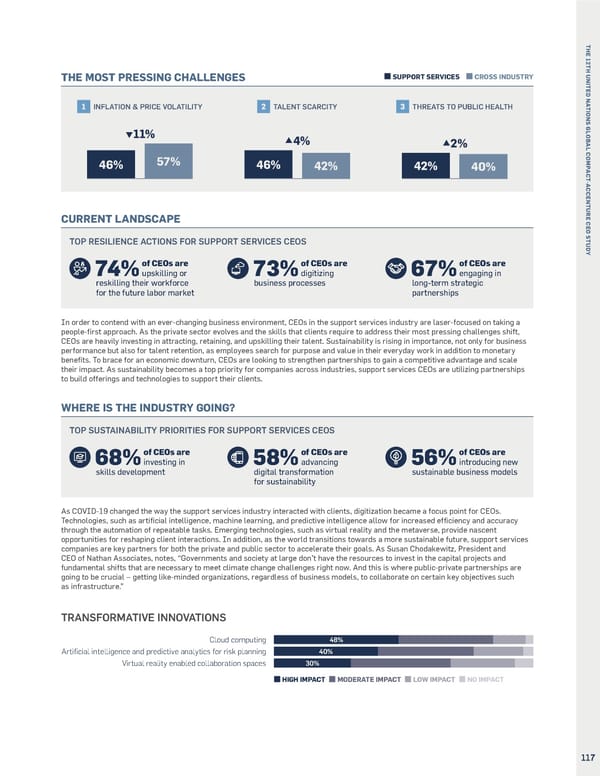
T H E 1 2 T H U THE MOST PRESSING CHALLENGES SUPPORT SERVICES CROSS INDUSTRY N I T E D N A 1 INFLATION & PRICE VOLATILITY 2 TALENT SCARCITY 3 THREATS TO PUBLIC HEALTH T I O N S G L 11% O B 4% A 2% L C O 57% M 46% 46% P 42% 42% 40% A C T - A C C E N T U R As industries across the world CURRENT LANDSCAPE E C E struggle with the results of the O S T pandemic, economic volatility, TOP RESILIENCE ACTIONS FOR SUPPORT SERVICES CEOS U D Y and geopolitical tensions, support SE of CEOs are of CEOs are of CEOs are services CEOs are focusing on upskilling or digitizing engaging in 74% 73% 67% building resilient workforces reskilling their workforce business processes long-term strategic and leveraging the power of ORTfor the future labor market partnerships technology to meet the ever- changing needs of their clients.In order to contend with an ever-changing business environment, CEOs in the support services industry are laser-focused on taking a people-first approach. As the private sector evolves and the skills that clients require to address their most pressing challenges shift, CEOs are heavily investing in attracting, retaining, and upskilling their talent. Sustainability is rising in importance, not only for business P performance but also for talent retention, as employees search for purpose and value in their everyday work in addition to monetary R benefits. To brace for an economic downturn, CEOs are looking to strengthen partnerships to gain a competitive advantage and scale their impact. As sustainability becomes a top priority for companies across industries, support services CEOs are utilizing partnerships P to build offerings and technologies to support their clients. V WHERE IS THE INDUSTRY GOING? TOP SUSTAINABILITY PRIORITIES FOR SUPPORT SERVICES CEOS “Education is key to building a U of CEOs are of CEOs are of CEOs are I investing in advancing introducing new resilient business. Leaders need 68% 58% 56% more training as the business skills development digital transformation sustainable business models environment has become CE for sustainability more complex, especially with S globalization and geopolitics.”As COVID-19 changed the way the support services industry interacted with clients, digitization became a focus point for CEOs. Technologies, such as artificial intelligence, machine learning, and predictive intelligence allow for increased efficiency and accuracy Grace Kwok May Han, Chairman and through the automation of repeatable tasks. Emerging technologies, such as virtual reality and the metaverse, provide nascent Executive Director of Allied Sustainability opportunities for reshaping client interactions. In addition, as the world transitions towards a more sustainable future, support services and Environmental Consultants companies are key partners for both the private and public sector to accelerate their goals. As Susan Chodakewitz, President and Group Limited CEO of Nathan Associates, notes, “Governments and society at large don’t have the resources to invest in the capital projects and fundamental shifts that are necessary to meet climate change challenges right now. And this is where public-private partnerships are going to be crucial – getting like-minded organizations, regardless of business models, to collaborate on certain key objectives such S as infrastructure.” TRANSFORMATIVE INNOVATIONS Cloud computing 48% Artificial intelligence and predictive analytics for risk planning 40% Virtual reality enabled collaboration spaces 30% HIGH IMPACT MODERATE IMPACT LOW IMPACT NO IMPACT 116 117
 Accenture CEO Study United Nations Global Compact Page 116 Page 118