

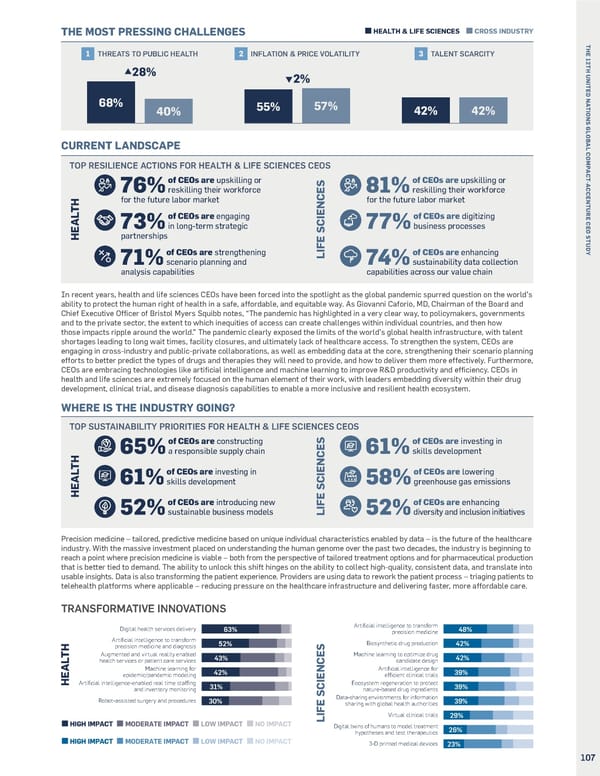
THE MOST PRESSING CHALLENGES HEALTH & LIFE SCIENCES CROSS INDUSTRY T H 1 THREATS TO PUBLIC HEALTH 2 INFLATION & PRICE VOLATILITY 3 TALENT SCARCITY E 1 2 T 28% H U 2% N I T E D N 68% A L 55% 57% T I 40% 42% 42% O N S G L O B A CURRENT LANDSCAPE L C IFE O M TOP RESILIENCE ACTIONS FOR HEALTH & LIFE SCIENCES CEOS P A C T of CEOs are upskilling or of CEOs are upskilling or - A C reskilling their workforce reskilling their workforce C The healthcare and life sciences 76% 81% E for the future labor market for the future labor market N T (LS) industries are undergoing U TH R a period of compressed of CEOs are engaging of CEOs are digitizing E C in long-term strategic business processes E 73% 77% transformation, driven by the partnerships O S HEAL T U global pandemic. In health, these D of CEOs are strengthening LIFE SCIENCES of CEOs are enhancing Y scenario planning and sustainability data collection changes focus on a more resilient, 71% 74% equitable healthcare system, & S analysis capabilities capabilities across our value chain that provide access to all. The LS In recent years, health and life sciences CEOs have been forced into the spotlight as the global pandemic spurred question on the world’s industry is focused on technology-ability to protect the human right of health in a safe, affordable, and equitable way. As Giovanni Caforio, MD, Chairman of the Board and enabled drug discovery and Chief Executive Officer of Bristol Myers Squibb notes, “The pandemic has highlighted in a very clear way, to policymakers, governments and to the private sector, the extent to which inequities of access can create challenges within individual countries, and then how development that provides better those impacts ripple around the world.” The pandemic clearly exposed the limits of the world’s global health infrastructure, with talent health outcomes and relieves Cshortages leading to long wait times, facility closures, and ultimately lack of healthcare access. To strengthen the system, CEOs are engaging in cross-industry and public-private collaborations, as well as embedding data at the core, strengthening their scenario planning pressure on the global healthcare efforts to better predict the types of drugs and therapies they will need to provide, and how to deliver them more effectively. Furthermore, infrastructure. CEOs are embracing technologies like artificial intelligence and machine learning to improve R&D productivity and efficiency. CEOs in TH health and life sciences are extremely focused on the human element of their work, with leaders embedding diversity within their drug IE development, clinical trial, and disease diagnosis capabilities to enable a more inclusive and resilient health ecosystem. L WHERE IS THE INDUSTRY GOING? TOP SUSTAINABILITY PRIORITIES FOR HEALTH & LIFE SCIENCES CEOS of CEOs are constructing of CEOs are investing in a responsible supply chain skills development 65% 61% AN TH of CEOs are investing in of CEOs are lowering skills development greenhouse gas emissions 61% 58% “Healthcare in the future should HEAL be personalized, and the basis of CEOs are introducing new of CEOs are enhancing sustainable business models diversity and inclusion initiatives 52% LIFE SCIENCES 52% of that is data. Proper collection C and management of that data is instrumental to our industry.”Precision medicine – tailored, predictive medicine based on unique individual characteristics enabled by data – is the future of the healthcare industry. With the massive investment placed on understanding the human genome over the past two decades, the industry is beginning to Isao Teshirogi, Ph.D., reach a point where precision medicine is viable – both from the perspective of tailored treatment options and for pharmaceutical production Chief Executive Officer of Shionogi Ethat is better tied to demand. The ability to unlock this shift hinges on the ability to collect high-quality, consistent data, and translate into HE usable insights. Data is also transforming the patient experience. Providers are using data to rework the patient process – triaging patients to & Co., Ltd. telehealth platforms where applicable – reducing pressure on the healthcare infrastructure and delivering faster, more affordable care. TRANSFORMATIVE INNOVATIONS S Digital health services delivery 63% Artificial intelligence to transform 48% precision medicine Artificial intelligence to transform 52% Biosynthetic drug production 42% precision medicine and diagnosis TH Augmented and virtual reality enabled 43% Machine learning to optimize drug 42% health services or patient care services candidate design Machine learning for Artificial intelligence for epidemic/pandemic modeling 42% efficient clinical trials 39% HEALArtificial intelligence-enabled real time staffing 31% Ecosystem regeneration to protect 39% and inventory monitoring nature-based drug ingredients Robot-assisted surgery and procedures 30% Data-sharing environments for information 39% sharing ith global health authorities LIFE SCIENCES irtual clinical trials 29% HIGH IMPACT MODERATE IMPACT LOW IMPACT NO IMPACT Digital tins of humans to model treatment hypotheses and test therapeutics 26% HIGH IMPACT MODERATE IMPACT LOW IMPACT NO IMPACT -D printed medical devices 23% 106 107
 Accenture CEO Study United Nations Global Compact Page 106 Page 108