

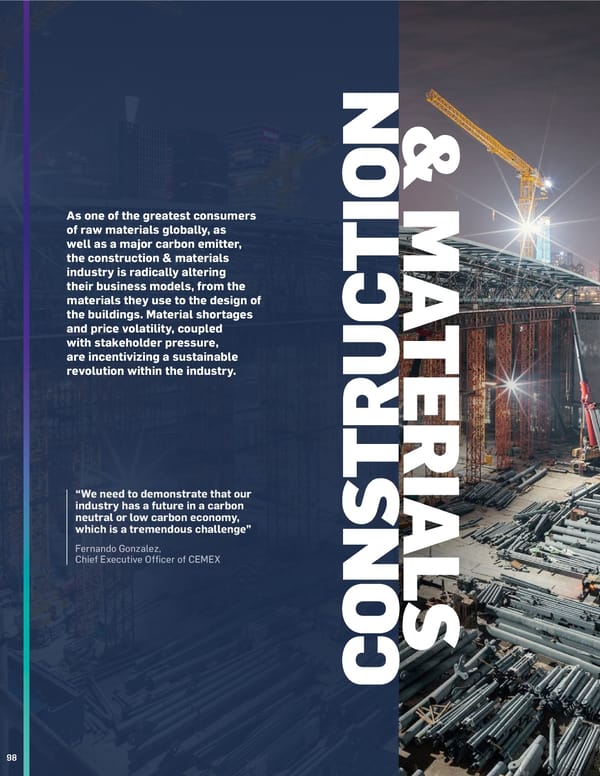
T H E 1 2 T H U THE MOST PRESSING CHALLENGES CONSTRUCTION & MATERIALS CROSS INDUSTRY N I T E D N A 1 INFLATION & PRICE VOLATILITY 2 TALENT SCARCITY 3 THREATS TO PUBLIC HEALTH T I O N & S G L 13% O B A 8% 1% L C O M 70% P 57% 50% A 42% 41% 40% C T - A M C C E ON N T U R As one of the greatest consumers I E C E of raw materials globally, as CURRENT LANDSCAPE O S T U well as a major carbon emitter, D the construction & materials T TOP RESILIENCE ACTIONS FOR CONSTRUCTION & MATERIALS CEOS Y industry is radically altering A of CEOs are of CEOs are of CEOs are upskilling or digitizing strengthening 77% 71% 63% their business models, from the reskilling their workforce business processes scenario planning and materials they use to the design of for the future labor market analysis capabilities the buildings. Material shortages and price volatility, coupled CTE As supply chain disruptions hit the construction & materials industry, resulting in significant delays and backorders, CEOs are investing with stakeholder pressure, in digital tools and processes to strengthen their supply chain visibility, enable better scenario planning, and better prepare for are incentivizing a sustainable inflation and price volatility. In addition to challenges with sourcing raw materials, the industry is also facing talent shortages linked to the pandemic, hindering the industry’s ability to recover. Along with the disruption to the ways of working caused by the pandemic, revolution within the industry. U construction & materials companies are focusing on building strong, resilient cultures, fostering employee well-being, and adapting to hybrid work environments. WHERE IS THE INDUSTRY GOING? RRI TOP SUSTAINABILITY PRIORITIES FOR CONSTRUCTION & MATERIALS CEOS of CEOs are of CEOs are of CEOs are investing in introducing new lowering 59% 56% 55% skills development sustainable business models GHG emissions “We need to demonstrate that our A The United Nations Environment Programme estimates that the built environment accounts for 37% of CO emissions, pressuring the industry has a future in a carbon 2 1 neutral or low carbon economy, ST construction & materials industry to adopt low-emitting materials and practices to reduce their footprint. Construction & materials which is a tremendous challenge” CEOs are responding by investing in green alternatives to basic materials such as aluminum, steel, and concrete. To further accelerate their path to net zero, construction & materials CEOs are unlocking the power of innovative technologies, such as digital twins, 2 Fernando Gonzalez, to improve resource efficiency – from energy to water usage – across the entire lifecycle of infrastructure. These technologies and Chief Executive Officer of CEMEX L innovations are also fueling a modular component trend within the industry, enabling a more circular model to emerge as items can be disassembled, adapted, or reused for renovations or the construction of new buildings. S TRANSFORMATIVE INNOVATIONS 62% ON Innovative low-carbon materials Distributed renewable energy generation 58% Use of modular components designed for circularity 48% Water conservation appliances and systems 45% C Sensors and analytics to monitor building occupancy for operational efficiency 44% HIGH IMPACT MODERATE IMPACT LOW IMPACT NO IMPACT 1. Accenture (2022) Sustainability in engineering and construction: The way forward. 98 2. UNEP (2022) 2022 Global Status Report for Buildings and Construction. 99
 Accenture CEO Study United Nations Global Compact Page 97 Page 99