

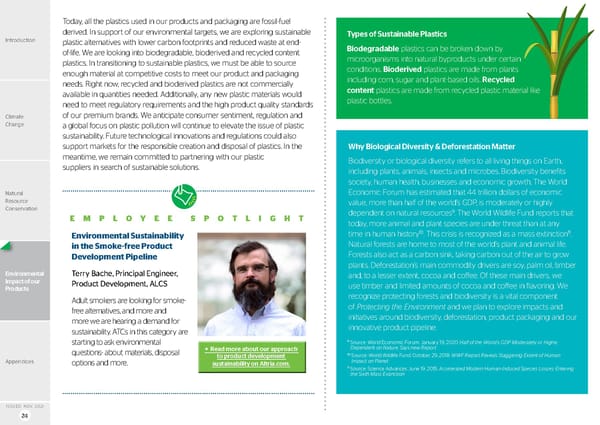
24 ISSUED: NOV. 2021 Why Biological Diversity & Deforestation Matter Biodiversity or biological diversity refers to all living things on Earth, including plants, animals, insects and microbes. Biodiversity benefits society, human health, businesses and economic growth. The World Economic Forum has estimated that 44 trillion dollars of economic value, more than half of the world’s GDP, is moderately or highly dependent on natural resources 9 . The World Wildlife Fund reports that today, more animal and plant species are under threat than at any time in human history 10 . This crisis is recognized as a mass extinction 11 . Natural forests are home to most of the world’s plant and animal life. Forests also act as a carbon sink, taking carbon out of the air to grow plants. Deforestation’s main commodity drivers are soy, palm oil, timber and, to a lesser extent, cocoa and coffee. Of these main drivers, we use timber and limited amounts of cocoa and coffee in flavoring. We recognize protecting forests and biodiversity is a vital component of Protecting the Environment and we plan to explore impacts and initiatives around biodiversity, deforestation, product packaging and our innovative product pipeline. 9 Source: World Economic Forum. January 19, 2020. Half of the World’s GDP Moderately or Highly Dependent on Nature, Says new Report 10 Source: World Wildlife Fund. October 29, 2018. WWF Report Reveals Staggering Extent of Human Impact on Planet 11 Source: Science Advances. June 19, 2015. Accelerated Modern Human-Induced Species Losses: Entering the Sixth Mass Extinction Today, all the plastics used in our products and packaging are fossil-fuel derived. In support of our environmental targets, we are exploring sustainable plastic alternatives with lower carbon footprints and reduced waste at end- of-life. We are looking into biodegradable, bioderived and recycled content plastics. In transitioning to sustainable plastics, we must be able to source enough material at competitive costs to meet our product and packaging needs. Right now, recycled and bioderived plastics are not commercially available in quantities needed. Additionally, any new plastic materials would need to meet regulatory requirements and the high product quality standards of our premium brands. We anticipate consumer sentiment, regulation and a global focus on plastic pollution will continue to elevate the issue of plastic sustainability. Future technological innovations and regulations could also support markets for the responsible creation and disposal of plastics. In the meantime, we remain committed to partnering with our plastic suppliers in search of sustainable solutions. Types of Sustainable Plastics Biodegradable plastics can be broken down by microorganisms into natural byproducts under certain conditions. Bioderived plastics are made from plants including corn, sugar and plant-based oils. Recycled content plastics are made from recycled plastic material like plastic bottles. EMPLOYEE SPOTLIGHT Environmental Sustainability in the Smoke-free Product Development Pipeline Terry Bache, Principal Engineer, Product Development, ALCS Adult smokers are looking for smoke- free alternatives, and more and more we are hearing a demand for sustainability. ATCs in this category are starting to ask environmental questions- about materials, disposal options and more. + Read more about our approach to product development sustainability on Altria.com.
 Altria Protect the Environment Report Page 23 Page 25