

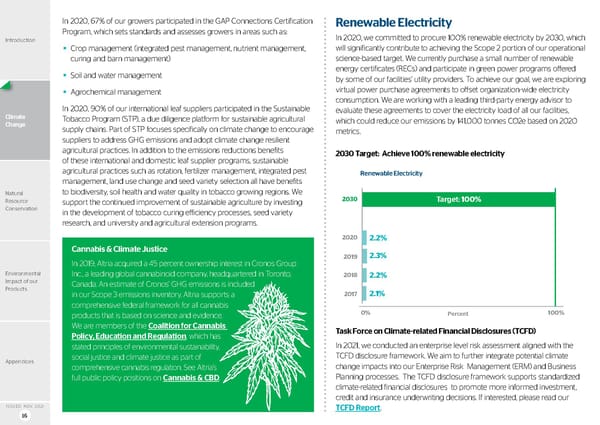
16 ISSUED: NOV. 2021 In 2020, 67% of our growers participated in the GAP Connections Certification Program, which sets standards and assesses growers in areas such as: ƒ Crop management (integrated pest management, nutrient management, curing and barn management) ƒ Soil and water management ƒ Agrochemical management In 2020, 90% of our international leaf suppliers participated in the Sustainable Tobacco Program (STP), a due diligence platform for sustainable agricultural supply chains. Part of STP focuses specifically on climate change to encourage suppliers to address GHG emissions and adopt climate change resilient agricultural practices. In addition to the emissions reductions benefits of these international and domestic leaf supplier programs, sustainable agricultural practices such as rotation, fertilizer management, integrated pest management, land use change and seed variety selection all have benefits to biodiversity, soil health and water quality in tobacco growing regions. We support the continued improvement of sustainable agriculture by investing in the development of tobacco curing efficiency processes, seed variety research, and university and agricultural extension programs. Renewable Electricity In 2020, we committed to procure 100% renewable electricity by 2030, which will significantly contribute to achieving the Scope 2 portion of our operational science-based target. We currently purchase a small number of renewable energy certificates (RECs) and participate in green power programs offered by some of our facilities’ utility providers. To achieve our goal, we are exploring virtual power purchase agreements to offset organization-wide electricity consumption. We are working with a leading third-party energy advisor to evaluate these agreements to cover the electricity load of all our facilities, which could reduce our emissions by 141,000 tonnes CO2e based on 2020 metrics. Task Force on Climate-related Financial Disclosures (TCFD) In 2021, we conducted an enterprise level risk assessment aligned with the TCFD disclosure framework. We aim to further integrate potential climate change impacts into our Enterprise Risk Management (ERM) and Business Planning processes. The TCFD disclosure framework supports standardized climate-related financial disclosures to promote more informed investment, credit and insurance underwriting decisions. If interested, please read our TCFD Report . 2030 2.3% 2.2% 2.2% 2.1% 2019 2020 2018 2017 0% 100% Percent Target: 100% 2030 Target: Achieve 100% renewable electricity Renewable Electricity Cannabis & Climate Justice In 2019, Altria acquired a 45 percent ownership interest in Cronos Group Inc., a leading global cannabinoid company, headquartered in Toronto, Canada. An estimate of Cronos’ GHG emissions is included in our Scope 3 emissions inventory. Altria supports a comprehensive federal framework for all cannabis products that is based on science and evidence. We are members of the Coalition for Cannabis Policy, Education and Regulation , which has stated principles of environmental sustainability, social justice and climate justice as part of comprehensive cannabis regulation. See Altria’s full public policy positions on Cannabis & CBD .
 Altria Protect the Environment Report Page 15 Page 17