

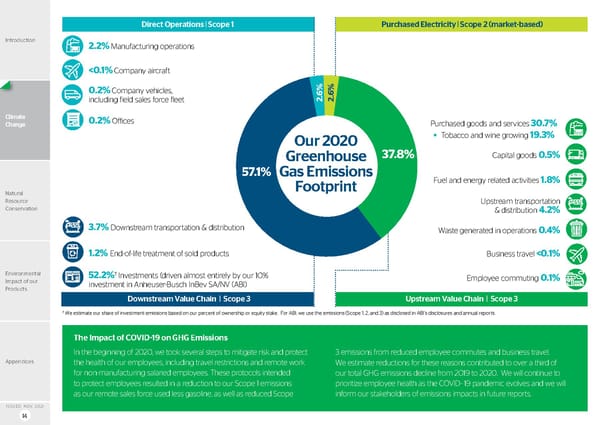
14 ISSUED: NOV. 2021 The Impact of COVID-19 on GHG Emissions In the beginning of 2020, we took several steps to mitigate risk and protect the health of our employees, including travel restrictions and remote work for non-manufacturing salaried employees. These protocols intended to protect employees resulted in a reduction to our Scope 1 emissions as our remote sales force used less gasoline, as well as reduced Scope 3 emissions from reduced employee commutes and business travel. We estimate reductions for these reasons contributed to over a third of our total GHG emissions decline from 2019 to 2020. We will continue to prioritize employee health as the COVID- 19 pandemic evolves and we will inform our stakeholders of emissions impacts in future reports. 2.2% Manufacturing operations 0.2% Company vehicles, including field sales force fleet 0.2% Offices <0.1% Company aircraft Our 2020 Greenhouse Gas Emissions Footprint 57.1% 3 7. 8 % 2.6% 2.6% Purchased Electricity | Scope 2 (market-based) Direct Operations | Scope 1 Upstream Value Chain | Scope 3 Capital goods 0.5% Fuel and energy related activities 1.8% Upstream transportation & distribution 4.2% Waste generated in operations 0.4% Business travel <0.1% Employee commuting 0.1% Purchased goods and services 30.7% ƒ Tobacco and wine growing 19.3% 1.2% End-of-life treatment of sold products 3.7% Downstream transportation & distribution 52.2% 7 Investments (driven almost entirely by our 10% investment in Anheuser-Busch InBev SA/NV (ABI) Downstream Value Chain | Scope 3 7 We estimate our share of investment emissions based on our percent of ownership or equity stake. For ABI, we use the emissions (Scope 1, 2, and 3) as disclosed in ABI’s disclosures and annual reports.
 Altria Protect the Environment Report Page 13 Page 15