

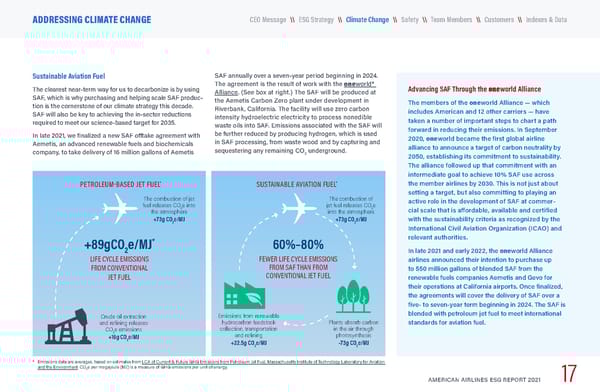
60%–80% FEWER LIFE CYCLE EMISSIONS FROM SAF THAN FROM CONVENTIONAL JET FUEL Sustainable Aviation Fuel The clearest near-term way for us to decarbonize is by using SAF, which is why purchasing and helping scale SAF produc - tion is the cornerstone of our climate strategy this decade. SAF will also be key to achieving the in-sector reductions required to meet our science-based target for 2035. In late 2021, we finalized a new SAF offtake agreement with Aemetis, an advanced renewable fuels and biochemicals company, to take delivery of 16 million gallons of Aemetis SAF annually over a seven-year period beginning in 2024. The agreement is the result of work with the one world® Alliance . (See box at right.) The SAF will be produced at the Aemetis Carbon Zero plant under development in Riverbank, California. The facility will use zero carbon intensity hydroelectric electricity to process nonedible waste oils into SAF. Emissions associated with the SAF will be further reduced by producing hydrogen, which is used in SAF processing, from waste wood and by capturing and sequestering any remaining CO 2 underground. Crude oil extraction and refining releases CO 2 e emissions +16g CO 2 e/MJ PETROLEUM-BASED JET FUEL * SUSTAINABLE AVIATION FUEL * Plants absorb carbon in the air through photosynthesis –73g CO 2 e/MJ +89gCO 2 e/MJ * LIFE CYCLE EMISSIONS FROM CONVENTIONAL JET FUEL The combustion of jet fuel releases CO 2 e into the atmosphere +73g CO 2 e/MJ The combustion of jet fuel releases CO 2 e into the atmosphere +73g CO 2 e/MJ Emissions from renewable hydrocarbon feedstock collection, transportation and refining +22.5g CO 2 e/MJ Advancing SAF Through the one world Alliance The members of the one world Alliance — which includes American and 12 other carriers — have taken a number of important steps to chart a path forward in reducing their emissions. In September 2020, one world became the first global airline alliance to announce a target of carbon neutrality by 2050, establishing its commitment to sustainability. The alliance followed up that commitment with an intermediate goal to achieve 10% SAF use across the member airlines by 2030. This is not just about setting a target, but also committing to playing an active role in the development of SAF at commer - cial scale that is affordable, available and certified with the sustainability criteria as recognized by the International Civil Aviation Organization (ICAO) and relevant authorities. In late 2021 and early 2022, the one world Alliance airlines announced their intention to purchase up to 550 million gallons of blended SAF from the renewable fuels companies Aemetis and Gevo for their operations at California airports. Once finalized, the agreements will cover the delivery of SAF over a five- to seven-year term beginning in 2024. The SAF is blended with petroleum jet fuel to meet international standards for aviation fuel. * Emissions data are averages, based on estimates from LCA of Current & Future GHG Emissions from Petroleum Jet Fuel, Massachusetts Institute of Technology Laboratory for Aviation and the Environment . CO 2 e per megajoule (MJ) is a measure of GHG emissions per unit of energy. AMERICAN AIRLINES ESG REPORT 2021 17 \\ Indexes & Data \\ Customers \\ Team Members \\ Safety \\ ESG Strategy CEO Message ADDRESSING CLIMATE CHANGE \\ Climate Change
 American Airlines ESG Report Page 17 Page 19