

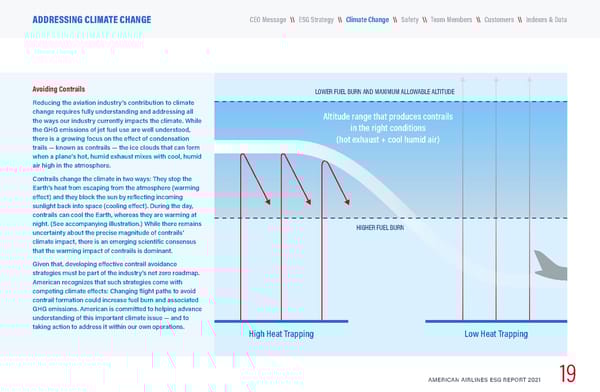
Avoiding Contrails Reducing the aviation industry’s contribution to climate change requires fully understanding and addressing all the ways our industry currently impacts the climate. While the GHG emissions of jet fuel use are well understood, there is a growing focus on the effect of condensation trails — known as contrails — the ice clouds that can form when a plane’s hot, humid exhaust mixes with cool, humid air high in the atmosphere. Contrails change the climate in two ways: They stop the Earth’s heat from escaping from the atmosphere (warming effect) and they block the sun by reflecting incoming sunlight back into space (cooling effect). During the day, contrails can cool the Earth, whereas they are warming at night. (See accompanying illustration.) While there remains uncertainty about the precise magnitude of contrails’ climate impact, there is an emerging scientific consensus that the warming impact of contrails is dominant. Given that, developing effective contrail avoidance strategies must be part of the industry’s net zero roadmap. American recognizes that such strategies come with competing climate effects: Changing flight paths to avoid contrail formation could increase fuel burn and associated GHG emissions. American is committed to helping advance understanding of this important climate issue — and to taking action to address it within our own operations. LOWER FUEL BURN AND MAXIMUM ALLOWABLE ALTITUDE HIGHER FUEL BURN High Heat Trapping Altitude range that produces contrails in the right conditions (hot exhaust + cool humid air) Low Heat Trapping AMERICAN AIRLINES ESG REPORT 2021 19 \\ Indexes & Data \\ Customers \\ Team Members \\ Safety \\ ESG Strategy CEO Message ADDRESSING CLIMATE CHANGE \\ Climate Change
 American Airlines ESG Report Page 19 Page 21