

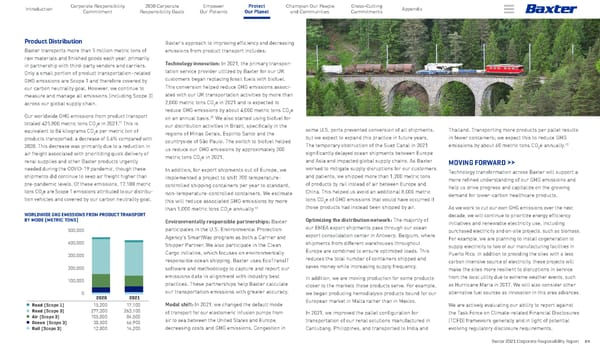
Baxter 2021 Corporate Responsibility Report 24 Protect Our Planet Corporate Responsibility Commitment Introduction 2030 Corporate Responsibility Goals Empower Our Patients Appendix Champion Our People and Communities Cross-Cutting Commitments Product Distribution Baxter transports more than 5 million metric tons of raw materials and finished goods each year, primarily in partnership with third-party vendors and carriers. Only a small portion of product transportation–related GHG emissions are Scope 1 and therefore covered by our carbon neutrality goal. However, we continue to measure and manage all emissions (including Scope 3) across our global supply chain. Our worldwide GHG emissions from product transport totaled 425,800 metric tons CO 2 e in 2021. 11 This is equivalent to 84 kilograms CO 2 e per metric ton of products transported, a decrease of 5.6% compared with 2020. This decrease was primarily due to a reduction in air freight associated with prioritizing quick delivery of renal supplies and other Baxter products urgently needed during the COVID-19 pandemic, though these shipments did continue to keep air freight higher than pre-pandemic levels. Of these emissions, 17,100 metric tons CO 2 e are Scope 1 emissions attributed to our distribu - tion vehicles and covered by our carbon neutrality goal. Baxter’s approach to improving efficiency and decreasing emissions from product transport includes: Technology innovation: In 2021, the primary transpor - tation service provider utilized by Baxter for our UK customers began replacing fossil fuels with biofuel. This conversion helped reduce GHG emissions associ- ated with our UK transportation activities by more than 2,000 metric tons CO 2 e in 2021 and is expected to reduce GHG emissions by about 4,000 metric tons CO 2 e on an annual basis. 12 We also started using biofuel for our distribution activities in Brazil, specifically in the regions of Minas Gerais, Espirito Santo and the countryside of São Paulo. The switch to biofuel helped us reduce our GHG emissions by approximately 300 metric tons CO 2 e in 2021. In addition, for export shipments out of Europe, we implemented a project to shift 700 temperature- controlled shipping containers per year to standard, non-temperature-controlled containers. We estimate this will reduce associated GHG emissions by more than 1,000 metric tons CO 2 e annually. 12 Environmentally responsible partnerships: Baxter participates in the U.S. Environmental Protection Agency’s SmartWay program as both a Carrier and Shipper Partner. We also participate in the Clean Cargo initiative, which focuses on environmentally responsible ocean shipping. Baxter uses EcoTransIT software and methodology to capture and report our emissions data in alignment with industry bes t practices. These partnerships help Baxter calculate our transportation emissions with greater accuracy. Modal shift: In 2021, we changed the default mode of transport for our elastomeric infusion pumps from air to sea between the United States and Europe, decreasing costs and GHG emissions. Congestion in some U.S. ports prevented conversion of all shipments, but we expect to expand this practice in future years. The temporary obstruction of the Suez Canal in 2021 significantly delayed ocean shipments between Europe and Asia and impacted global supply chains. As Baxter worked to mitigate supply disruptions for our customers and patients, we shipped more than 1,200 metric tons of products by rail instead of air between Europe and China. This helped us avoid an additional 8,000 metric tons CO 2 e of GHG emissions that would have occurred if those products had instead been shipped by air. Optimizing the distribution network: The majority of our EMEA export shipments pass through our ocean export consolidation center in Antwerp, Belgium, where shipments from different warehouses throughout Europe are combined to ensure optimized loads. This reduces the total number of containers shipped and saves money while increasing supply frequency. In addition, we are moving production for some products closer to the markets those products serve. For example, we began producing hemodialysis products bound for our European market in Malta rather than in Mexico. In 2021, we improved the pallet configuration for transportation of our renal solutions manufactured in Canlubang, Philippines, and transported to India and Thailand. Transporting more products per pallet results in fewer containers; we expect this to reduce GHG emissions by about 60 metric tons CO 2 e annually. 12 MOVING FORWARD >> Technology transformation across Baxter will support a more refined understanding of our GHG emissions and help us drive progress and capitalize on the growing demand for lower-carbon healthcare products. As we work to cut our own GHG emissions over the next decade, we will continue to prioritize energy efficiency initiatives and renewable electricity use, including purchased electricity and on-site projects, such as biomass. For example, we are planning to install cogeneration to supply electricity to two of our manufacturing facilities in Puerto Rico. In addition to providing the sites with a less carbon intensive source of electricity, these projects will make the sites more resilient to disruptions in service from the local utility due to extreme weather events, such as Hurricane Maria in 2017. We will also consider other alternative fuel sources as innovation in this area advances. We are actively evaluating our ability to report against the Task Force on Climate-related Financial Disclosures (TCFD) framework generally and in light of potential evolving regulatory disclosure requirements. WORLDWIDE GHG EMISSIONS FROM PRODUCT TRANSPORT BY MODE ( METRIC TONS ) Road (Scope 1) 15,200 17,100 Road (Scope 3) 277,300 263,100 Air (Scope 3) 105,800 84,500 Ocean (Scope 3) 38,500 46,900 Rail (Scope 3) 12,800 14,200 0 100,000 200,000 300,000 400,000 500,000 2020 2021
 Baxter Corporate Responsibility Report Page 23 Page 25