

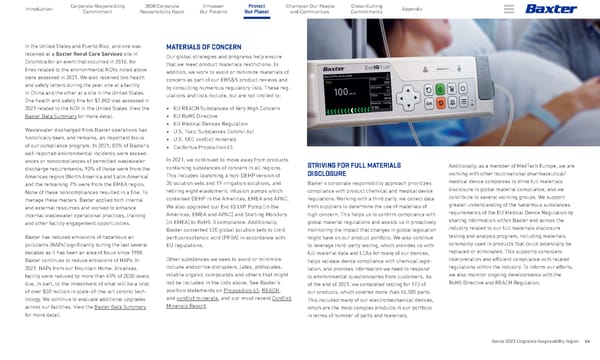
Baxter 2021 Corporate Responsibility Report 34 Protect Our Planet Corporate Responsibility Commitment Introduction 2030 Corporate Responsibility Goals Empower Our Patients Appendix Champion Our People and Communities Cross-Cutting Commitments STRIVING FOR FULL MATERIALS DISCLOSURE Baxter’s corporate responsibility approach prioritizes compliance with product chemical and medical device regulations. Working with a third party, we collect data from suppliers to determine the use of materials of high concern. This helps us to confirm compliance with global material regulations and assists us in proactively monitoring the impact that changes in global legislation might have on our product portfolio. We also continue to leverage third-party testing, which provides us with full material data and LCAs for many of our devices, helps validate device compliance with chemical legis- lation , and provides information we need to respond to environmental questionnaires from customers. As of the end of 2021, we completed testing for 173 of our products, which covered more than 16,500 parts. This included many of our electromechanical devices, which are the most complex products in our portfolio in terms of number of parts and materials. Additionally, as a member of MedTech Europe, we are working with other multinational pharmaceutical/ medical device companies to drive full materials disclosure in global material compliance, and we contribute to several working groups. We support greater understanding of the hazardous substances requirements of the EU Medical Device Regulation by sharing information within Baxter and across the industry related to our full materials disclosure testing and analysis program, including materials commonly used in products that could potentially be replaced or eliminated. This supports consistent interpretation and efficient compliance with related regulations within the industry. To inform our efforts, we also monitor ongoing developments with the RoHS Directive and REACH Regulation. MATERIALS OF CONCERN Our global strategies and programs help ensure that we meet product materials restrictions. In addition, we work to avoid or minimize materials of concern as part of our EHS&S product reviews and by consulting numerous regulatory lists. These reg - ulations and lists include, but are not limited to: • EU REACH Substances of Very High Concern • EU RoHS Directive • EU Medical Devices Regulation • U.S. Toxic Substances Control Act • U.S. SEC conflict minerals • California Proposition 65 In 2021, we continued to move away from products containing substances of concern in all regions. This includes launching a non-DEHP version of 30 solution sets and 19 irrigation solutions, and retiring eight elastomeric infusion pumps which contained DEHP in the Americas, EMEA and APAC. We also upgraded our Evo IQ LVP Pump (in the Americas, EMEA and APAC) and Starling Monitors (in EMEA) to RoHS-3 compliance. Additionally, Baxter converted 120 global solution sets to limit perfluorooctanoic acid (PFOA) in accordance with EU regulations. Other substances we seek to avoid or minimize include endocrine disrupters, latex, phthalates, volatile organic compounds and others that might not be included in the lists above. See Baxter’s position statements on Proposition 65, REACH, and conflict minerals, and our most recent Conflict Minerals Report. in the United States and Puerto Rico, and one was received at a Baxter Renal Care Services site in Colombia for an event that occurred in 2016. No fines related to the environmental NOVs noted above were assessed in 2021. We also received two health and safety letters during the year, one at a facility in China and the other at a site in the United States. One health and safety fine for $7,802 was assessed in 2021 related to the NOV in the United States. View the Baxter Data Summary for more detail. Wastewater discharged from Baxter operations has historically been, and remains, an important focus of our compliance program. In 2021, 85% of Baxter’s self-reported environmental incidents were exceed - ances or noncompliances of permitted wastewater discharge requirements; 93% of those were from the Americas region (North America and Latin America) and the remaining 7% were from the EMEA region. None of these noncompliances resulted in a fine. To manage these matters, Baxter applied both internal and external resources and worked to enhance internal wastewater operational practices, training and other facility engagement opportunities. Baxter has reduced emissions of hazardous air pollutants (HAPs) significantly during the last several decades as it has been an area of focus since 1988. Baxter continues to reduce emissions of HAPs. In 2021, HAPs from our Mountain Home, Arkansas, facility were reduced by more than 65% of 2020 levels due, in part, to the investment of what will be a total of over $50 million in state-of-the-art control tech- nology. We continue to evaluate additional upgrades across our facilities. View the Baxter Data Summary for more detail.
 Baxter Corporate Responsibility Report Page 33 Page 35