

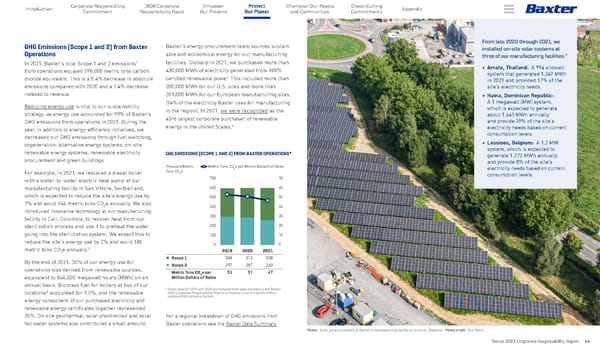
Baxter 2021 Corporate Responsibility Report 22 Protect Our Planet Corporate Responsibility Commitment Introduction 2030 Corporate Responsibility Goals Empower Our Patients Appendix Champion Our People and Communities Cross-Cutting Commitments GHG Emissions (Scope 1 and 2) from Baxter Operations In 2021, Baxter’s total Scope 1 and 2 emissions 1 from operations equaled 598,000 metric tons carbon dioxide equivalent. This is a 0.4% decrease in absolute emissions compared with 2020 and a 7.4% decrease indexed to revenue. Reducing energy use is vital to our sustainability strategy, as energy use accounted for 99% of Baxter’s GHG emissions from operations in 2021. During the year, in addition to energy-efficiency initiatives, we decreased our GHG emissions through fuel switching, cogeneration, alternative energy systems, on-site renewable energy systems, renewable electricity procurement and green buildings . For example, in 2021, we replaced a diesel boiler with a water-to-water electric heat pump at our manufacturing facility in San Vittore, Switzerland, which is expected to reduce the site’s energy use by 7% and avoid 144 metric tons CO 2 e annually. We also introduced innovative technology at our manufacturin g facility in Cali, Colombia, to recover heat from our sterilization process and use it to preheat the water going into the sterilization system. We expect this to reduce the site’s energy use by 2% and avoid 180 metric tons CO 2 e annually. 2 By the end of 2021, 30% of our energy use for operations was derived from renewable sources, equivalent to 846,000 megawatt hours (MWh) on an annual basis. Biomass fuel for boilers at two of our locations 3 accounted for 9.5%, and the renewable energy component of our purchased electricity and renewable energy certificates together represented 20%. On-site geothermal, solar photovoltaic and solar hot water systems also contributed a small amount. Baxter’s energy procurement team sources sustain - able and economical energy for our manufacturing facilities. Globally in 2021, we purchased more than 430,000 MWh of electricity generated from 100% certified renewable power. This included more than 200,000 MWh for our U.S. sites and more than 201,000 MWh for our European manufacturing sites (94% of the electricity Baxter uses for manufacturin g in the region). In 2021, we were recognized as the 43rd largest corporate purchaser of renewable energy in the United States. 4 For a regional breakdown of GHG emissions from Baxter operations see the Baxter Data Summary . From late 2020 through 2021, we installed on-site solar systems at three of our manufacturing facilities . 5 • Amata, Thailand: A 994 kilowatt system that generated 1,247 MWh in 2021 and provided 17% of the site’s electricity needs • Haina, Dominican Republic: A 1 megawatt (MW) system, which is expected to generate about 1,645 MWh annually and provide 39% of the site’s electricity needs based on current consumption levels • Lessines, Belgium: A 1.2 MW system, which is expected to generate 1,272 MWh annually and provide 8% of the site’s electricity needs based on current consumption levels GHG EMISSIONS ( SCOPE 1 AND 2 ) FROM BAXTER OPERATIONS* Thousand Metric Tons CO 2 e Metric Tons CO 2 e per Million Dollars of Sales 2019 2020 2021 Scope 1 300 313 338 Scope 2 297 287 260 Metric Tons CO 2 e per 53 51 47 Million Dollars of Sales 0 100 200 300 400 500 600 700 0 10 20 30 40 50 60 70 * Some data for 2019 and 2020 are restated from data reported in the Baxter 2020 Corporate Responsibility Report to improve accuracy and to reflect updated GHG emission factors. Photo: Solar panels installed at Baxter’s manufacturing facility in Lessines, Belgium. Photo credit: Eric Wery
 Baxter Corporate Responsibility Report Page 21 Page 23