

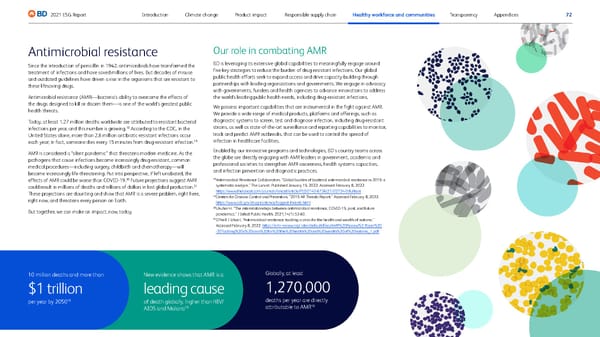
72 2021 ESG Report Transparency Responsible supply chain Product impact Climate change Introduction Healthy workforce and communities Appendices Antimicrobial resistance Since the introduction of penicillin in 1942, antimicrobials have transformed the treatment of infections and have saved millions of lives. But decades of misuse and outdated guidelines have driven a rise in the organisms that are resistant to these lifesaving drugs. Antimicrobial resistance (AMR)—bacteria’s ability to overcome the effects of the drugs designed to kill or disarm them—is one of the world’s greatest public health threats. Today, at least 1.27 million deaths worldwide are attributed to resistant bacterial infections per year, and this number is growing. 18 According to the CDC, in the United States alone, more than 2.8 million antibiotic-resistant infections occur each year; in fact, someone dies every 15 minutes from drug-resistant infection. 19 AMR is considered a “silent pandemic” that threatens modern medicine. As the pathogens that cause infections become increasingly drug-resistant, common medical procedures—including surgery, childbirth and chemotherapy—will become increasingly life-threatening. Put into perspective, if left unabated, the effects of AMR could be worse than COVID-19. 20 Future projections suggest AMR could result in millions of deaths and trillions of dollars in lost global production. 21 These projections are daunting and show that AMR is a severe problem, right here, right now, and threatens every person on Earth. But together, we can make an impact, now, today. Our role in combating AMR BD is leveraging its extensive global capabilities to meaningfully engage around five key strategies to reduce the burden of drug-resistant infections. Our global public health efforts seek to expand access and drive capacity-building through partnerships with leading organizations and governments. We engage in advocacy with governments, funders and health agencies to advance innovations to address the world’s leading public health needs, including drug-resistant infections. We possess important capabilities that are instrumental in the fight against AMR. We provide a wide range of medical products, platforms and offerings, such as diagnostic systems to screen, test and diagnose infection, including drug-resistant strains, as well as state-of-the-art surveillance and reporting capabilities to monitor, track and predict AMR outbreaks, that can be used to control the spread of infection in healthcare facilities. Enabled by our innovative programs and technologies, BD’s country teams across the globe are directly engaging with AMR leaders in government, academia and professional societies to strengthen AMR awareness, health systems capacities, and infection prevention and diagnostic practices. 18 Antimicrobial Resistance Collaborators. “Global burden of bacterial antimicrobial resistance in 2019: a systematic analysis.” The Lancet . Published January 19, 2022. Accessed February 8, 2022. https://www.thelancet.com/journals/lancet/article/PIIS0140-6736(21)02724-0/fulltext 19 Centers for Disease Control and Prevention. “2019 AR Threats Report.” Accessed February 8, 2022. https://www.cdc.gov/drugresistance/biggest-threats.html 20 Ukuhor H. “The interrelationships between antimicrobial resistance, COVID-19, past, and future pandemics.” J Infect Public Health. 2021;14(1):53-60. 21 O’Neill J (chair). “Antimicrobial resistance: tackling a crisis for the health and wealth of nations.” Accessed February 8, 2022. https://amr-review.org/ sites/default/files/AMR%20Review%2-Paper%20 -20Tackling%20a%20crisis%20for%20the%20health%20and%20wealth%20of%20nations_1.pdf Globally, at least 1,270,000 deaths per year are directly attributable to AMR 18 New evidence shows that AMR is a leading cause of death globally, higher than HIV/ AIDS and Malaria 18 10 million deaths and more than $1 trillion per year by 2050 19
 BD ESG Report Page 71 Page 73