

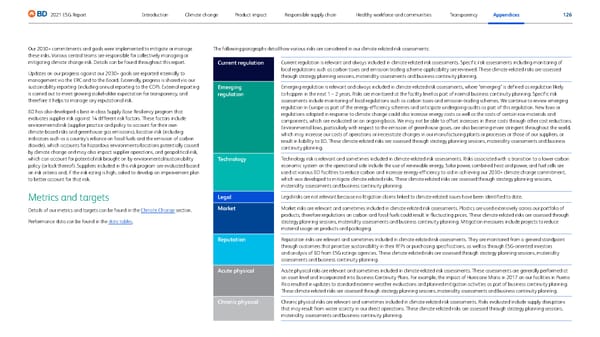
126 2021 ESG Report Transparency Appendices Responsible supply chain Product impact Climate change Introduction Healthy workforce and communities Our 2030+ commitments and goals were implemented to mitigate or manage these risks. Various central teams are responsible for collectively managing or mitigating climate change risk. Details can be found throughout this report. Updates on our progress against our 2030+ goals are reported internally to management via the ERC and to the Board. Externally, progress is shared via our sustainability reporting (including annual reporting to the CDP). External reporting is carried out to meet growing stakeholder expectation for transparency, and therefore it helps to manage any reputational risk. BD has also developed a best-in-class Supply Base Resiliency program that evaluates supplier risk against 14 different risk factors. These factors include environmental risk (supplier practice and policy to account for their own climate-based risks and greenhouse gas emissions), location risk (including indicators such as a country’s reliance on fossil fuels and the emission of carbon dioxide), which accounts for hazardous environments/locations potentially caused by climate change and may also impact supplier operations, and geopolitical risk, which can account for potential risk brought on by environmental/sustainability policy (or lack thereof). Suppliers included in this risk program are evaluated based on risk criteria and, if the risk rating is high, asked to develop an improvement plan to better account for that risk. Metrics and targets Details of our metrics and targets can be found in the Climate Change section. Performance data can be found in the data tables . The following paragraphs detail how various risks are considered in our climate-related risk assessments: Current regulation Current regulation is relevant and always included in climate-related risk assessments. Specific risk assessments including monitoring of local regulations such as carbon taxes and emission trading scheme applicability are reviewed. These climate-related risks are assessed through strategy planning sessions, materiality assessments and business continuity planning. Emerging regulation Emerging regulation is relevant and always included in climate-related risk assessments, where “emerging” is defined as regulation likely to happen in the next 1 – 2 years. Risks are monitored at the facility level as part of normal business continuity planning. Specific risk assessments include monitoring of local regulations such as carbon taxes and emission-trading schemes. We continue to review emerging regulation in Europe as part of the energy-efficiency schemes and anticipate undergoing audits as part of this regulation. New laws or regulations adopted in response to climate change could also increase energy costs as well as the costs of certain raw materials and components, which are evaluated on an ongoing basis. We may not be able to offset increases in these costs through other cost reductions. Environmental laws, particularly with respect to the emission of greenhouse gases, are also becoming more stringent throughout the world, which may increase our costs of operations or necessitate changes in our manufacturing plants or processes or those of our suppliers, or result in liability to BD. These climate-related risks are assessed through strategy planning sessions, materiality assessments and business continuity planning. Technology Technology risk is relevant and sometimes included in climate-related risk assessments. Risks associated with a transition to a lower-carbon economic system on the operational side include the use of renewable energy. Solar power, combined heat and power, and fuel cells are used at various BD facilities to reduce carbon and increase energy-efficiency to aid in achieving our 2030+ climate change commitment, which was developed to mitigate climate-related risks. These climate-related risks are assessed through strategy planning sessions, materiality assessments and business continuity planning. Legal Legal risks are not relevant because no litigation claims linked to climate-related issues have been identified to date. Market Market risks are relevant and sometimes included in climate-related risk assessments. Plastics are used extensively across our portfolio of products, therefore regulations on carbon and fossil fuels could result in fluctuating prices. These climate-related risks are assessed through strategy planning sessions, materiality assessments and business continuity planning. Mitigation measures include projects to reduce material usage on products and packaging. Reputation Reputation risks are relevant and sometimes included in climate-related risk assessments. They are monitored from a general standpoint through customers that prioritize sustainability in their RFPs or purchasing specifications, as well as through ESG-oriented investors and analysis of BD from ESG ratings agencies. These climate-related risks are assessed through strategy planning sessions, materiality assessments and business continuity planning. Acute physical Acute physical risks are relevant and sometimes included in climate-related risk assessments. These assessments are generally performed at an asset level and incorporated into Business Continuity Plans. For example, the impact of Hurricane Maria in 2017 on our facilities in Puerto Rico resulted in updates to standard extreme weather evaluations and planned mitigation activities as part of business continuity planning. These climate-related risks are assessed through strategy planning sessions, materiality assessments and business continuity planning. Chronic physical Chronic physical risks are relevant and sometimes included in climate-related risk assessments. Risks evaluated include supply disruptions that may result from water scarcity in our direct operations. These climate-related risks are assessed through strategy planning sessions, materiality assessments and business continuity planning.
 BD ESG Report Page 125 Page 127