

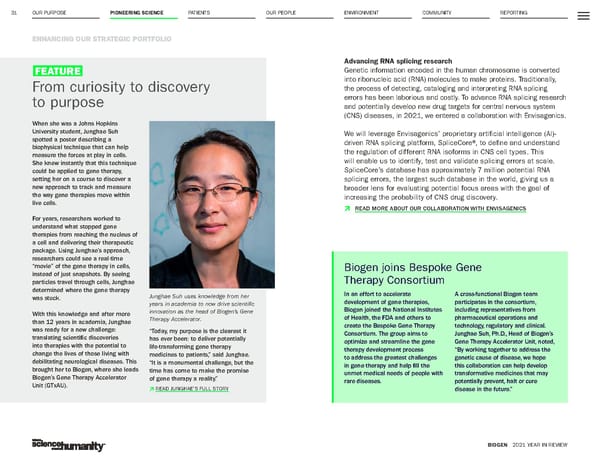
OUR PURPOSE PIONEERING SCIENCE PATIENTS OUR PEOPLE ENVIRONMENT COMMUNITY REPORTING 31 ENHANCING OUR STRATEGIC PORTFOLIO BIOGEN 2021 YEAR IN REVIEW Advancing RNA splicing research Genetic information encoded in the human chromosome is converted into ribonucleic acid (RNA) molecules to make proteins. Traditionally, the process of detecting, cataloging and interpreting RNA splicing errors has been laborious and costly. To advance RNA splicing research and potentially develop new drug targets for central nervous system (CNS) diseases, in 2021, we entered a collaboration with Envisagenics. We will leverage Envisagenics’ proprietary artificial intelligence (AI)- driven RNA splicing platform, SpliceCore®, to define and understand the regulation of different RNA isoforms in CNS cell types. This will enable us to identify, test and validate splicing errors at scale. SpliceCore’s database has approximately 7 million potential RNA splicing errors, the largest such database in the world, giving us a broader lens for evaluating potential focus areas with the goal of increasing the probability of CNS drug discovery. Þ READ MORE ABOUT OUR COLLABORATION WITH ENVISAGENICS FEATURE From curiosity to discovery to purpose When she was a Johns Hopkins University student, Junghae Suh spotted a poster describing a biophysical technique that can help measure the forces at play in cells. She knew instantly that this technique could be applied to gene therapy, setting her on a course to discover a new approach to track and measure the way gene therapies move within live cells. For years, researchers worked to understand what stopped gene therapies from reaching the nucleus of a cell and delivering their therapeutic package. Using Junghae’s approach, researchers could see a real-time “movie” of the gene therapy in cells, instead of just snapshots. By seeing particles travel through cells, Junghae determined where the gene therapy was stuck. With this knowledge and after more than 12 years in academia, Junghae was ready for a new challenge: translating scientific discoveries into therapies with the potential to change the lives of those living with debilitating neurological diseases. This brought her to Biogen, where she leads Biogen’s Gene Therapy Accelerator Unit (GTxAU). “Today, my purpose is the clearest it has ever been: to deliver potentially life-transforming gene therapy medicines to patients,” said Junghae. “It is a monumental challenge, but the time has come to make the promise of gene therapy a reality.” Þ READ JUNGHAE’S FULL STORY Junghae Suh uses knowledge from her years in academia to now drive scientific innovation as the head of Biogen’s Gene Therapy Accelerator. Biogen joins Bespoke Gene Therapy Consortium In an effort to accelerate development of gene therapies, Biogen joined the National Institutes of Health, the FDA and others to create the Bespoke Gene Therapy Consortium. The group aims to optimize and streamline the gene therapy development process to address the greatest challenges in gene therapy and help fill the unmet medical needs of people with rare diseases. A cross-functional Biogen team participates in the consortium, including representatives from pharmaceutical operations and technology, regulatory and clinical. Junghae Suh, Ph.D., Head of Biogen’s Gene Therapy Accelerator Unit, noted, “By working together to address the genetic cause of disease, we hope this collaboration can help develop transformative medicines that may potentially prevent, halt or cure disease in the future.”
 Biogen Year In Review Page 30 Page 32