

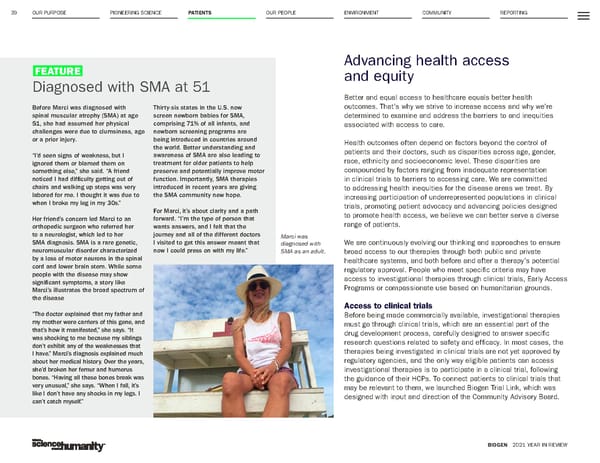
OUR PURPOSE PIONEERING SCIENCE PATIENTS OUR PEOPLE ENVIRONMENT COMMUNITY REPORTING 39 BIOGEN 2021 YEAR IN REVIEW FEATURE Diagnosed with SMA at 51 Before Marci was diagnosed with spinal muscular atrophy (SMA) at age 51, she had assumed her physical challenges were due to clumsiness, age or a prior injury. “I’d seen signs of weakness, but I ignored them or blamed them on something else,” she said. “A friend noticed I had difficulty getting out of chairs and walking up steps was very labored for me. I thought it was due to when I broke my leg in my 30s.” Her friend’s concern led Marci to an orthopedic surgeon who referred her to a neurologist, which led to her SMA diagnosis. SMA is a rare genetic, neuromuscular disorder characterized by a loss of motor neurons in the spinal cord and lower brain stem. While some people with the disease may show significant symptoms, a story like Marci’s illustrates the broad spectrum of the disease “The doctor explained that my father and my mother were carriers of this gene, and that’s how it manifested,” she says. “It was shocking to me because my siblings don’t exhibit any of the weaknesses that I have.” Marci’s diagnosis explained much about her medical history. Over the years, she’d broken her femur and humerus bones. “Having all these bones break was very unusual,” she says. “When I fall, it’s like I don’t have any shocks in my legs. I can’t catch myself.” Thirty-six states in the U.S. now screen newborn babies for SMA, comprising 71% of all infants, and newborn screening programs are being introduced in countries around the world. Better understanding and awareness of SMA are also leading to treatment for older patients to help preserve and potentially improve motor function. Importantly, SMA therapies introduced in recent years are giving the SMA community new hope. For Marci, it’s about clarity and a path forward. “I’m the type of person that wants answers, and I felt that the journey and all of the different doctors I visited to get this answer meant that now I could press on with my life.” Marci was diagnosed with SMA as an adult. Advancing health access and equity Better and equal access to healthcare equals better health outcomes. That’s why we strive to increase access and why we’re determined to examine and address the barriers to and inequities associated with access to care. Health outcomes often depend on factors beyond the control of patients and their doctors, such as disparities across age, gender, race, ethnicity and socioeconomic level. These disparities are compounded by factors ranging from inadequate representation in clinical trials to barriers to accessing care. We are committed to addressing health inequities for the disease areas we treat. By increasing participation of underrepresented populations in clinical trials, promoting patient advocacy and advancing policies designed to promote health access, we believe we can better serve a diverse range of patients. We are continuously evolving our thinking and approaches to ensure broad access to our therapies through both public and private healthcare systems, and both before and after a therapy’s potential regulatory approval. People who meet specific criteria may have access to investigational therapies through clinical trials, Early Access Programs or compassionate use based on humanitarian grounds. Access to clinical trials Before being made commercially available, investigational therapies must go through clinical trials, which are an essential part of the drug development process, carefully designed to answer specific research questions related to safety and efficacy. In most cases, the therapies being investigated in clinical trials are not yet approved by regulatory agencies, and the only way eligible patients can access investigational therapies is to participate in a clinical trial, following the guidance of their HCPs. To connect patients to clinical trials that may be relevant to them, we launched Biogen Trial Link, which was designed with input and direction of the Community Advisory Board.
 Biogen Year In Review Page 38 Page 40