

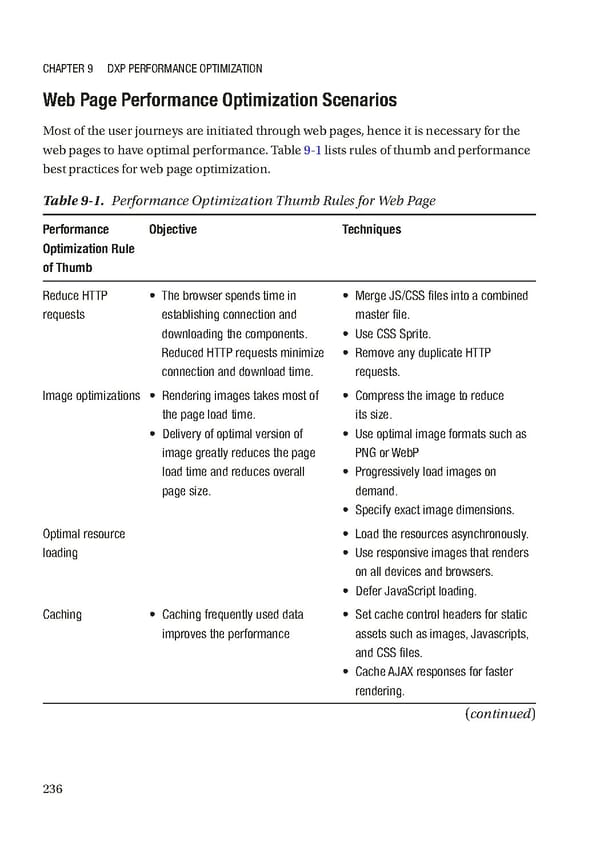
CHAPTeR 9 DXP PeRfORMANCe OPTIMIzATION Web Page Performance Optimization Scenarios Most of the user journeys are initiated through web pages, hence it is necessary for the web pages to have optimal performance. Table 9-1 lists rules of thumb and performance best practices for web page optimization. Table 9-1. Performance Optimization Thumb Rules for Web Page Performance Objective Techniques Optimization Rule of Thumb Reduce HTTP • The browser spends time in • Merge JS/CSS files into a combined requests establishing connection and master file. downloading the components. • Use CSS Sprite. Reduced HTTP requests minimize • Remove any duplicate HTTP connection and download time. requests. Image optimizations • Rendering images takes most of • Compress the image to reduce the page load time. its size. • Delivery of optimal version of • Use optimal image formats such as image greatly reduces the page PNG or WebP load time and reduces overall • Progressively load images on page size. demand. • Specify exact image dimensions. Optimal resource • Load the resources asynchronously. loading • Use responsive images that renders on all devices and browsers. • Defer JavaScript loading. Caching • Caching frequently used data • Set cache control headers for static improves the performance assets such as images, Javascripts, and CSS files. • Cache AJAX responses for faster rendering. (continued) 236
 Building Digital Experience Platforms Page 249 Page 251