

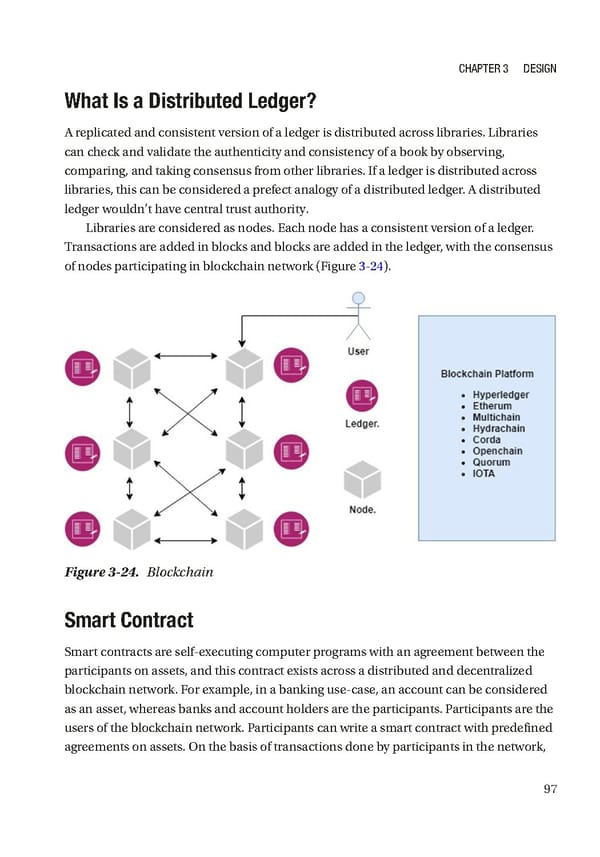
Chapter 3 Design What Is a Distributed Ledger? A replicated and consistent version of a ledger is distributed across libraries. Libraries can check and validate the authenticity and consistency of a book by observing, comparing, and taking consensus from other libraries. If a ledger is distributed across libraries, this can be considered a prefect analogy of a distributed ledger. A distributed ledger wouldn’t have central trust authority. Libraries are considered as nodes. Each node has a consistent version of a ledger. Transactions are added in blocks and blocks are added in the ledger, with the consensus of nodes participating in blockchain network (Figure 3-24). Figure 3-24. Blockchain Smart Contract Smart contracts are self-executing computer programs with an agreement between the participants on assets, and this contract exists across a distributed and decentralized blockchain network. For example, in a banking use-case, an account can be considered as an asset, whereas banks and account holders are the participants. Participants are the users of the blockchain network. Participants can write a smart contract with predefined agreements on assets. On the basis of transactions done by participants in the network, 97
 Building Digital Experience Platforms Page 116 Page 118