

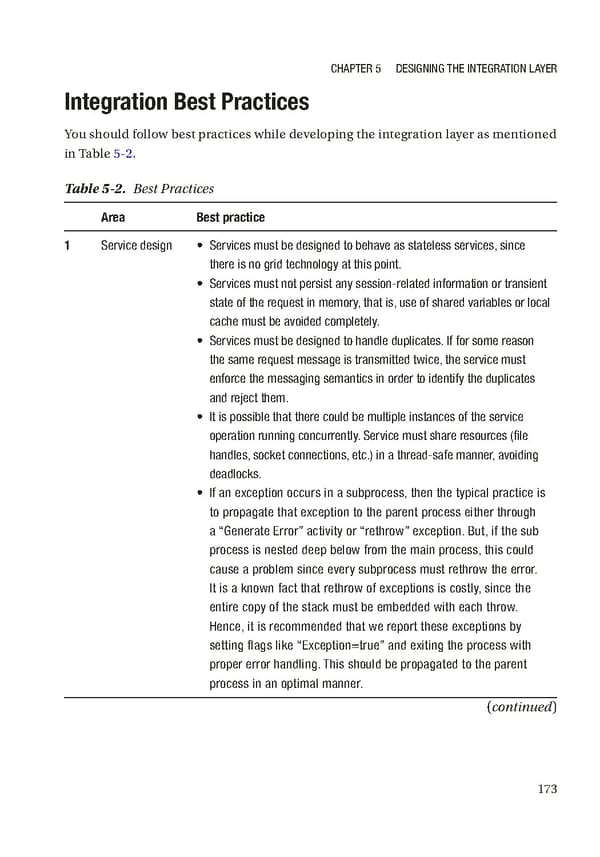
Chapter 5 Designing the integration Layer Integration Best Practices You should follow best practices while developing the integration layer as mentioned in Table 5-2. Table 5-2. Best Practices Area Best practice 1 service design • services must be designed to behave as stateless services, since there is no grid technology at this point. • services must not persist any session-related information or transient state of the request in memory, that is, use of shared variables or local cache must be avoided completely. • services must be designed to handle duplicates. if for some reason the same request message is transmitted twice, the service must enforce the messaging semantics in order to identify the duplicates and reject them. • it is possible that there could be multiple instances of the service operation running concurrently. service must share resources (file handles, socket connections, etc.) in a thread-safe manner, avoiding deadlocks. • if an exception occurs in a subprocess, then the typical practice is to propagate that exception to the parent process either through a “generate error” activity or “rethrow” exception. But, if the sub process is nested deep below from the main process, this could cause a problem since every subprocess must rethrow the error. it is a known fact that rethrow of exceptions is costly, since the entire copy of the stack must be embedded with each throw. hence, it is recommended that we report these exceptions by setting flags like “exception=true” and exiting the process with proper error handling. this should be propagated to the parent process in an optimal manner. (continued) 173
 Building Digital Experience Platforms Page 189 Page 191