

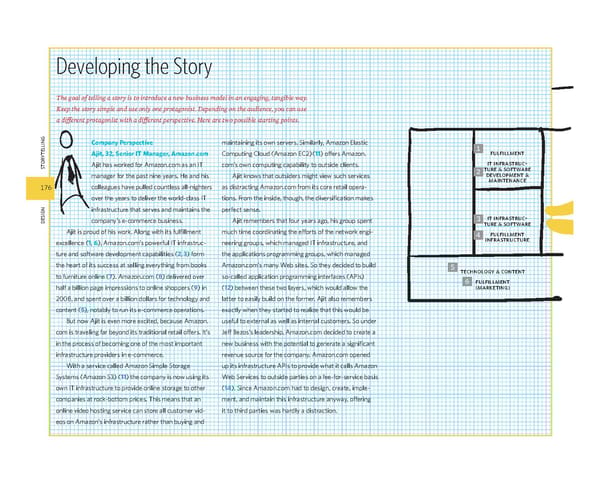
176 storyteLLIng desIgn 176 Developing the Story The goal of telling a story is to introduce a new business model in an engaging, tangible way. Keep the story simple and use only one protagonist. Depending on the audience, you can use a different protagonist with a different perspective. Here are two possible starting points. Company Perspective Ajit, 32, Senior IT Manager, Amazon.com Ajit has worked for Amazon.com as an IT manager for the past nine years. He and his colleagues have pulled countless all-nighters over the years to deliver the world-class IT infrastructure that serves and maintains the company’s e-commerce business. Ajit is proud of his work. Along with its fulfi llment excellence ( 1 , 6 ), Amazon.com’s powerful IT infrastruc- ture and software development capabilities ( 2 , 3 ) form the heart of its success at selling everything from books to furniture online ( 7 ). Amazon.com ( 8 ) delivered over half a billion page impressions to online shoppers ( 9 ) in 2008, and spent over a billion dollars for technology and content ( 5 ), notably to run its e-commerce operations. But now Ajit is even more excited, because Amazon. com is traveling far beyond its traditional retail offers. It’s in the process of becoming one of the most important infrastructure providers in e-commerce. With a service called Amazon Simple Storage Systems (Amazon S3) ( 11 ) the company is now using its own IT infrastructure to provide online storage to other companies at rock-bottom prices. This means that an online video hosting service can store all customer vid- eos on Amazon’s infrastructure rather than buying and maintaining its own servers. Similarly, Amazon Elastic Computing Cloud (Amazon EC2) ( 11 ) offers Amazon. com’s own computing capability to outside clients. Ajit knows that outsiders might view such services as distracting Amazon.com from its core retail opera- tions. From the inside, though, the diversifi cation makes perfect sense. Ajit remembers that four years ago, his group spent much time coordinating the efforts of the network engi- neering groups, which managed IT infrastructure, and the applications programming groups, which managed Amazon.com’s many Web sites. So they decided to build so-called application programming interfaces (APIs) ( 12 ) between these two layers, which would allow the latter to easily build on the former. Ajit also remembers exactly when they started to realize that this would be useful to external as well as internal customers. So under Jeff Bezos’s leadership, Amazon.com decided to create a new business with the potential to generate a signifi cant revenue source for the company. Amazon.com opened up its infrastructure APIs to provide what it calls Amazon Web Services to outside parties on a fee-for-service basis ( 14 ). Since Amazon.com had to design, create, imple- ment, and maintain this infrastructure anyway, offering it to third parties was hardly a distraction. amazon web services: s3, ec2, sqs, other web services companies and developers aPIs utility computing fees fulfi llment it infrastruc- ture & software development & maintenance it infrastruc- ture & software fulfi llment infrastructure technology & content fulfi llment (marketing) online retail shop consumer market amazon.com sales margins 1 2 3 4 5 6 bmgen_final.indd 176 6/15/10 5:43 PM
 Business Model Generation Flipbook Page 181 Page 183