

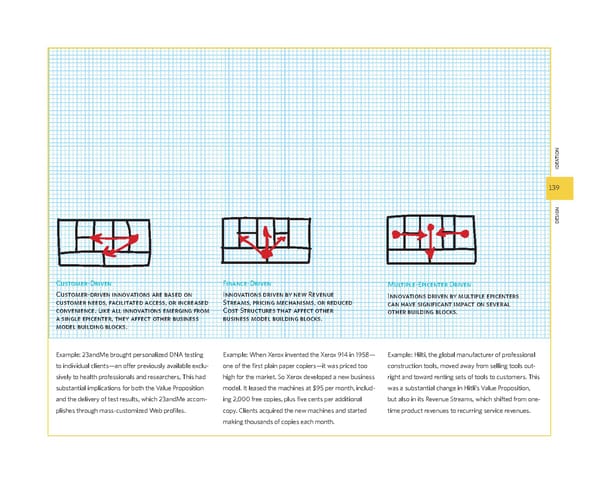
139 desIgn 139 IdeatIon multiple-epicenter driven Innovations driven by multiple epicenters can have signifi cant impact on several other building blocks. Example: Hilti, the global manufacturer of professional construction tools, moved away from selling tools out- right and toward renting sets of tools to customers. This was a substantial change in Hitli’s Value Proposition, but also in its Revenue Streams, which shifted from one- time product revenues to recurring service revenues. Customer-driven Customer-driven innovations are based on customer needs, facilitated access, or increased convenience. Like all innovations emerging from a single epicenter, they affect other business model building blocks. Example: 23andMe brought personalized DNA testing to individual clients—an offer previously available exclu- sively to health professionals and researchers, This had substantial implications for both the Value Proposition and the delivery of test results, which 23andMe accom- plishes through mass-customized Web profi les. Finance-driven Innovations driven by new revenue streams, pricing mechanisms, or reduced Cost structures that affect other business model building blocks. Example: When Xerox invented the Xerox 914 in 1958— one of the fi rst plain paper copiers—it was priced too high for the market. So Xerox developed a new business model. It leased the machines at $95 per month, includ- ing 2,000 free copies, plus fi ve cents per additional copy. Clients acquired the new machines and started making thousands of copies each month. bmgen_final.indd 139 6/15/10 5:40 PM
 Business Model Generation Flipbook Page 144 Page 146