

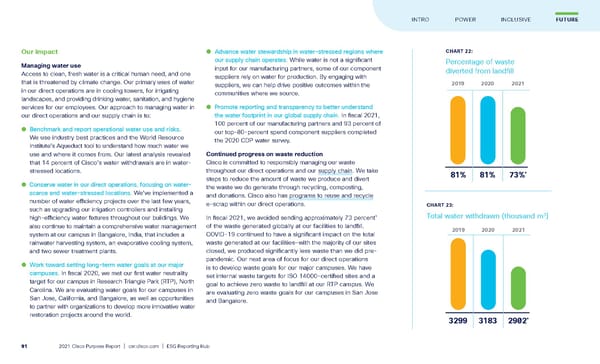
Our impact Managing water use Access to clean, fresh water is a critical human need, and one that is threatened by climate change. Our primary uses of water in our direct operations are in cooling towers, for irrigating landscapes, and providing drinking water, sanitation, and hygiene services for our employees. Our approach to managing water in our direct operations and our supply chain is to: ● Benchmark and report operational water use and risks . We use industry best practices and the World Resource Institute’s Aqueduct tool to understand how much water we use and where it comes from. Our latest analysis revealed that 14 percent of Cisco’s water withdrawals are in water- stressed locations. ● Conserve water in our direct operations, focusing on water- scarce and water-stressed locations. We’ve implemented a number of water efficiency projects over the last few years, such as upgrading our irrigation controllers and installing high-efficiency water fixtures throughout our buildings. We also continue to maintain a comprehensive water management system at our campus in Bangalore, India, that includes a rainwater harvesting system, an evaporative cooling system, and two sewer treatment plants. ● Work toward setting long-term water goals at our major campuses. In fiscal 2020, we met our first water neutrality target for our campus in Research Triangle Park (RTP), North Carolina. We are evaluating water goals for our campuses in San Jose, California, and Bangalore, as well as opportunities to partner with organizations to develop more innovative water restoration projects around the world. ● Advance water stewardship in water-stressed regions where our supply chain operates. While water is not a significant input for our manufacturing partners, some of our component suppliers rely on water for production. By engaging with suppliers, we can help drive positive outcomes within the communities where we source. ● Promote reporting and transparency to better understand the water footprint in our global supply chain. In fiscal 2021, 100 percent of our manufacturing partners and 93 percent of our top-80-percent spend component suppliers completed the 2020 CDP water survey. Continued progress on waste reduction Cisco is committed to responsibly managing our waste throughout our direct operations and our supply chain . We take steps to reduce the amount of waste we produce and divert the waste we do generate through recycling, composting, and donations. Cisco also has programs to reuse and recycle e-scrap within our direct operations. In fiscal 2021, we avoided sending approximately 73 percent * of the waste generated globally at our facilities to landfill. COVID-19 continued to have a significant impact on the total waste generated at our facilities—with the majority of our sites closed, we produced significantly less waste than we did pre- pandemic. Our next area of focus for our direct operations is to develop waste goals for our major campuses. We have set internal waste targets for ISO 14000-certified sites and a goal to achieve zero waste to landfill at our RTP campus. We are evaluating zero waste goals for our campuses in San Jose and Bangalore. CHART 22: Percentage of waste diverted from landfill 2019 81% 2020 81% 2021 73% * CHART 23: Total water withdrawn (thousand m 3 ) 2019 3299 2020 3183 2021 2902 * FUTURE INTRO POWER INCLUSIVE 2021 Cisco Purpose Report | csr.cisco.com | ESG Reporting Hub 91
 Cisco Purpose Report Page 91 Page 93