

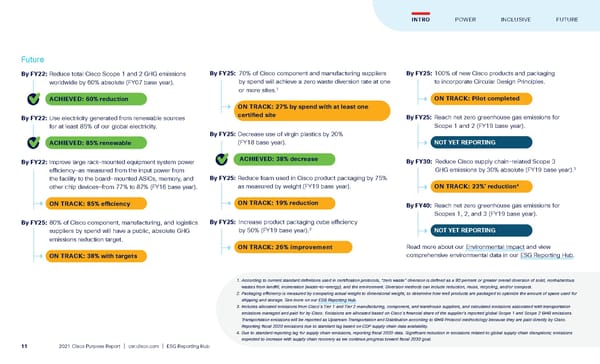
Future By FY22: Reduce total Cisco Scope 1 and 2 GHG emissions worldwide by 60% absolute (FY07 base year). ACHIEVED: 60% reduction By FY22: Use electricity generated from renewable sources for at least 85% of our global electricity. ACHIEVED: 85% renewable By FY22: Improve large rack-mounted equipment system power efficiency—as measured from the input power from the facility to the board-mounted ASICs, memory, and other chip devices—from 77% to 87% (FY16 base year). ON TRACK: 85% efficiency By FY25: 80% of Cisco component, manufacturing, and logistics suppliers by spend will have a public, absolute GHG emissions reduction target. ON TRACK: 38% with targets By FY25: 70% of Cisco component and manufacturing suppliers by spend will achieve a zero waste diversion rate at one or more sites. 1 ON TRACK: 27% by spend with at least one certified site By FY25: Decrease use of virgin plastics by 20% (FY18 base year). ACHIEVED: 38% decrease By FY25: Reduce foam used in Cisco product packaging by 75% as measured by weight (FY19 base year). ON TRACK: 19% reduction By FY25: Increase product packaging cube efficiency by 50% (FY19 base year). 2 ON TRACK: 26% improvement By FY25: 100% of new Cisco products and packaging to incorporate Circular Design Principles. ON TRACK: Pilot completed By FY25: Reach net zero greenhouse gas emissions for Scope 1 and 2 (FY19 base year). NOT YET REPORTING By FY30: Reduce Cisco supply chain-related Scope 3 GHG emissions by 30% absolute (FY19 base year). 3 ON TRACK: 23% * reduction 4 By FY40: Reach net zero greenhouse gas emissions for Scopes 1, 2, and 3 (FY19 base year). NOT YET REPORTING Read more about our Environmental Impact and view comprehensive environmental data in our ESG Reporting Hub . 1. According to current standard definitions used in certification protocols, “zero waste” diversion is defined as a 90 percent or greater overall diversion of solid, nonhazardous wastes from landfill, incineration (waste-to-energy), and the environment. Diversion methods can include reduction, reuse, recycling, and/or compost. 2. Packaging efficiency is measured by comparing actual weight to dimensional weight, to determine how well products are packaged to optimize the amount of space used for shipping and storage. See more on our ESG Reporting Hub . 3. Includes allocated emissions from Cisco’s Tier 1 and Tier 2 manufacturing, component, and warehouse suppliers, and calculated emissions associated with transportation emissions managed and paid for by Cisco. Emissions are allocated based on Cisco’s financial share of the supplier’s reported global Scope 1 and Scope 2 GHG emissions. Transportation emissions will be reported as Upstream Transportation and Distribution according to GHG Protocol methodology because they are paid directly by Cisco. Reporting fiscal 2020 emissions due to standard lag based on CDP supply chain data availability. 4. Due to standard reporting lag for supply chain emissions, reporting fiscal 2020 data. Significant reduction in emissions related to global supply chain disruptions; emissions expected to increase with supply chain recovery as we continue progress toward fiscal 2030 goal. FUTURE INTRO POWER INCLUSIVE 11 2021 Cisco Purpose Report | csr.cisco.com | ESG Reporting Hub
 Cisco Purpose Report Page 11 Page 13