

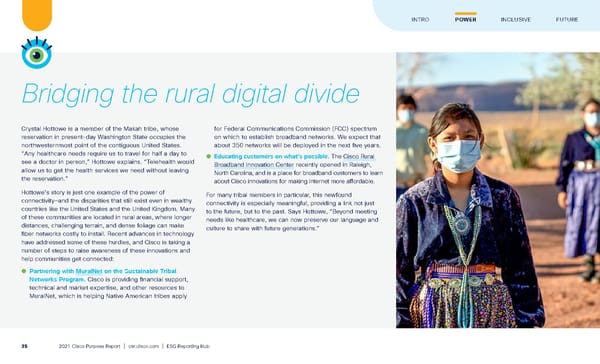
Bridging the rural digital divide Crystal Hottowe is a member of the Makah tribe, whose reservation in present-day Washington State occupies the northwesternmost point of the contiguous United States. “Any healthcare needs require us to travel for half a day to see a doctor in person,” Hottowe explains. “Telehealth would allow us to get the health services we need without leaving the reservation.” Hottowe’s story is just one example of the power of connectivity—and the disparities that still exist even in wealthy countries like the United States and the United Kingdom. Many of these communities are located in rural areas, where longer distances, challenging terrain, and dense foliage can make fiber networks costly to install. Recent advances in technology have addressed some of these hurdles, and Cisco is taking a number of steps to raise awareness of these innovations and help communities get connected: ● Partnering with MuralNet on the Sustainable Tribal Networks Program. Cisco is providing financial support, technical and market expertise, and other resources to MuralNet, which is helping Native American tribes apply for Federal Communications Commission (FCC) spectrum on which to establish broadband networks. We expect that about 350 networks will be deployed in the next five years. ● Educating customers on what’s possible. The Cisco Rural Broadband Innovation Center recently opened in Raleigh, North Carolina, and is a place for broadband customers to learn about Cisco innovations for making Internet more affordable. For many tribal members in particular, this newfound connectivity is especially meaningful, providing a link not just to the future, but to the past. Says Hottowe, “Beyond meeting needs like healthcare, we can now preserve our language and culture to share with future generations.” FUTURE INTRO POWER INCLUSIVE 2021 Cisco Purpose Report | csr.cisco.com | ESG Reporting Hub 35
 Cisco Purpose Report Page 35 Page 37