

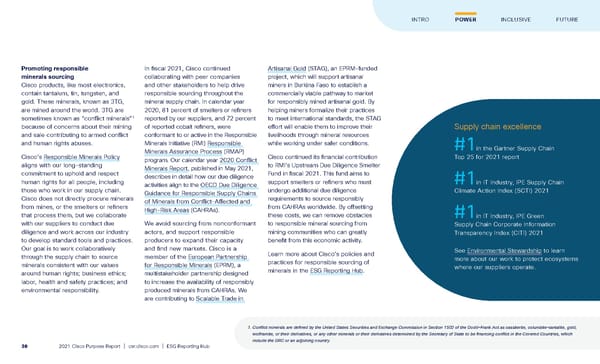
Promoting responsible minerals sourcing Cisco products, like most electronics, contain tantalum, tin, tungsten, and gold. These minerals, known as 3TG, are mined around the world. 3TG are sometimes known as “conflict minerals” 1 because of concerns about their mining and sale contributing to armed conflict and human rights abuses. Cisco’s Responsible Minerals Policy aligns with our long-standing commitment to uphold and respect human rights for all people, including those who work in our supply chain. Cisco does not directly procure minerals from mines, or the smelters or refiners that process them, but we collaborate with our suppliers to conduct due diligence and work across our industry to develop standard tools and practices. Our goal is to work collaboratively through the supply chain to source minerals consistent with our values around human rights; business ethics; labor, health and safety practices; and environmental responsibility. In fiscal 2021, Cisco continued collaborating with peer companies and other stakeholders to help drive responsible sourcing throughout the mineral supply chain. In calendar year 2020, 81 percent of smelters or refiners reported by our suppliers, and 72 percent of reported cobalt refiners, were conformant to or active in the Responsible Minerals Initiative (RMI) Responsible Minerals Assurance Process (RMAP) program. Our calendar year 2020 Conflict Minerals Report , published in May 2021, describes in detail how our due diligence activities align to the OECD Due Diligence Guidance for Responsible Supply Chains of Minerals from Conflict-Affected and High-Risk Areas (CAHRAs). We avoid sourcing from nonconformant actors, and support responsible producers to expand their capacity and find new markets. Cisco is a member of the European Partnership for Responsible Minerals (EPRM), a multistakeholder partnership designed to increase the availability of responsibly produced minerals from CAHRAs. We are contributing to Scalable Trade in Artisanal Gold (STAG), an EPRM-funded project, which will support artisanal miners in Burkina Faso to establish a commercially viable pathway to market for responsibly mined artisanal gold. By helping miners formalize their practices to meet international standards, the STAG effort will enable them to improve their livelihoods through mineral resources while working under safer conditions. Cisco continued its financial contribution to RMI’s Upstream Due Diligence Smelter Fund in fiscal 2021. This fund aims to support smelters or refiners who must undergo additional due diligence requirements to source responsibly from CAHRAs worldwide. By offsetting these costs, we can remove obstacles to responsible mineral sourcing from mining communities who can greatly benefit from this economic activity. Learn more about Cisco’s policies and practices for responsible sourcing of minerals in the ESG Reporting Hub . 1. Conflict minerals are defined by the United States Securities and Exchange Commission in Section 1502 of the Dodd-Frank Act as cassiterite, columbite-tantalite, gold, wolframite, or their derivatives, or any other minerals or their derivatives determined by the Secretary of State to be financing conflict in the Covered Countries, which include the DRC or an adjoining country. Supply chain excellence #1 in the Gartner Supply Chain Top 25 for 2021 report #1 in IT Industry, IPE Supply Chain Climate Action Index (SCTI) 2021 #1 in IT Industry, IPE Green Supply Chain Corporate Information Transparency Index (CITI) 2021 See Environmental Stewardship to learn more about our work to protect ecosystems where our suppliers operate. FUTURE INTRO POWER INCLUSIVE 2021 Cisco Purpose Report | csr.cisco.com | ESG Reporting Hub 30
 Cisco Purpose Report Page 30 Page 32