

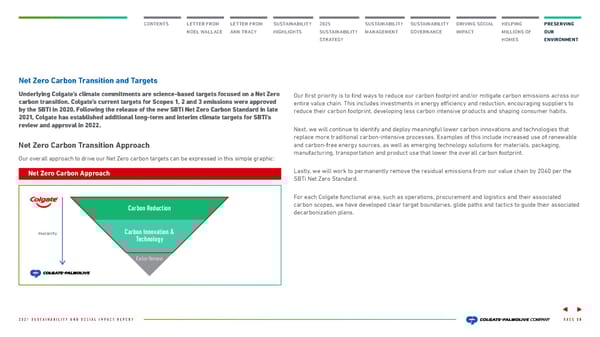
CONTENTS LETTER FROM NOEL WALLACE LETTER FROM ANN TRACY 2025 SUSTAINABILITY STRATEGY SUSTAINABILITY HIGHLIGHTS SUSTAINABILITY MANAGEMENT SUSTAINABILITY GOVERNANCE DRIVING SOCIAL IMPACT HELPING MILLIONS OF HOMES PRESERVING OUR ENVIRONMENT Net Zero Carbon Transition and Targets Underlying Colgate’s climate commitments are science-based targets focused on a Net Zero carbon transition. Colgate’s current targets for Scopes 1, 2 and 3 emissions were approved by the SBTi in 2020. Following the release of the new SBTi Net Zero Carbon Standard in late 2021, Colgate has established additional long-term and interim climate targets for SBTi’s review and approval in 2022. Net Zero Carbon Transition Approach Our overall approach to drive our Net Zero carbon targets can be expressed in this simple graphic: Net Zero Carbon Approach Hierarchy Carbon Reduction Carbon Innovation & Technology Carbon Removal Our first priority is to find ways to reduce our carbon footprint and/or mitigate carbon emissions across our entire value chain. This includes investments in energy efficiency and reduction, encouraging suppliers to reduce their carbon footprint, developing less carbon intensive products and shaping consumer habits. Next, we will continue to identify and deploy meaningful lower carbon innovations and technologies that replace more traditi onal carbon-intensive processes. Examples of this include increased use of renewable and carbon-free energy sources, as well as emerging technology solutions for materials, packaging, manufacturing, transportation and product use that lower the overall carbon footprint. Lastly, we will work to permanently remove the residual emissions from our value chain by 2040 per the SBTi Net Zero Standard . For each Colgate functional area, such as operations, procurement and logistics and their associated carbon scopes, we have d eveloped clear target boundaries, glide paths and tactics to guide their associated decarbonization plans. PAGE 58 2021 SUSTAINABILITY AND SOCIAL IMPACT REPORT
 Colgate-Palmolive Sustainability and Social Impact Report Page 58 Page 60