

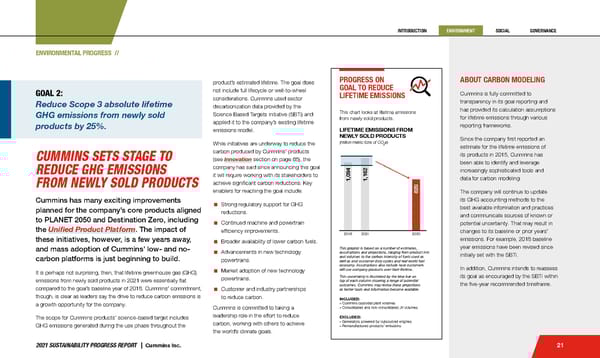
2021 SUSTAINABILITY PROGRESS REPORT | Cummins Inc. PROGRESS ON GOAL TO REDUCE LIFETIME EMISSIONS This chart looks at lifetime emissions from newly sold products. LIFETIME EMISSIONS FROM NEWLY SOLD PRODUCTS (million metric tons of CO 2 e) This graphic is based on a number of estimates, assumptions and projections, ranging from product mix and volumes to the carbon intensity of fuels used as well as end customer duty cycles and real world fuel economy. Assumptions also include how customers will use company products over their lifetime. This uncertainty is illustrated by the blue bar on top of each column showing a range of potential outcomes. Cummins may revise these projections as better tools and information become available. INCLUDED: » Cummins custodial plant volumes » Consolidated and non-consolidated JV volumes EXCLUDED: » Generators powered by outsourced engines » Remanufactured products’ emissions ENVIRONMENTAL PROGRESS // 21 ABOUT CARBON MODELING Cummins is fully committed to transparency in its goal reporting and has provided its calculation assumptions for lifetime emissions through various reporting frameworks. Since the company first reported an estimate for the lifetime emissions of its products in 2015, Cummins has been able to identify and leverage increasingly sophisticated tools and data for carbon modeling. The company will continue to update its GHG accounting methods to the best available information and practices and communicate sources of known or potential uncertainty. That may result in changes to its baseline or prior years’ emissions. For example, 2018 baseline year emissions have been revised since initially set with the SBTi. In addition, Cummins intends to reassess its goal as encouraged by the SBTi within the five-year recommended timeframe. product’s estimated lifetime. The goal does not include full lifecycle or well-to-wheel considerations. Cummins used sector decarbonization data provided by the Science Based Targets initiative (SBTi) and applied it to the company’s existing lifetime emissions model. While initiatives are underway to reduce the carbon produced by Cummins’ products (see Innovation section on page 65), the company has said since announcing this goal it will require working with its stakeholders to achieve significant carbon reductions. Key enablers for reaching the goal include: Strong regulatory support for GHG reductions. Continued machine and powertrain efficiency improvements. Broader availability of lower carbon fuels. Advancements in new technology powertrains. Market adoption of new technology powertrains. Customer and industry partnerships to reduce carbon. Cummins is committed to taking a leadership role in the effort to reduce carbon, working with others to achieve the world’s climate goals. CUMMINS SETS STAGE TO REDUCE GHG EMISSIONS FROM NEWLY SOLD PRODUCTS Cummins has many exciting improvements planned for the company’s core products aligned to PLANET 2050 and Destination Zero, including the Unified Product Platform . The impact of these initiatives, however, is a few years away, and mass adoption of Cummins’ low- and no- carbon platforms is just beginning to build. It is perhaps not surprising, then, that lifetime greenhouse gas (GHG) emissions from newly sold products in 2021 were essentially flat compared to the goal’s baseline year of 2018. Cummins’ commitment, though, is clear as leaders say the drive to reduce carbon emissions is a growth opportunity for the company. The scope for Cummins products’ science-based target includes GHG emissions generated during the use phase throughout the GOAL 2: Reduce Scope 3 absolute lifetime GHG emissions from newly sold products by 25%. 0 820 1,162 1,094 2030 2021 2018
 Cummins Sustainability Progress Report Page 21 Page 23