

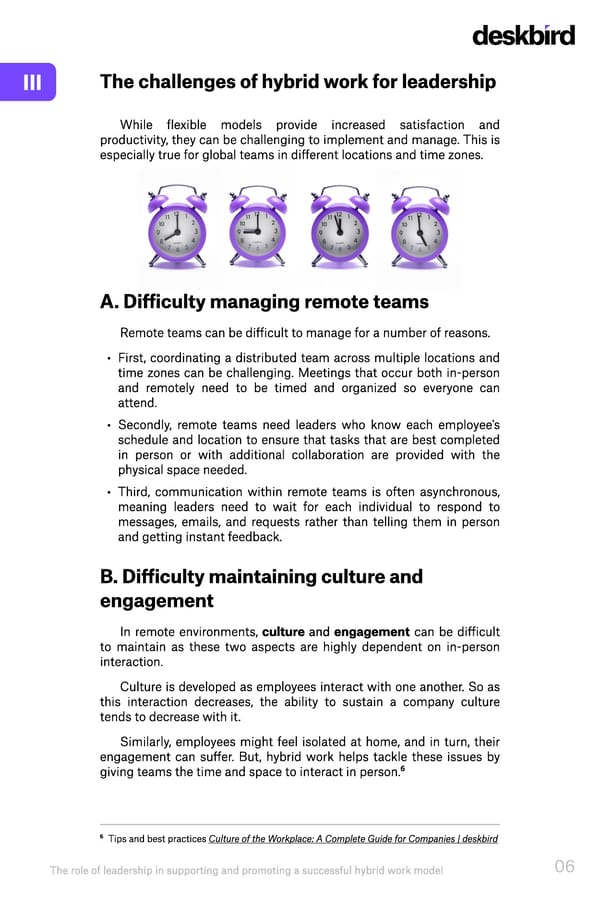
III 06 The challenges of hybrid work for leadership The role of leadership in supporting and promoting a successful hybrid work model 6 Tips and best practices Culture of the Workplace: A Complete Guide for Companies | deskbird While flexible models provide increased satisfaction and productivity, they can be challenging to implement and manage. This is especially true for global teams in different locations and time zones. A. Difficulty managing remote teams Remote teams can be difficult to manage for a number of reasons.— Ÿ First, coordinating a distributed team across multiple locations and time zones can be challenging. Meetings that occur both in-person and remotely need to be timed and organized so everyone can attend. Ÿ Secondly, remote teams need leaders who know each employee's schedule and location to ensure that tasks that are best completed in person or with additional collaboration are provided with the physical space needed. Ÿ Third, communication within remote teams is often asynchronous, meaning leaders need to wait for each individual to respond to messages, emails, and requests rather than telling them in person and getting instant feedback. B. Difficulty maintaining culture and engagement I n remote environments, culture and engagement can be difficult to maintain as these two aspects are highly dependent on in-person interaction. C ulture is developed as employees interact with one another. So as this interaction decreases, the ability to sustain a company culture tends to decrease with it. Similarly, employees might feel isolated at home, and in turn, their engagement can suffer. B ut, hybrid work helps tackle these issues by giving teams the time and space to interact in person.6
 Deskbird 2023 | Whitepaper Page 5 Page 7