

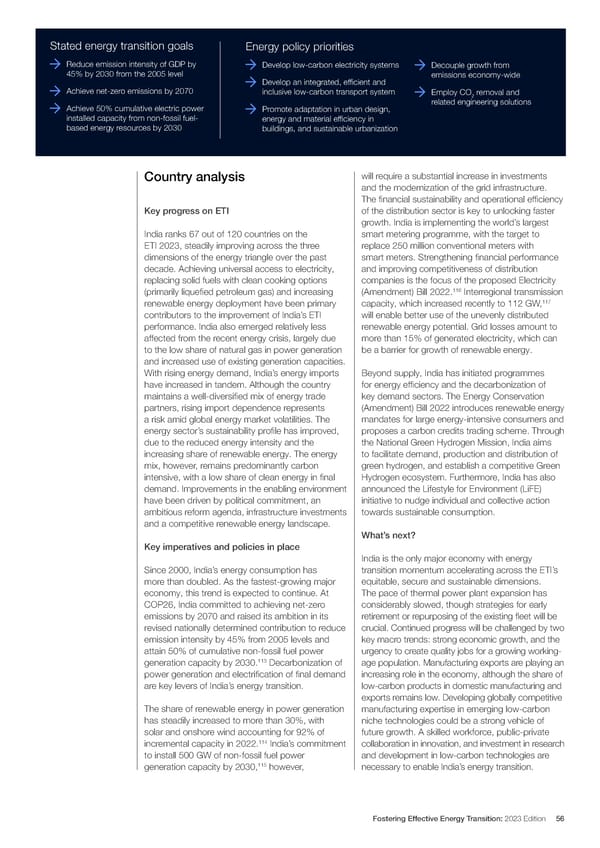
Stated energy transition goals Energy policy priorities Reduce emission intensity of GDP by Develop low-carbon electricity systems Decouple growth from 45% by 2030 from the 2005 level Develop an integrated, ef昀椀cient and emissions economy-wide Achieve net-zero emissions by 2070 inclusive low-carbon transport system Employ CO removal and 2 Achieve 50% cumulative electric power Promote adaptation in urban design, related engineering solutions installed capacity from non-fossil fuel- energy and material ef昀椀ciency in based energy resources by 2030 buildings, and sustainable urbanization will require a substantial increase in investments Country analysis and the modernization of the grid infrastructure. The 昀椀nancial sustainability and operational ef昀椀ciency Key progress on ETI of the distribution sector is key to unlocking faster growth. India is implementing the world’s largest India ranks 67 out of 120 countries on the smart metering programme, with the target to ETI 2023, steadily improving across the three replace 250 million conventional meters with dimensions of the energy triangle over the past smart meters. Strengthening 昀椀nancial performance decade. Achieving universal access to electricity, and improving competitiveness of distribution replacing solid fuels with clean cooking options companies is the focus of the proposed Electricity 116 Interregional transmission (primarily lique昀椀ed petroleum gas) and increasing (Amendment) Bill 2022. 117 renewable energy deployment have been primary capacity, which increased recently to 112 GW, contributors to the improvement of India’s ETI will enable better use of the unevenly distributed performance. India also emerged relatively less renewable energy potential. Grid losses amount to affected from the recent energy crisis, largely due more than 15% of generated electricity, which can to the low share of natural gas in power generation be a barrier for growth of renewable energy. and increased use of existing generation capacities. With rising energy demand, India’s energy imports Beyond supply, India has initiated programmes have increased in tandem. Although the country for energy ef昀椀ciency and the decarbonization of maintains a well-diversi昀椀ed mix of energy trade key demand sectors. The Energy Conservation partners, rising import dependence represents (Amendment) Bill 2022 introduces renewable energy a risk amid global energy market volatilities. The mandates for large energy-intensive consumers and energy sector’s sustainability pro昀椀le has improved, proposes a carbon credits trading scheme. Through due to the reduced energy intensity and the the National Green Hydrogen Mission, India aims increasing share of renewable energy. The energy to facilitate demand, production and distribution of mix, however, remains predominantly carbon green hydrogen, and establish a competitive Green intensive, with a low share of clean energy in 昀椀nal Hydrogen ecosystem. Furthermore, India has also demand. Improvements in the enabling environment announced the Lifestyle for Environment (LiFE) have been driven by political commitment, an initiative to nudge individual and collective action ambitious reform agenda, infrastructure investments towards sustainable consumption. and a competitive renewable energy landscape. What’s next? Key imperatives and policies in place India is the only major economy with energy Since 2000, India’s energy consumption has transition momentum accelerating across the ETI’s more than doubled. As the fastest-growing major equitable, secure and sustainable dimensions. economy, this trend is expected to continue. At The pace of thermal power plant expansion has COP26, India committed to achieving net-zero considerably slowed, though strategies for early emissions by 2070 and raised its ambition in its retirement or repurposing of the existing 昀氀eet will be revised nationally determined contribution to reduce crucial. Continued progress will be challenged by two emission intensity by 45% from 2005 levels and key macro trends: strong economic growth, and the attain 50% of cumulative non-fossil fuel power urgency to create quality jobs for a growing working- 113 generation capacity by 2030. Decarbonization of age population. Manufacturing exports are playing an power generation and electri昀椀cation of 昀椀nal demand increasing role in the economy, although the share of are key levers of India’s energy transition. low-carbon products in domestic manufacturing and exports remains low. Developing globally competitive The share of renewable energy in power generation manufacturing expertise in emerging low-carbon has steadily increased to more than 30%, with niche technologies could be a strong vehicle of solar and onshore wind accounting for 92% of future growth. A skilled workforce, public-private 114 incremental capacity in 2022. India’s commitment collaboration in innovation, and investment in research to install 500 GW of non-fossil fuel power and development in low-carbon technologies are 115 generation capacity by 2030, however, necessary to enable India’s energy transition. Fostering Effective Energy Transition: 2023 Edition 56
 Fostering Effective Energy Transition 2023 Page 55 Page 57