

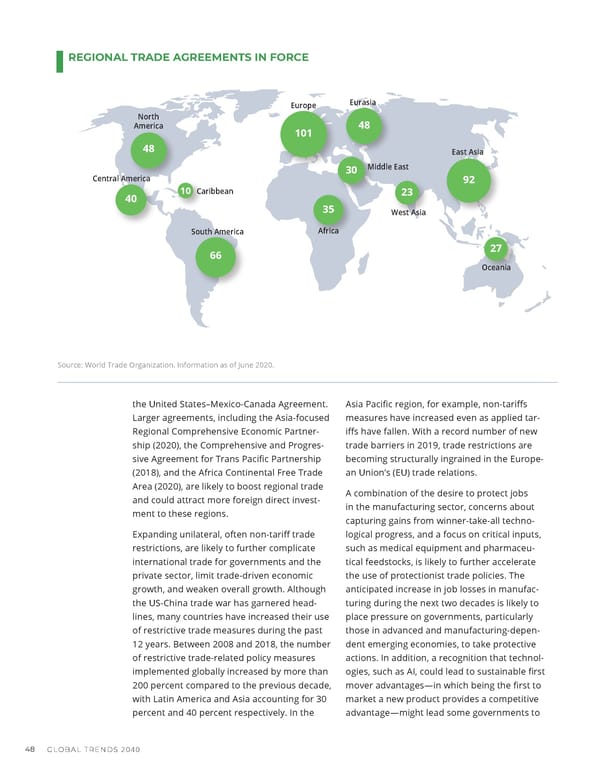
REGIONAL TRADE AGREEMENTS IN FORCE Europe Eurasia North 48 America 101 48 East Asia 30 Middle East Central America 92 40 10 Caribbean 23 35 West Asia South America Africa 66 27 Oceania Source: World Trade Organization. Information as of June 2020. the United States–Mexico-Canada Agreement. Asia Paci昀椀c region, for example, non-tari昀昀s Larger agreements, including the Asia-focused measures have increased even as applied tar- Regional Comprehensive Economic Partner- i昀昀s have fallen. With a record number of new ship (2020), the Comprehensive and Progres- trade barriers in 2019, trade restrictions are sive Agreement for Trans Paci昀椀c Partnership becoming structurally ingrained in the Europe- (2018), and the Africa Continental Free Trade an Union’s (EU) trade relations. Area (2020), are likely to boost regional trade and could attract more foreign direct invest- A combination of the desire to protect jobs ment to these regions. in the manufacturing sector, concerns about capturing gains from winner-take-all techno- Expanding unilateral, often non-tari昀昀 trade logical progress, and a focus on critical inputs, restrictions, are likely to further complicate such as medical equipment and pharmaceu- international trade for governments and the tical feedstocks, is likely to further accelerate private sector, limit trade-driven economic the use of protectionist trade policies. The growth, and weaken overall growth. Although anticipated increase in job losses in manufac- the US-China trade war has garnered head- turing during the next two decades is likely to lines, many countries have increased their use place pressure on governments, particularly of restrictive trade measures during the past those in advanced and manufacturing-depen- 12 years. Between 2008 and 2018, the number dent emerging economies, to take protective of restrictive trade-related policy measures actions. In addition, a recognition that technol- implemented globally increased by more than ogies, such as AI, could lead to sustainable 昀椀rst 200 percent compared to the previous decade, mover advantages—in which being the 昀椀rst to with Latin America and Asia accounting for 30 market a new product provides a competitive percent and 40 percent respectively. In the advantage—might lead some governments to 48 GLOBAL TRENDS 2040
 GlobalTrends 2040 Page 55 Page 57