

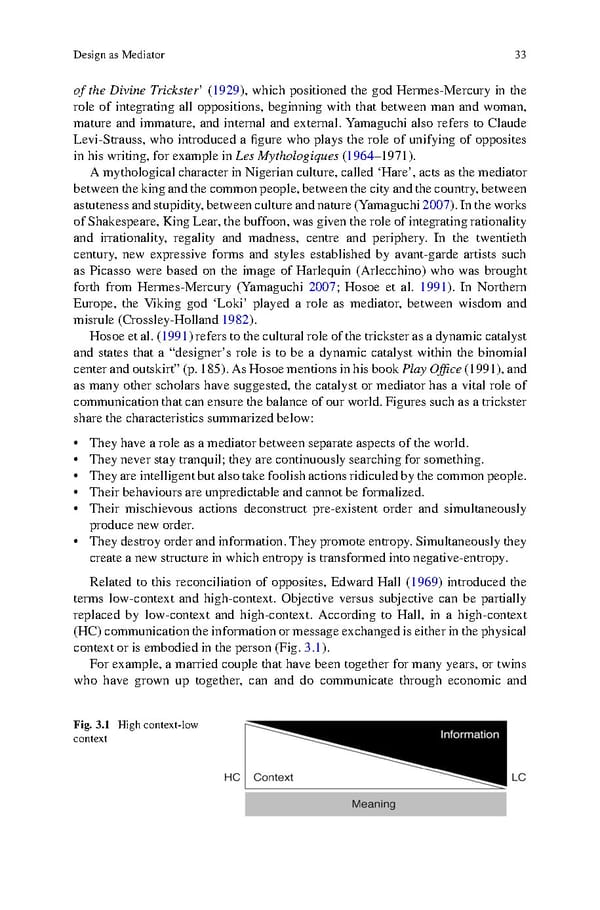
Design as Mediator 33 of the Divine Trickster’(1929), which positioned the god Hermes-Mercury in the role of integrating all oppositions, beginning with that between man and woman, mature and immature, and internal and external. Yamaguchi also refers to Claude Levi-Strauss, who introduced a figure who plays the role of unifying of opposites in his writing, for example in Les Mythologiques (1964–1971). Amythologicalcharacter in Nigerian culture, called ‘Hare’, acts as the mediator betweenthekingandthecommonpeople,betweenthecityandthecountry,between astutenessandstupidity,betweencultureandnature(Yamaguchi2007).Intheworks of Shakespeare, King Lear, the buffoon, was given the role of integrating rationality and irrationality, regality and madness, centre and periphery. In the twentieth century, new expressive forms and styles established by avant-garde artists such as Picasso were based on the image of Harlequin (Arlecchino) who was brought forth from Hermes-Mercury (Yamaguchi 2007; Hosoe et al. 1991). In Northern Europe, the Viking god ‘Loki’ played a role as mediator, between wisdom and misrule (Crossley-Holland 1982). Hosoeetal.(1991)referstotheculturalroleofthetricksterasadynamiccatalyst and states that a “designer’s role is to be a dynamic catalyst within the binomial centerandoutskirt”(p.185).AsHosoementionsinhisbookPlayOffice(1991),and as many other scholars have suggested, the catalyst or mediator has a vital role of communicationthatcan ensurethebalanceof ourworld.Figures such as a trickster share the characteristics summarized below: • Theyhavearoleasamediatorbetweenseparateaspects of the world. • Theyneverstay tranquil; they are continuouslysearching for something. • Theyareintelligentbutalsotakefoolishactionsridiculedbythecommonpeople. • Their behavioursare unpredictable and cannot be formalized. • Their mischievous actions deconstruct pre-existent order and simultaneously produceneworder. • Theydestroyorderandinformation.Theypromoteentropy.Simultaneouslythey create a new structure in which entropy is transformed into negative-entropy. Related to this reconciliation of opposites, Edward Hall (1969) introduced the terms low-context and high-context. Objective versus subjective can be partially replaced by low-context and high-context. According to Hall, in a high-context (HC)communicationtheinformationormessageexchangediseitherinthephysical context or is embodied in the person (Fig. 3.1). For example, a married couple that have been together for many years, or twins who have grown up together, can and do communicate through economic and Fig. 3.1 High context-low context
 Human Experiential Design of Presence in Everyday Page 41 Page 43