

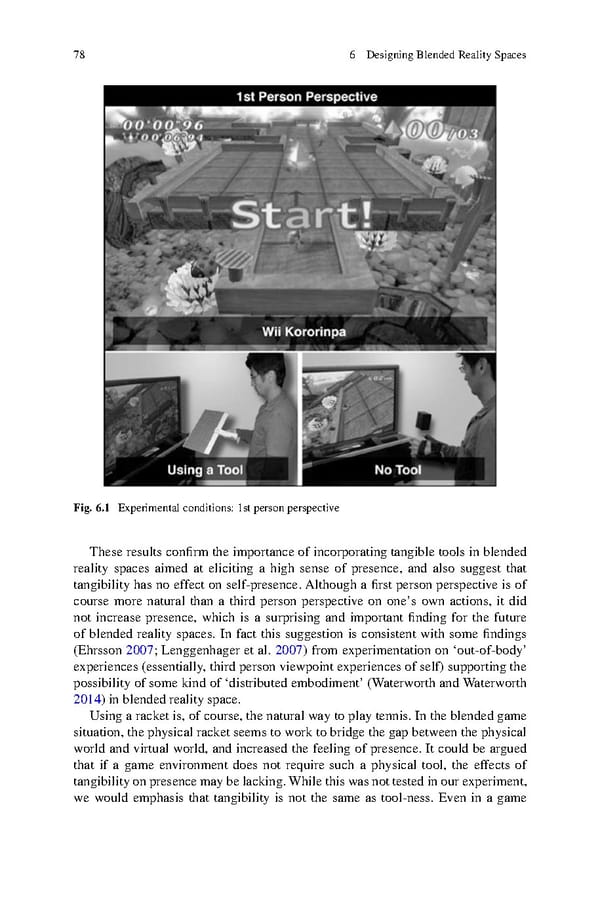
78 6 DesigningBlended Reality Spaces Fig. 6.1 Experimental conditions: 1st person perspective These results confirm the importance of incorporating tangible tools in blended reality spaces aimed at eliciting a high sense of presence, and also suggest that tangibility has no effect on self-presence. Although a first person perspective is of course more natural than a third person perspective on one’s own actions, it did not increase presence, which is a surprising and important finding for the future of blended reality spaces. In fact this suggestion is consistent with some findings (Ehrsson 2007; Lenggenhager et al. 2007) from experimentation on ‘out-of-body’ experiences (essentially, third person viewpoint experiences of self) supporting the possibility of some kind of ‘distributed embodiment’ (Waterworth and Waterworth 2014)in blendedreality space. Using a racket is, of course, the natural way to play tennis. In the blended game situation, the physical racket seems to work to bridge the gap between the physical world and virtual world, and increased the feeling of presence. It could be argued that if a game environment does not require such a physical tool, the effects of tangibility on presence may be lacking.While this was not tested in our experiment, we would emphasis that tangibility is not the same as tool-ness. Even in a game
 Human Experiential Design of Presence in Everyday Page 84 Page 86