

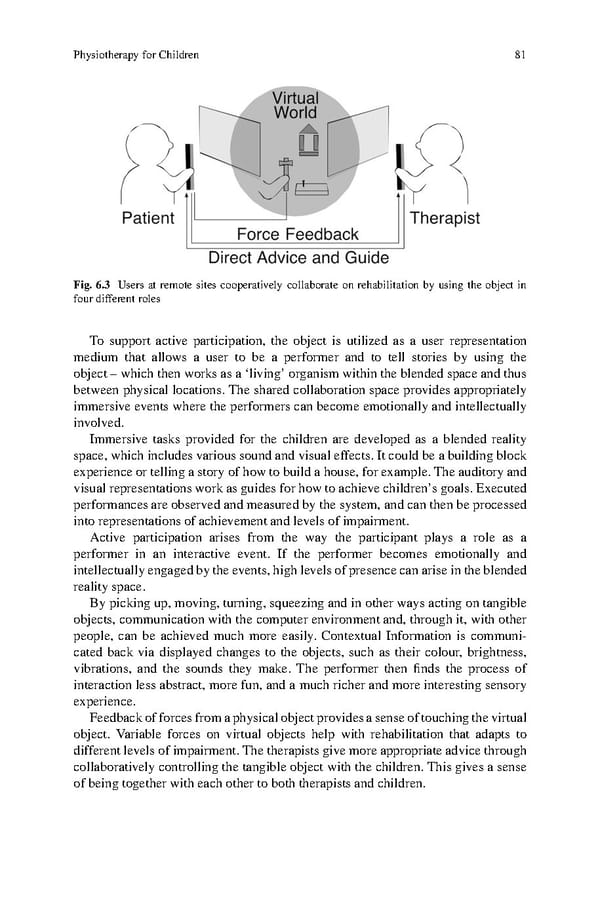
Physiotherapy for Children 81 Fig. 6.3 Users at remote sites cooperatively collaborate on rehabilitation by using the object in four different roles To support active participation, the object is utilized as a user representation medium that allows a user to be a performer and to tell stories by using the object – which then works as a ‘living’ organism within the blended space and thus between physical locations. The shared collaboration space provides appropriately immersive events where the performers can become emotionally and intellectually involved. Immersive tasks provided for the children are developed as a blended reality space, which includes various sound and visual effects. It could be a building block experienceor telling a story of how to build a house, for example. The auditory and visual representations work as guides for how to achieve children’s goals. Executed performancesare observed and measured by the system, and can then be processed into representations of achievement and levels of impairment. Active participation arises from the way the participant plays a role as a performer in an interactive event. If the performer becomes emotionally and intellectually engagedbythe events, high levels of presence can arise in the blended reality space. Bypickingup, moving,turning, squeezing and in other ways acting on tangible objects, communication with the computer environment and, through it, with other people, can be achieved much more easily. Contextual Information is communi- cated back via displayed changes to the objects, such as their colour, brightness, vibrations, and the sounds they make. The performer then finds the process of interaction less abstract, more fun, and a much richer and more interesting sensory experience. Feedbackofforcesfromaphysicalobjectprovidesasenseoftouchingthevirtual object. Variable forces on virtual objects help with rehabilitation that adapts to different levels of impairment. The therapists give more appropriate advice through collaboratively controlling the tangible object with the children. This gives a sense of being together with each other to both therapists and children.
 Human Experiential Design of Presence in Everyday Page 87 Page 89