

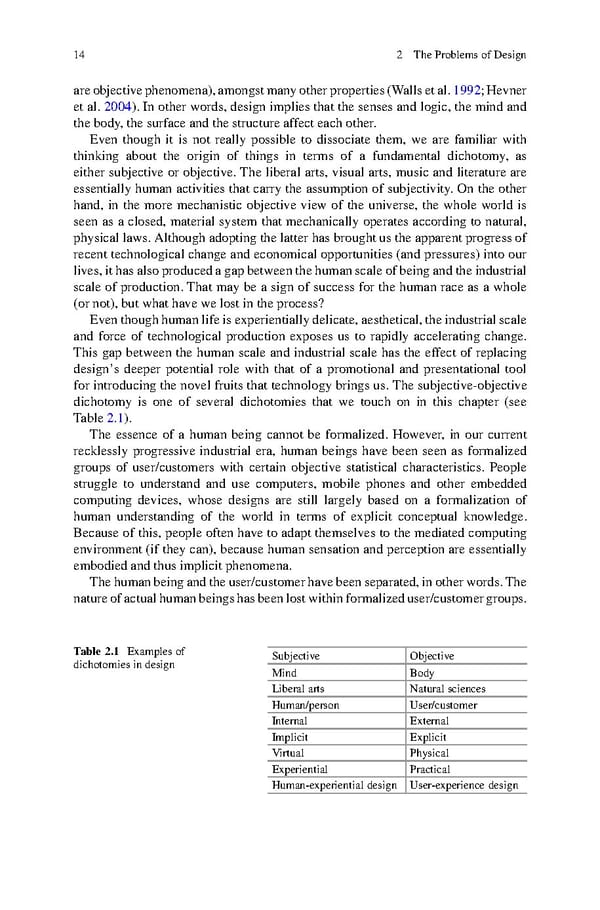
14 2 TheProblemsofDesign areobjectivephenomena),amongstmanyotherproperties(Wallsetal.1992;Hevner et al. 2004). In other words, design implies that the senses and logic, the mind and the body, the surface and the structure affect each other. Even though it is not really possible to dissociate them, we are familiar with thinking about the origin of things in terms of a fundamental dichotomy, as either subjective or objective. The liberal arts, visual arts, music and literature are essentially human activities that carry the assumption of subjectivity. On the other hand, in the more mechanistic objective view of the universe, the whole world is seen as a closed, material system that mechanically operates according to natural, physical laws. Although adopting the latter has brought us the apparent progress of recent technological change and economical opportunities (and pressures) into our lives, it has also produceda gap between the humanscale of being and the industrial scale of production. That may be a sign of success for the human race as a whole (or not), but what have we lost in the process? Eventhoughhumanlifeisexperientiallydelicate,aesthetical,theindustrialscale and force of technological production exposes us to rapidly accelerating change. This gap between the human scale and industrial scale has the effect of replacing design’s deeper potential role with that of a promotional and presentational tool for introducing the novel fruits that technology brings us. The subjective-objective dichotomy is one of several dichotomies that we touch on in this chapter (see Table 2.1). The essence of a human being cannot be formalized. However, in our current recklessly progressive industrial era, human beings have been seen as formalized groups of user/customers with certain objective statistical characteristics. People struggle to understand and use computers, mobile phones and other embedded computing devices, whose designs are still largely based on a formalization of human understanding of the world in terms of explicit conceptual knowledge. Because of this, people often have to adapt themselves to the mediated computing environment (if they can), because human sensation and perception are essentially embodiedandthusimplicitphenomena. Thehumanbeingandtheuser/customerhavebeenseparated,inotherwords.The natureofactualhumanbeingshasbeenlostwithinformalizeduser/customergroups. Table 2.1 Examples of Subjective Objective dichotomies in design Mind Body Liberal arts Natural sciences Human/person User/customer Internal External Implicit Explicit Virtual Physical Experiential Practical Human-experiential design User-experience design
 Human Experiential Design of Presence in Everyday Page 23 Page 25