

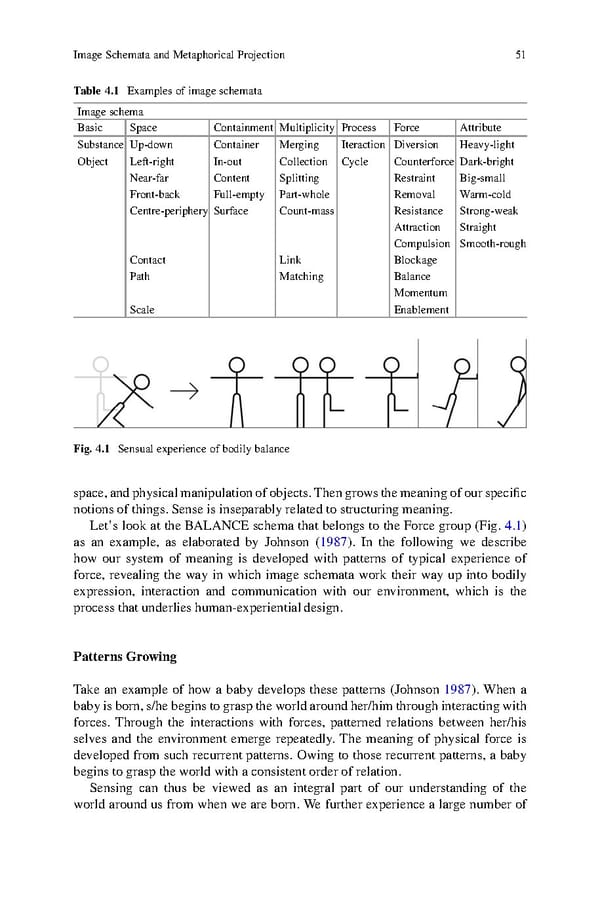
Image Schemata and Metaphorical Projection 51 Table 4.1 Examples of image schemata Image schema Basic Space Containment Multiplicity Process Force Attribute Substance Up-down Container Merging Iteraction Diversion Heavy-light Object Left-right In-out Collection Cycle Counterforce Dark-bright Near-far Content Splitting Restraint Big-small Front-back Full-empty Part-whole Removal Warm-cold Centre-periphery Surface Count-mass Resistance Strong-weak Attraction Straight Compulsion Smooth-rough Contact Link Blockage Path Matching Balance Momentum Scale Enablement Fig. 4.1 Sensual experience of bodily balance space,andphysicalmanipulationofobjects.Thengrowsthemeaningofourspecific notions of things. Sense is inseparably related to structuring meaning. Let’s look at the BALANCE schema that belongs to the Force group (Fig. 4.1) as an example, as elaborated by Johnson (1987). In the following we describe how our system of meaning is developed with patterns of typical experience of force, revealing the way in which image schemata work their way up into bodily expression, interaction and communication with our environment, which is the process that underlies human-experientialdesign. Patterns Growing Take an example of how a baby develops these patterns (Johnson 1987). When a babyisborn,s/hebeginstograsptheworldaroundher/himthroughinteractingwith forces. Through the interactions with forces, patterned relations between her/his selves and the environment emerge repeatedly. The meaning of physical force is developed from such recurrent patterns. Owing to those recurrent patterns, a baby begins to grasp the world with a consistent order of relation. Sensing can thus be viewed as an integral part of our understanding of the world around us from when we are born. We further experience a large number of
 Human Experiential Design of Presence in Everyday Page 59 Page 61