

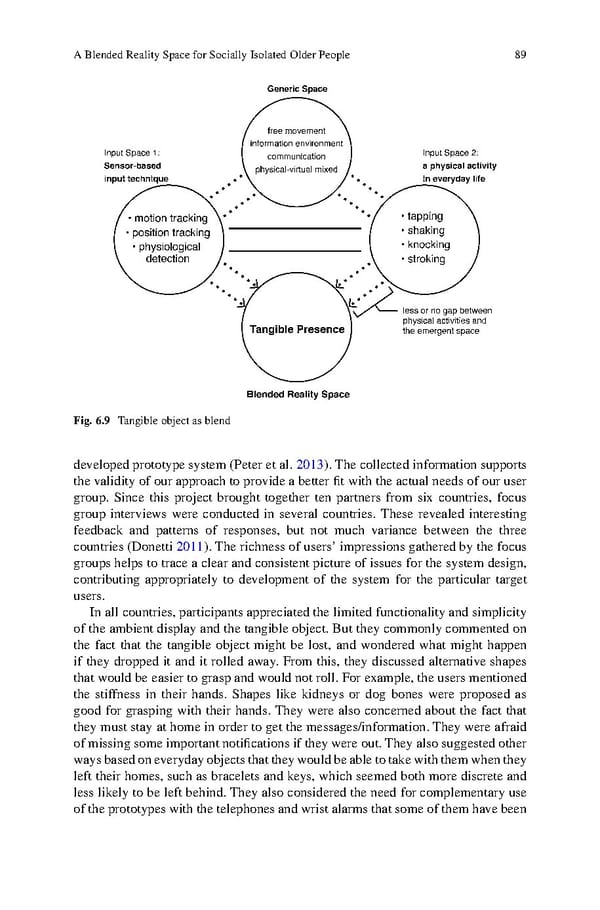
ABlendedRealitySpace for Socially Isolated Older People 89 Fig. 6.9 Tangible object as blend developed prototype system (Peter et al. 2013). The collected information supports the validity of our approach to provide a better fit with the actual needs of our user group. Since this project brought together ten partners from six countries, focus group interviews were conducted in several countries. These revealed interesting feedback and patterns of responses, but not much variance between the three countries (Donetti 2011). The richness of users’ impressions gathered by the focus groups helps to trace a clear and consistent picture of issues for the system design, contributing appropriately to development of the system for the particular target users. In all countries, participants appreciated the limited functionality and simplicity of the ambient display and the tangible object. But they commonly commented on the fact that the tangible object might be lost, and wondered what might happen if they dropped it and it rolled away. From this, they discussed alternative shapes that would be easier to grasp and would not roll. For example, the users mentioned the stiffness in their hands. Shapes like kidneys or dog bones were proposed as good for grasping with their hands. They were also concerned about the fact that they must stay at home in order to get the messages/information. They were afraid of missing some importantnotifications if they were out. They also suggested other waysbasedoneverydayobjectsthattheywouldbeabletotakewiththemwhenthey left their homes, such as bracelets and keys, which seemed both more discrete and less likely to be left behind. They also considered the need for complementary use of the prototypes with the telephones and wrist alarms that some of them have been
 Human Experiential Design of Presence in Everyday Page 95 Page 97