

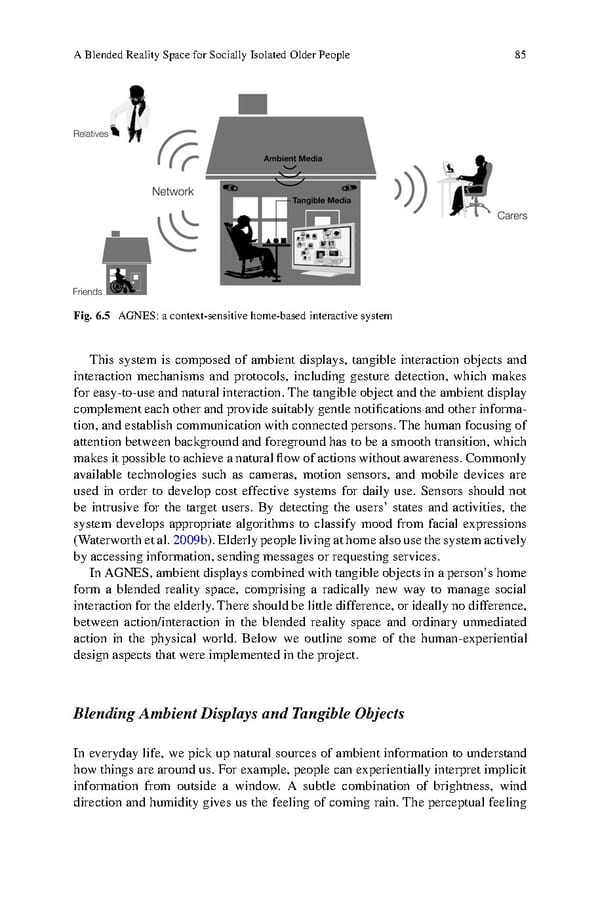
ABlendedRealitySpace for Socially Isolated Older People 85 Fig. 6.5 AGNES: a context-sensitive home-based interactive system This system is composed of ambient displays, tangible interaction objects and interaction mechanisms and protocols, including gesture detection, which makes for easy-to-use and natural interaction. The tangible object and the ambient display complementeachotherandprovidesuitablygentlenotificationsandotherinforma- tion, and establish communication with connected persons. The human focusing of attention between background and foreground has to be a smooth transition, which makesitpossibletoachieveanaturalflowofactionswithoutawareness.Commonly available technologies such as cameras, motion sensors, and mobile devices are used in order to develop cost effective systems for daily use. Sensors should not be intrusive for the target users. By detecting the users’ states and activities, the system develops appropriate algorithms to classify mood from facial expressions (Waterworthetal.2009b).Elderlypeoplelivingathomealsousethesystemactively byaccessinginformation,sending messages or requesting services. In AGNES,ambientdisplayscombinedwithtangibleobjectsin aperson’shome form a blended reality space, comprising a radically new way to manage social interaction for the elderly. There should be little difference, or ideally no difference, between action/interaction in the blended reality space and ordinary unmediated action in the physical world. Below we outline some of the human-experiential design aspects that were implemented in the project. Blending Ambient Displays and Tangible Objects In everyday life, we pick up natural sources of ambient information to understand howthings are around us. For example, people can experientially interpret implicit information from outside a window. A subtle combination of brightness, wind direction and humidity gives us the feeling of coming rain. The perceptual feeling
 Human Experiential Design of Presence in Everyday Page 91 Page 93