

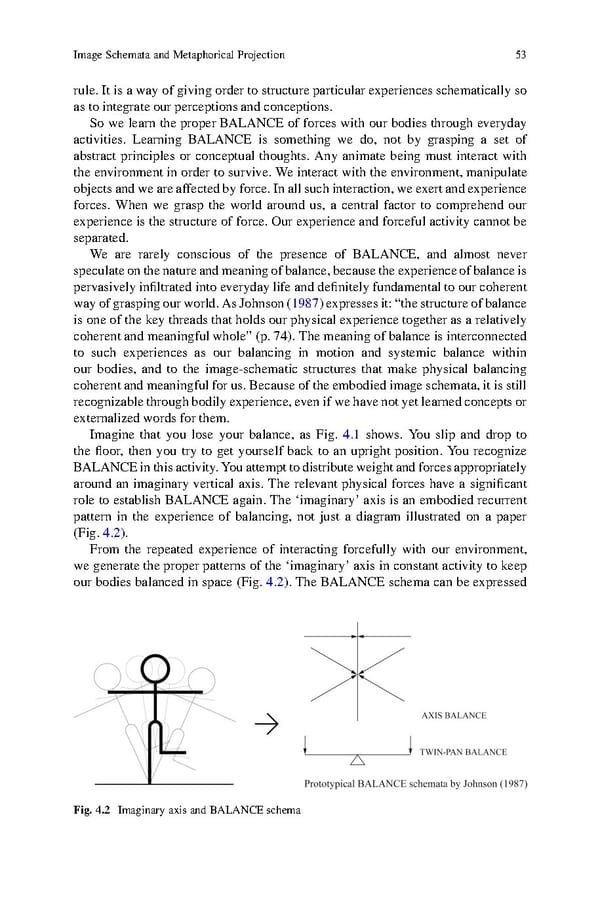
Image Schemata and Metaphorical Projection 53 rule. It is a way of giving order to structure particular experiences schematically so as to integrate our perceptions and conceptions. So we learn the proper BALANCE of forces with our bodies through everyday activities. Learning BALANCE is something we do, not by grasping a set of abstract principles or conceptual thoughts. Any animate being must interact with the environment in order to survive. We interact with the environment, manipulate objectsandweareaffectedbyforce.Inallsuchinteraction,weexertandexperience forces. When we grasp the world around us, a central factor to comprehend our experience is the structure of force. Our experience and forceful activity cannot be separated. We are rarely conscious of the presence of BALANCE, and almost never speculateonthenatureandmeaningofbalance,becausetheexperienceofbalanceis pervasively infiltrated into everyday life and definitely fundamental to our coherent wayofgraspingourworld.AsJohnson(1987)expressesit:“thestructureofbalance is one of the key threads that holds our physical experience together as a relatively coherent and meaningfulwhole” (p. 74). The meaning of balance is interconnected to such experiences as our balancing in motion and systemic balance within our bodies, and to the image-schematic structures that make physical balancing coherentandmeaningfulforus.Becauseoftheembodiedimageschemata,itisstill recognizablethroughbodilyexperience,evenif wehavenotyetlearnedconceptsor externalized words for them. Imagine that you lose your balance, as Fig. 4.1 shows. You slip and drop to the floor, then you try to get yourself back to an upright position. You recognize BALANCEinthisactivity.Youattempttodistributeweightandforcesappropriately around an imaginary vertical axis. The relevant physical forces have a significant role to establish BALANCE again. The ‘imaginary’ axis is an embodied recurrent pattern in the experience of balancing, not just a diagram illustrated on a paper (Fig. 4.2). From the repeated experience of interacting forcefully with our environment, wegenerate the proper patterns of the ‘imaginary’ axis in constant activity to keep our bodies balanced in space (Fig. 4.2). The BALANCE schema can be expressed Fig. 4.2 Imaginary axis and BALANCE schema
 Human Experiential Design of Presence in Everyday Page 61 Page 63