

Kohl's 2021 ESG Report
Environmental, Social & Governance Report 2021
Table of Contents 2021 ESG REPORT 03 Welcome / CEO Letter 04 Environmental, Social & Governance at Kohl’s 05 Environmental Sustainability 28 Diversity & Inclusion 42 Workplace Benefits & Our Commitment to Associates 47 Philanthropy 56 Social Supply Chain 68 Values, Ethics, Human Rights & Governance 72 Workforce Safety, Health & Well-Being 75 Product Safety 77 Cybersecurity & Privacy 79 Business Continuity, Crisis Management & Disaster Preparedness
Welcome Michelle Gass Chief Executive Officer 2021 ESG REPORT This past year, Kohl’s continued to make progress against our 2025 environmental goals, we continued to support communities nationwide with more than $30 million in resources and we made progress against our Diversity & Inclusion framework that we articulated in 2020. As the country continues to address racial inequities, we are committed to being part of making meaningful progress for more equitable actions and outcomes. While we know there is much more to do, we are driven by the progress we have made and the promise of more to come. As a purpose-led organization, ESG stewardship will continue to be an integral piece of Kohl’s culture and an important component of the company’s strategic vision to be the most trusted retailer of choice for the active and casual lifestyle. Sincerely, Dear Stakeholders, 2021 represented the second year in the global COVID-19 pandemic, which continued to act as a stark reminder of how dependent we are in collectively caring for each other and the planet we share. I continue to be so appreciative and impressed with how our associates and our company have managed through this ongoing pandemic to support our customers, our business and one another. Kohl’s has a long-standing commitment to being a responsible corporate citizen. We believe in supporting our associates, our customers and our communities through our environmental, social and governance (ESG) stewardship. I am proud that Kohl’s approaches our ESG efforts as both our responsibility and our privilege to be part of making a positive difference. As presented in this 2021 ESG report, we have continued to take meaningful steps to ensure Kohl’s leaves a smaller environmental footprint on the planet while also making a positive difference in the lives of families nationwide, including our Kohl’s associates, our valued customers and the community partners we are honored to serve. We remain committed to the highest standards of integrity and performance and are dedicated to fostering a best-in-class workplace that celebrates transparency, opportunity and appreciation. Michelle Gass, Chief Executive Officer 3
Environmental, Social & Governance at Kohl’s Our purpose — to inspire and empower families to lead fulfilled lives — guides how we work with partners, how we approach philanthropy, how we consider the environment, and how we touch the lives of our customers, associates and communities. These efforts extend to the Environmental, Social and Governance (ESG) areas of our business. ESG stewardship is a key component of our strategy and our vision: To be the most trusted retailer of choice for the active and casual lifestyle. We believe ESG stewardship is important to building a more-sustainable future for all and creating long-term shareholder value. Environmental, Social & Governance at Kohl’s 4 2021 ESG REPORT *This report has not been audited by a third party. To learn more about our commitment to the environment, our associates, customers, community, partners and shareholders, visit Corporate.Kohls.com . About this Report This report aims to share information with our partners, shareholders, customers and associates regarding our ESG progress. Our reporting is guided by frameworks such as industry-recognized standards and frameworks including the Sustainability Accounting Standards Board (SASB), the Task Force on Climate-related Financial Disclosures (TCFD), and the CDP Climate Disclosures.Please visit our Investor Relations website for more information about Kohl’s SASB Index or Kohl’s TCFD Report. Reporting Period This ESG report covers the fiscal year 2021 (January 31, 2021 to January 29, 2022) unless otherwise indicated. More Information For more information about our history, business, sales growth, stores and more, see our 2021 Fact Book at Corporate.Kohls.com .
Environmental Sustainability 2021 ESG REPORT
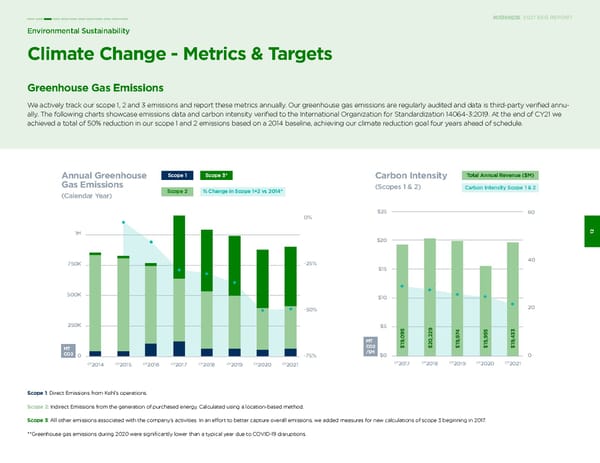
Board oversight of our ESG strategy is essential to sustain the long-term interests of all stakeholders. In 2021, we expanded the scope of responsibility of the Nominating and Governance Committee to include oversight of ESG matters, and the Committee was renamed the Nominating and ESG Committee. Additionally, beginning in 2020, we established criteria within our Chief Executive Officer’s performance evaluation objectives that are tied to our environmental performance, including promoting an effective sustainability agenda. As laid out in Kohl’s Environmental Policy , we are committed to incorporating environmentally responsible practices throughout our value chain. We also are committed to maintaining compliance with all applicable environmental laws and regulations, as well as consulting with stakeholders on environmental issues. Kohl’s has an Environmental, Health and Safety (EHS) Information Management System (IMS) for all stores and distribution centers. The EHS IMS records safety and environmental compliance data, training completion records and overall EHS performance, allowing us to monitor data and effectively manage inspections, upcoming permit expiration and create simple and actionable data representation in various formats. In partnership with Kohl’s environmental consultants, Kohl’s conducts quarterly reviews of the IMS and EHS data to ensure its continued suitability, adequacy and effectiveness. Reviews are conducted by a cross-functional team and cover audit results, communications, KPIs and progress against objectives and targets. Environmental Sustainability At Kohl’s, we believe that incorporating sustainable solutions in the way we do business will help to build better futures for families. With such a large retail footprint, we are in a unique position to make a positive impact on the planet, and have set environmental sustainability goals to ensure that impact is forward-looking. Our sustainability strategy is guided by leveraging business practices and decisions that enhance the objectives of the United Nations Sustainable Development Goals (SDG). Environmental Sustainability 6 2021 ESG REPORT
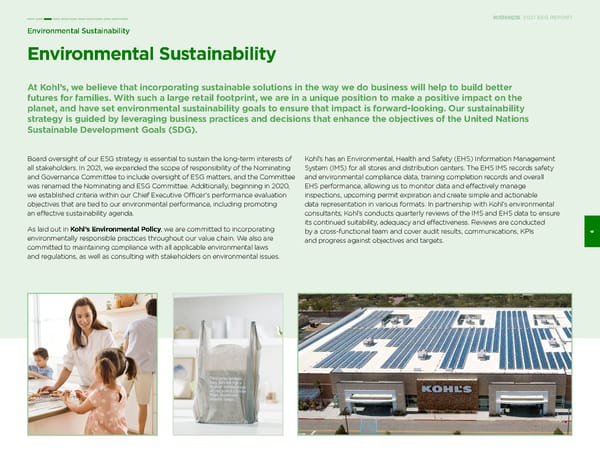
Achieve 100% sustainably sourced cotton for Kohl’s proprietary brands by 2025 24% of cotton was sustainably sourced Require 50% of polyester styles to contain recycled materials in Kohl’s proprietary brands by 2025 20% of styles contain recycled polyester Require all approved facilities producing Kohl’s private and exclusive branded products to complete the Higg Index Environmental Module by 2025 100% of approved facilities were required to complete the Higg Index Facility Environmental Module (FEM) in 2021, 80.5% of all approved facilities completed the Higg FEM Utilizing the Higg Index, drive substantial reduction in water use in the production of Kohl’s-owned branded products by 2025 Higg FEM 2020 performance analysis for water-intensive facilities revealed that our suppliers located in the most-water-stressed regions already have strong water management practices in place Kohl’s completed a water risk assessment using the World Resources Institute’s (WRI) Aqueduct Water Risk Atlas to map areas of water risks across our global supply chain Emphasize the elimination and reduction of chemicals and strive for zero discharge of hazardous chemicals in tier 1 suppliers for select Kohl’s proprietary brands Our Manufacturing Restricted Substance List (MRSL) is now aligned with the Zero Discharge of Hazardous Chemicals (ZDHC) MRSL 100% of our proprietary brand towels and sheets are MADE IN GREEN or STANDARD 100 by OEKO-TEX® Divert 85% of Kohl’s U.S. operational waste from landfills annually 86.5% of waste was diverted from landfills, CY2021 Label 100% of Kohl’s-owned branded packaging with the How2Recycle® label by 2025 95% of shipping bags and boxes 100% of in-store shopping bags 100% of private/exclusive shoeboxes Reduce the amount of plastic and cardboard in Kohl’s-owned branded packaging We continue to reduce the amount of packaging we use by enhancing our e-fulfillment technology Reduce combined scope 1 and scope 2 greenhouse gas emissions by 50% versus 2014 baseline by 2025 50% reduction in scope 1 and 2, CY2021 Reduce energy consumption by 30% at Kohl’s facilities by 2025 versus a 2008 baseline 29% reduction in energy consumption since 2008, CY2021 Expand renewable energy platforms by building off of the company’s existing 161 solar and wind locations. 165 solar and wind locations Support the transition to a low-carbon transportation system, building off of the company’s existing 96 locations offering electric vehicle (EV) charging 146 locations offered EV charging 2025 Goals and Progress In 2019, we set sustainability goals, including quantitative targets focused on three key areas: climate action, waste and recycling and sustainable sourcing. We are committed to monitoring and reporting performance and progress against these goals. Environmental Sustainability 7 2021 ESG REPORT Sustainable Sourcing Our sustainable sourcing goals for Kohl’s private brand products are focused on the efficient use of natural resources and environmentally sound management of chemicals. Waste and Recycling Our waste and recycling goals are focused on the management of all wastes, reducing waste generation and promoting relevant recycling information to customers. Climate Change Our climate action goals are focused on the reduction of greenhouse emissions and the increase of renewable energy use. Goal Progress *Goal progress is updated as of year-end FY2021 unless otherwise noted. Goal Progress Goal Progress
Awards and Partnerships We are proud to share the following awards and key partnerships, demonstrating our commitment to implementing our environmental ESG initiatives. We report emissions data and climate management strategies annually to the Climate Disclosure Project (CDP). We achieved a Leadership level A- for the second consecutive year on the 2021 Climate Change disclosure. We are honored to be recognized as a global leader in sustainability and were included in the 2021 S&P Global Sustainability Yearbook. The annual yearbook includes companies that rank in the top 15% of their industry for sustainability performance and environmental, social and governance (ESG) commitments as part of the S&P Corporate Sustainability Assessment. Kohl’s was named to the Dow Jones Sustainability Index (DJSI) North America listing for the fourth consecutive year (2018-2021), acknowledging the company’s sustainability performance and ESG commitments. The DJSI evaluates a company’s impact on people, communities and the planet for socially conscious investors. As part of the Science Based Targets initiative (SBTi), Kohl’s has committed to align its GHG reduction targets with SBTi’s target-setting criteria, climate science and the core commitment of the Paris Agreement. We are proud to announce that we have joined the U.S. Department of Energy’s Better Climate Challenge, committing to reduce our Scope 1 and 2 greenhouse gas emissions. As a partner in the U.S. Department of Energy’s Better Buildings Challenge, we reached our goal of 20% energy reduction by 2020 two years early. Kohl’s has now set its sights higher with a new goal to cut energy by an additional 10% by 2025. We have been an active member of the EPA’s Green Power Partnership since 2006 and have been named on EPA’s Green Power Top 30 Retail list since 2014. We are proud to be ranked as one of the Top 25 Corporate Users by Solar Energy Industries Association® (SEIA) for our continued prioritization of on-site solar installations. As an EPA ENERGY STAR® partner since 1998, we were selected as a 2021 ENERGY STAR® Partner of the Year winner for Sustained Excellence, an honor reserved for partners demonstrating outstanding leadership year over year. As a shipping partner, we were recognized on the EPA SmartWay® 2021 High Performer List as an industry leader in the environmental and energy performance of our freight supply chain. In 2021, we were honored with the EPA WasteWise Regional award for excellence in waste management. We have been a voluntary partner and active participant of the EPA’s WasteWise program since 2006. We are one of the founding members of the Sustainable Apparel Coalition (SAC) and maintain an active membership. The coalition works together to standardize sustainability measures in the apparel, home and footwear supply chain. The Higg Index is a suite of tools that measures several environmental and social impacts, delivering a holistic overview of supply chain factory compliance and sustainability performance. We use it to make more-sustainable choices when it comes to supply chain and facility performance. We actively serve on the advisory board of the Wisconsin Sustainable Business Council (WSBC) and received the Green Masters Award in 2021 for our performance across multiple initiatives. We became an active member of the How2Recycle® label program in 2019. How2Recycle® is a standardized labeling system that clearly communicates recycling instructions to the public. Environmental Sustainability 8 2021 ESG REPORT
Leadership Level CDP Ranking Since 2007, we have disclosed emissions data to CDP. Our CDP Climate Change response includes detailed information on our strategy and performance, enabling us to measure and manage our environmental impacts. As a result of our continuing efforts, we were awarded CDP’s A- ranking in 2021. This is the third consecutive year we have been recognized at the CDP’s Leadership Level, demonstrating a significant acknowledgment of our continued commitment to climate action. Task Force on Climate-Related Financial Disclosures (TCFD) Beginning in 2021, Kohl's climate-related disclosures are guided by using the TCFD framework. We plan to leverage the TCFD framework and recommendations as we continue our commitment to managing climate-related issues. Board Oversight Our governance practices form the foundation for how we manage risk, ensure accountability, and provide transparency to our stakeholders. The Nominating and ESG Committee of Kohl’s Board of Directors actively oversees our ESG initiatives to understand both risks and growth opportunities, as well as progress made against the company’s goals. To that end, the Nominating and ESG Committee receives regular updates on ESG topics from management and provides reports to the full Board of Directors. In this way, Kohl’s Board of Directors plays a vital role in shaping and supporting our long-term ESG strategies while addressing the Board’s oversight responsibilities related to the management and performance of ESG issues, all of which is essential to sustain the long-term interest of all stakeholders. Climate Change As a leader in the retail sector, we are committed to managing climate risks and taking action. We demonstrated our support for action on climate change and for The Paris Agreement by signing the American Business Act Pledge on Climate Change in 2015. Additionally, Kohl’s is committed to reducing our carbon footprint to reach net zero by 2050. By investing in renewables and LED lighting, creating sustainable business practices, and ofiering low-carbon transportation options, Kohl’s is focused on reducing emissions. View Kohl’s TCFD Report here . Environmental Sustainability 9 2021 ESG REPORT Management Role The Chief Risk and Compliance Officer has ultimate responsibility for overseeing our climate strategy. As part of the Risk Reduction Committee, the CRCO is responsible for assessing and managing climate risks and opportunities. Our Risk Reduction Committee allows for collaboration across key departments and includes members of the executive team. The committee has climate-related responsibilities, including assessing and managing risks and opportunities, and reports to the full Board on priority risks. The Committee’s input on climate-related issues provides key support to the Board. Climate-Related Risks Risks related to the transition to a lower-carbon economy include carbon pricing along with heightened policies and legislation for emission reporting. In addition to these transition risks, we also see firsthand how physical risks related to climate change affect our business. Unusual and potentially long-term shifts in climate patterns such as rising temperatures, storm intensity and rising sea levels can shift consumer shopping patterns and cause physical damage to our properties as well as to the communities we operate in.
Climate Change For more, visit the Business Continuity , Crisis Management & Disaster Preparedness section of this report. Business Continuity We have a business continuity team dedicated to supporting the well-being of associates and customers in times of natural disaster, crisis and unplanned incidents. To navigate through the incident management lifecycle, the team ensures preparedness, supports impacted locations, leads cross-functional exchanges of information and suggests actions to mitigate risk across the business. Environmental Sustainability 10 2021 ESG REPORT Climate Risk Management We integrate climate-related issues into our annual risk assessments, ensuring that climate risks are incorporated into our overall business strategy, providing flexibility to react quickly to address and manage current or emerging risks. Climate-related risks and opportunities are identified through known industry-specific risks, monitoring the regulatory environment, macro as well as brand and reputation considerations. Identified risks are assessed based on type as well as the potential cost of the impact. The ERM establishes a procedure and protocol for any financially material risks, and action plans to mitigate risks are developed and deployed via individual risk owners. We leverage a number of different means to monitor and manage our environmental risks, strategies and target progress. Kohl’s Risk Reduction Committee owns our robust Enterprise Risk Management (ERM) program, which is designed to prioritize and monitor progress in managing potential impacts of regulatory, operational, financial and reputational risks across the organization.
GOAL Reduce combined scope 1 and scope 2 greenhouse gas emissions by 50% versus 2014 baseline by 2025. Climate Change - Metrics & Targets Kohl’s climate action goals are focused on the reduction of greenhouse gas emissions and increase of renewable energy use. We are committed to reducing our combined scope 1 and 2 greenhouse gas emissions by 50% versus a 2014 baseline by 2025. Science Based Target Initiative (SBTi) In July 2021, we strengthened our climate leadership by joining the Science Based Targets initiative. Through SBTi, we have committed to align our greenhouse gas reduction targets with climate science and the core commitment of the Paris Agreement. Since 2007, we have set emissions goals through our CDP reporting and in 2019 we announced our goals publicly. Over the next two years, we will work with SBTi to set our new science-based emissions reduction targets. Environmental Sustainability 11 2021 ESG REPORT Better Climate Challenge Partner In November 2021, we were one of the first companies to join the U.S. Department of Energy’s Better Climate Challenge, strengthening our commitment to reduce our greenhouse gas emissions. As a partner in the challenge, we plan to share our carbon reduction progress and strategies to help other organizations build on our success.
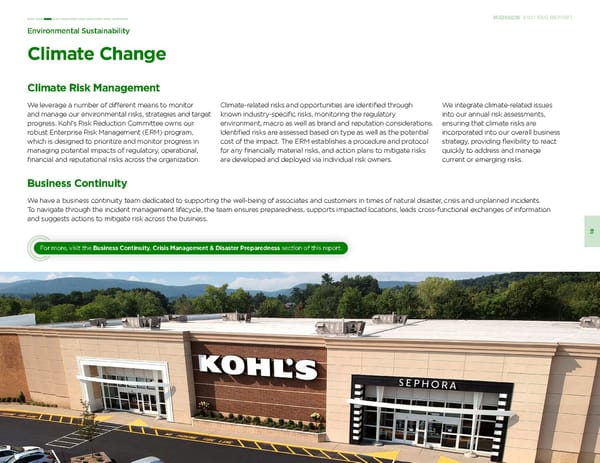
1M 750K 500K 250K 0 MT CO2 0% -25% -50% -75% CY 2014 CY 2015 CY 2016 CY 2017 CY 2018 CY 2019 CY 2020 CY 2021 Greenhouse Gas Emissions We actively track our scope 1, 2 and 3 emissions and report these metrics annually. Our greenhouse gas emissions are regularly audited and data is third-party verified annu- ally. The following charts showcase emissions data and carbon intensity verified to the International Organization for Standardization 14064-3:2019. At the end of CY21 we achieved a total of 50% reduction in our scope 1 and 2 emissions based on a 2014 baseline, achieving our climate reduction goal four years ahead of schedule. Environmental Sustainability 12 2021 ESG REPORT Scope 1 : Direct Emissions from Kohl’s operations. Scope 2 : Indirect Emissions from the generation of purchased energy. Calculated using a location-based method. Scope 3 : All other emissions associated with the company’s activities. In an effort to better capture overall emissions, we added measures for new calculations of scope 3 beginning in 2017. **Greenhouse gas emissions during 2020 were significantly lower than a typical year due to COVID-19 disruptions. Climate Change - Metrics & Targets Annual Greenhouse Gas Emissions (Calendar Year) Scope 1 Scope 2 Scope 3* % Change in Scope 1+2 vs 2014* $25 $20 $15 $10 $5 $0 60 40 20 0 MT CO2 /$M $19,095 $19,974 $15,955 $19,433 $20,229 CY 2017 CY 2018 CY 2019 CY 2020 CY 2021 Total Annual Revenue ($M) Carbon Intensity Scope 1 & 2 Carbon Intensity (Scopes 1 & 2)
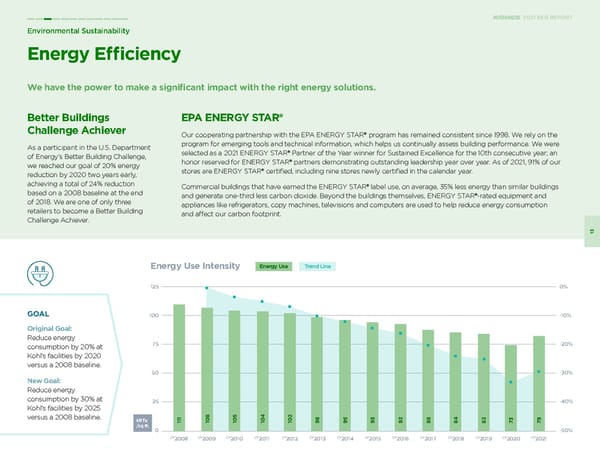
EPA ENERGY STAR® Energy Efficiency We have the power to make a significant impact with the right energy solutions. Better Buildings Challenge Achiever As a participant in the U.S. Department of Energy’s Better Building Challenge, we reached our goal of 20% energy reduction by 2020 two years early, achieving a total of 24% reduction based on a 2008 baseline at the end of 2018. We are one of only three retailers to become a Better Building Challenge Achiever. Our cooperating partnership with the EPA ENERGY STAR® program has remained consistent since 1998. We rely on the program for emerging tools and technical information, which helps us continually assess building performance. We were selected as a 2021 ENERGY STAR® Partner of the Year winner for Sustained Excellence for the 10th consecutive year; an honor reserved for ENERGY STAR® partners demonstrating outstanding leadership year over year. As of 2021, 91% of our stores are ENERGY STAR® certified, including nine stores newly certified in the calendar year. Commercial buildings that have earned the ENERGY STAR® label use, on average, 35% less energy than similar buildings and generate one-third less carbon dioxide. Beyond the buildings themselves, ENERGY STAR®-rated equipment and appliances like refrigerators, copy machines, televisions and computers are used to help reduce energy consumption and affect our carbon footprint. Environmental Sustainability 13 2021 ESG REPORT GOAL Original Goal: Reduce energy consumption by 20% at Kohl’s facilities by 2020 versus a 2008 baseline. New Goal: Reduce energy consumption by 30% at Kohl’s facilities by 2025 versus a 2008 baseline. Energy Use Intensity Energy Use Trend Line 111 105 104 102 98 95 93 92 88 84 82 108 kBTu /sq ft. 125 100 75 50 25 0 73 79 CY 2008 CY 2009 CY 2010 CY 2011 CY 2012 CY 2013 CY 2014 CY 2015 CY 2016 CY 2017 CY 2018 CY 2019 CY 2020 CY 2021 0% -10% -20% -30% -40% -50%
Lighting and Heating, Ventilation and Air Conditioning (HVAC) Upgrades To further increase energy efficiency at all stores, we installed central energy management systems that operate most of the interior and exterior lighting and heating and cooling systems. Light-emitting diode (LED) fixtures light the way at many of our locations. We continue to retrofit stores with high-efficiency lighting to reduce emissions and save electricity. In 2021, we completed 130 LED retrofits, which will save more than 42 million kilowatt-hours (kWh) per year. In our ongoing commitment to energy efficiency, Kohl’s is ramping up deployment of LED lighting across our fleet. By the end of 2025, we will have LED lighting installed at all of our properties. To date, 63% of our stores have received LED retrofits across the majority of their floor plans. Additionally, 71 stores received an HVAC system replacement for optimum efficiency. Leadership in Energy and Environmental Design™ (LEED®) We use the Leadership in Energy and Environmental Design (LEED) green building program rating systems to guide the design, construction and operation of our stores. Commercial buildings that are LEED certified use, on average, 25% less energy than similar buildings and generate one-third less carbon dioxide emissions. We continue to emphasize LEED, where appropriate, and our portfolio stands as a testament to the steps we have taken to reduce our environmental impact and provide customers with a positive and healthy shopping environment. Our certified buildings meet LEED criteria because of our investment in the following aspects of design and construction: Building Materials - Low Volatile Organic Compound (VOC) materials such as wall coverings, carpet and ceiling tiles are used in the interior. We also employ the use of pre- and post-recycled content throughout our buildings. Heat Island Effect - Reflective roofing material is often used to reduce the “heat island effect” that occurs when air and surface temperatures rise. These materials contribute to lowering a building’s energy demands. Environmental Sustainability 14 2021 ESG REPORT Energy Efficiency
Additionally, there are two wind turbines installed at our Findlay, Ohio distribution center. The solar trees and wind turbines are a visible statement of our commitment to energy efficiency. In 2007, Kohl’s started out with about 38,000 solar panels on the rooftops of 19 California stores. We currently host 162 rooftop solar arrays around the country, totaling more than 200,000 solar panels, including three large solar trees at Kohl’s corporate headquarters. This year, Kohl’s is launching a program to equip 15 of our rooftops across Arizona and Illinois with solar arrays within the next year. The 15 new projects will increase Kohl’s Installed Solar Capacity by 10.4%, to a total of 56.97 MW. The company is also contracting to support the development of 23.4 MW of community solar projects across New York in 2022. Renewable Energy Credits (RECs) We also maintain a commitment to renewable energy use through the purchase and production of renewable energy credits (RECs). In 2021, we secured RECs totaling approximately 85,278 megawatt-hours (MWh), including 24,278 MWh from our on-site solar arrays, where we retain or own the RECs. These RECs resulted in the offset of 28,212 metric tons of carbon. Environmental Sustainability 15 2021 ESG REPORT Renewable Energy With over 50 megawatts (MW) of solar energy installed, we are among the leading retailers increasingly turning to solar to power operations. GOAL Expand renewable energy platforms by building off the company’s existing 161 solar and wind locations. Using renewable clean energy mitigates risks to the planet and our communities while conserving natural resources. We continue to explore renewable energy projects both on and off-site. EPA Green Power Partner Illustrating our commitment to leveraging renewable energy resources and technologies that provide the highest environmental benefit, we have been an active member of EPA’s Green Power Partnership since 2006 and have been named on EPA’s Green Power Top 30 Retail list since 2014. We are also proud to be ranked as one of the Top 25 Corporate Users by Solar Energy Industries Association® (SEIA) for our continued prioritization of onsite solar installations. Solar and Wind In 2021, an estimated 58,732 megawatt-hours (MWh) of solar energy was used, meaning more than 6% of the electricity we used to power our business came from renewable sources. Many of our stores get up to 50% of their energy from solar. We currently host 164 solar arrays around the country, totaling more than 200,000 solar panels and nine solar trees. Solar trees are designed to track the sun and rotate throughout the day, allowing each solar tree to potentially generate between 25-35 megawatt-hours of power annually. They are equipped with EV charging stations, and one solar tree can generate enough power to charge six electric vehicles daily. Each solar tree shades six parking spaces, providing shade-cooled parking spots for associates and guests. IN 2021, AN ESTIMATED 58,732 MWH OF SOLAR ENERGY WAS USED.
Kohl’s is committed to accelerating the adoption of electric vehicles by expanding charging networks. At the end of FY2021, we had more than 325 electric vehicle charging spots spread across 146 locations. These stations provide more than 105,000 charging sessions per year to our customers and associates. By maintaining our solidarity with electric vehicle owners, the charging we provide powers nearly 809,000 miles of driving and saves more than 36,000 gallons of gasoline annually. As we work to reduce our environmental footprint, we want to enable our customers to do the same. Environmental Sustainability 2021 ESG REPORT 16 325+ ELECTRIC VEHICLE CHARGING SPOTS 105,000+ CHARGING SESSIONS POWERED NEARLY 809,000 MILES OF DRIVING MORE THAN 36,000 GALLONS OF GAS SAVED GOAL Support the transition to a low-carbon transportation system, building off of the company’s existing 96 locations offering electric vehicle charging. Electric Vehicle Charging
Logistics Environmental Sustainability 17 2021 ESG REPORT Kohl’s Fleet Our fleet is managed by vendor partners who are held to high standards through vetting and studying their sustainable practices. To cut down on vehicle emissions, we continually work to improve the environmental performance of our fleet. By saving miles, reducing packaging, and being ultra-efficient with the way we supply our stores, we strive to contribute to a more sustainable future. Providing families with the products they love requires a complex network of shipping logistics. The global supply chain network is also an opportunity to work toward sustainable outcomes and continue to build upon our environmental performance.
Environmental Sustainability 18 2021 ESG REPORT Logistics EPA SmartWay® Shipper Partner We are a shipper partner of the U.S. EPA SmartWay® Transport Program. SmartWay® Partners share a vision to move materials, supplies and goods in ways that protect the environment, enhance our nation’s energy security and foster economic vitality. EPA’s SmartWay® membership is both sought after and encouraged for all vendors. In 2021, 100% of our domestic miles were with SmartWay® members. Our transportation data is constantly analyzed to uncover heightened efficiencies while reporting back to the EPA. SmartWay® tools are used to measure our emissions footprint and find ways to reduce fuel costs. EPA SmartWay® High Performer List We are proud to have been recognized for these efforts on the SmartWay® 2021 High Performer List as an industry leader in the environmental and energy performance of our freight supply chain. Receiving this distinction places Kohl’s among the top 5% of all SmartWay shipper partners. Our exceptional performance moving goods in the cleanest and most energy-efficient way possible ultimately leads to cleaner and healthier communities. Mile & Weight Improvement Activities Backhaul Program Utilization of inbound trailers to support freight return loads from stores improves route optimization and reduces empty miles from our system. We also ensure store teams properly load backhaul trailers to maximize space. Drop-and-Hook Idle time for trucks is drastically reduced by utilizing drop-and-hook methods at the origin and destination of shipments. Our fleet is nearly 100% drop-and-hook at store destinations. California Air Resources Board Our California fleet is compliant with California Air Resources Board, all tires are low-rolling resistant and all required trailers have airfoils installed in the undercarriage. Rail We also rely heavily on rail transport. Current rail usage stands at nearly 38% of truckload freight. On average, rail produces 75% fewer carbon emissions than an average truckload delivery. Future Fleet Emerging technologies will make future fleets more efficient. Already, several of our carriers have placed orders for hydrogen fuel cell trucks, electric trucks and high-performance diesel trucks. The proliferation of airfoils, trailer skirting, rear foils, cab air flow diverters and wheel covers are making our fleet more efficient every day.
Environmental Sustainability 19 2021 ESG REPORT Logistics - Shipping Partners We are proud to partner with carrier brands that actively promote sustainability efforts and that volunteer for membership in associations whose missions reflect the care we have toward the environment. International Carriers Our ocean carriers are engaged through membership in the Business for Social Responsibility (BSR) Clean Cargo Working Group. More than 97% of our cargo travels on a BSR ship providing up-to-date emissions data in order to gain a deeper understanding of our supply chain footprint. Our carriers belong to environmental programs that benchmark sustainability goals. Expeditors Expeditors are a group of carriers who share a concern for transparency, freight transportation efficiency and the mitigation of harmful greenhouse gasses from our business. This group belongs to SmartWay®, Transporte, Limpio, Clean Cargo Working Group and Washington Business for Climate Action. Evergreen Evergreen Marine Corp. launched green bonds to raise capital for green initiatives. These bonds will fund improved energy efficiencies, preventing and controlling pollution and sustainable environmental development for all its operations. Orient Overseas Container Line Orient Overseas Container Line (OOCL) provides an online carbon calculator to assist us in measuring carbon dioxide emissions. “GIGA Class” vessels on this line consume less energy and achieve the best Energy Efficiency Design Index (EEDI) values, which are 48% better than the EEDI baseline requirement set by the International Maritime Bureau. OOCL maintains membership in the World Wildlife Fund, Climate Change Business Forum and Clean Cargo Working Group, which were all voluntarily joined. They also hold Qualship 21 certification from the U.S. Coast Guard, which promotes the most rigid safety and environmental standards in the world for non-U.S. flagged vessels.
Environmental Sustainability 20 2021 ESG REPORT Waste Management We are committed to the management of all waste, reducing waste generation and promoting relevant recycling information to customers and associates. GOAL Divert 85% of our U.S. operational waste from landfills annually. EPA WasteWise Since 2006, we have been a voluntary partner and active participant in the United States Environmental Protection Agency’s WasteWise program. WasteWise program, which helps businesses apply sustainable materials management practices. We are a recognized leader in waste management, and we were honored with the EPA WasteWise 2020 National and 2021 Regional awards for preventing waste and promoting recycling to achieve both environmental and economic benefits. Solid Waste Our solid waste management policy governs how we manage waste and recycling in stores and at our corporate facilities. The separation of cardboard, paper and plastic is a key companywide practice,and our goal when disposing of consumables and durable goods is to recycle as much material as possible. Auto-Haul Program In 2015, we began testing an auto-haul program, pre-scheduled cardboard and trash compactor pickups, in more than 100 high-volume stores. The program reduces instances of cardboard compactors becoming full, leading to cardboard being thrown into the trash. This reduction increases recycling and lowers expenses. Due to successful results, the test was expanded to more than 650 stores in 2019, and we implemented an all-store rollout in 2020, with 93% of our stores now on the auto-haul program. Regulated Waste Our regulated materials management program ensures our stores, distribution centers, e-fulfillment centers and corporate offices utilize authorized and compliant disposal and recycling methods which helps provide a safe and healthy environment for our customers and associates. Kohl’s requires our waste disposal vendors to comply with applicable laws and maintain industry standards in the treatment, disposal or repurposing of all hazardous and non-hazardous waste to ensure that they properly manage environmental risks. Every Kohl’s location has an area dedicated to properly handling regulated materials like cleaning chemicals, batteries, light bulbs, aerosol cans, paints and sharps. Additionally, select categories of unsalable beauty products are diverted from landfills and repurposed into paints, floor cleaners and deodorizing sprays. 19,328 110,489 85% 18,266 117,616 87% 34,101 167,233 83% 27,736 132,787 83% 27,135 141,632 84% CY 2017 CY 2018 CY 2019 CY 2020 CY 2021 Tons Recycled Diversion Rate Tons Landfilled Diversion Rate Percent of waste diverted from landfills per calendar year:
Plastic Bags In 2021, we recycled more than 5 million pounds of plastic film, bags and wrap. When a customer leaves our store, the plastic bags they’re holding are made from 30-50% recycled, unbleached plastic. Customers can also drop plastic bags in the in-store recycling bins and leave their hangers with us to reuse and recycle. Paper Bags Stores in select markets have eliminated the use of plastic bags at checkout and now offer paper bags. While our plastic bags are fully recyclable through our store take-back program, paper bags can be recycled in customers’ curbside bins. Customers can find out how to recycle their bags by referencing the How2Recycle® label on each of our bags. Reusable Bags In 2020, we made it even easier for customers to cut back on their plastic waste by offering reusable bags for sale in all stores. Our reusable bags will be updated quarterly with new prints to excite and engage our customers into becoming more sustainable. Gift Cards We are currently exploring the elimination of plastic gift cards and moving toward paper gift cards. With paper being recyclable, this could eliminate more than 20 tons of plastic from landfills. Our e-gift cards are also a convenient zero-waste option for customers. Fabric Scraps The business of influencing fashion yields thousands of fabric scraps. Associates in fabric cutting locations are sorting scraps and recycling them. Depending on the scrap size and design print, material is reused or turned into things like building or automobile insulation. Paperless Options We also reduce waste by reminding Kohl’s Card holders they can opt for paperless billing. Since 2014, we have issued more than 350 million electronic credit card statements. More than one-third of all cardholders now receive their statements electronically. Additionally, all customers can opt in to receive e-receipts when they shop in store. Plastic & Paper Waste Management Our associates and customers play a key role as we work to increase our diversion rate. We ensure teams are equipped to take action with training opportunities, regular and strategic communication on our recycling commitments and rewards for high-performing locations. Our customers are provided with recycling resources in our stores and can opt for paperless receipts and credit statements. We are constantly exploring ways to eliminate waste and empower our associates and customers to recycle. Environmental Sustainability 2021 ESG REPORT 21
How2Recycle® As an active member of How2Recycle®, we empower our customers to recycle our packaging correctly. How2Recycle® provides a standardized labeling system that communicates recycling instructions on packaging where space allows. Environmental Sustainability 22 2021 ESG REPORT Packaging GOAL Reduce the amount of plastic and cardboard in Kohl’s-owned branded packaging. Label 100% of Kohl’s-owned branded packaging with the How2Recycle® label by 2025. Product packaging can have a significant impact on the environment and we are committed to taking steps to reduce our impact. Starting at the design stage, we consider the entire lifecycle of a package and are mindful to incorporate sustainable solutions. During development, we strongly encourage our suppliers to offer certified, recycled, recyclable, or reusable materials. Shipping Packaging Our merchant and logistics teams are working to reduce the amount of packaging used for product shipments to our customers, stores and distribution centers. New technology at select e-fulfillment centers allows us to right-size a shipping package by automatically trimming it to fit the merchandise. The trimmed pieces are then recycled into future packaging. Additionally, since 2011, Kohl’s has transitioned to only using green air pillows which break down faster in a landfill than traditional air pillows. These efforts also help control costs by reducing packaging materials and requiring less handling during the shipping process. Branded Apparel Packaging and Labels Since 2019, Kohl’s has been focused on reducing branded apparel packaging and labels by eliminating duplicative elements, evaluating size and paperweight and transitioning toward the use of certified paper for private and exclusive brands. Nearly 100% of our estimated 3 million pounds of branded apparel packaging paper has been converted to FSC-certified paper. We continue to convert materials by sourcing certified and recyclable solutions with the goal of converting all branded apparel product packaging and labels by 2025. Molded plastics are in progress of being converted to recycled content, and woven and printed labels on garments are on track to be reduced and converted to certified recycled content by the end of 2022.
Better Buildings Water Savings Network As a U.S. Department of Energy Better Buildings Water Savings Network Partner, we strive to decrease our portfolio-wide source water use intensity (WUI) and to increase the percent improvement compared to a set baseline. Since 2010, we have improved our water performance by 13% across our portfolio. Environmental Sustainability 23 2021 ESG REPORT Water Management Water Stewardship Water is a precious resource and our stores are designed to manage it accordingly. Existing stores have low-flow faucets and new stores have low-flow toilets. Together, these measures help reduce indoor water usage at locations throughout the country. Smart irrigation controllers that use live weather data to adjust outdoor water usage has lowered irrigation water use. Water Use Intensity *Water consumption during 2020 was significantly lower than a typical year since COVID-19 disruptions resulted in temporary building closures and reduced occupancy for much of the year. 10 8 6 4 2 0 Gal / Sq ft CY 2010 CY 2011 CY 2012 CY 2013 CY 2014 CY 2015 CY 2016 CY 2017 CY 2018 CY 2019 CY 2020 CY 2021 50% 0% -50% -100% Water Use Intensity % Change vs 2010
Environmental Sustainability 24 2021 ESG REPORT Sustainable Sourcing We’re working to make Kohl’s proprietary-branded products more sustainably sourced. Environmental Impacts on our Supply Chain Supply chain operations can have an impact on the environment through energy and water consumption, carbon emissions, wastewater, chemical use and waste disposal. If the environmental impacts of our supply chain are left unmanaged, they could pose both financial and reputational risks. In an effort to make meaningful improvements and more sustainable choices when it comes to protecting the well-being of factory workers, local communities and the environment, we use the Higg Index. GOAL Require all approved facilities producing Kohl’s private-and exclusive-branded product to complete the Higg Index Facility Environmental Module by 2025. Utilizing the Higg Index, drive substantial water-use reduction in the production of Kohl’s-owned branded products by 2025. Type of supplier Percentage that have completed the Higg FEM Percentage in compliance with wastewater discharge permits and/or contractual agreement Tier 1 89% 98.9% Beyond Tier 1 61% 99.3% Sustainable Apparel Coalition (SAC) The complex nature of global supply chain issues requires collaboration among many stakeholders. We are committed to consulting with stakeholders on environmental issues within our supply chain. We are one of the founding members of the Sustainable Apparel Coalition (SAC) and maintain an active membership. The SAC is a group of apparel manufacturers, retailers, brands and nongovernment organizations working together to standardize supply chain sustainability measures. Higg Index The Higg Index is a suite of tools that accurately measures several environmental and social impacts, delivering a holistic overview of supply chain factory compliance and sustainability performance. We require all approved facilities producing private- and exclusive-branded products to complete the Higg Facility Environmental Module (FEM). The Higg FEM assesses energy use, greenhouse gas and air emissions, water use, wastewater, waste management, environmental management systems and chemical management. In addition, our strategic suppliers are required to complete the Higg Verified Facility Environmental Module (VFEM) as well as the Higg Facility Social and Labor Module (FSLM). For more information on our environmental supply chain programs, please see the Social Supply Chain section of this report.
Environmental Sustainability 25 2021 ESG REPORT Chemical Management Our chemical management strategy actively works to identify, prevent, eliminate and reduce the use of certain chemicals in Kohl’s proprietary brand products. Kohl’s is committed to meeting and striving to exceed industry standards of chemical management across our teams, our vendors and our facilities by continuing to advance our restricted substances standards and specifications. We continuously seek solutions to reduce the use of chemicals in our products, work to eliminate chemicals of concern, and improve chemical management in our operations. We strive to increase transparency to chemicals contained in or used to make the products we sell at Kohl’s. Our Chemical Management Policy , Restricted Substance List (RSL) and the ZDHC Manufacturing Restricted Substances List (MRSL) apply to all textile and footwear raw materials and related finished products we sell within our proprietary brands. Chemical Management Strategy Kohl’s maintains a public Restricted Substance List (RSL) that limits or prohibits the presence of 122 chemicals within products manufactured for and sold to Kohl’s. Kohl’s RSL is in addition to, not in lieu of, all applicable laws. In some cases, we have chosen to set standards and specifications that are stricter than what is required around the use of formaldehyde and flame retardants. Beginning in 2021, Kohl’s became a participating Friend of the Zero Discharge of Hazardous Chemicals Foundation (ZDHC). ZDHC is the industry leader in Manufacturing Restricted Substances List (MRSL) management. In addition to our RSL, we are requiring that each of our suppliers adhere to the ZDHC MRSL 2.0 , which limits or prohibits the use of more than 220 chemicals in the manufacturing process of products. Safer Chemical Alternatives & Third Party Standards We are committed to working with our vendors and facilities to ensure the products we sell and use are safe and healthy for our customers and the environment. We expect our vendors to be constantly in search of safer chemical alternatives to achieve our RSL/MRSL requirements. Our vendors and suppliers are required to undergo third-party testing to ensure all products are produced, processed, manufactured and tested in full compliance with all applicable laws as well as any standards and specifications set by Kohl’s. As a pillar of our chemical management strategy, we have partnered with several third parties, including OEKO-TEX and Global Organic Textile Standard (GOTS), to provide certifications for several products within our private and exclusive brands in support of our chemical management goals. These certifications are communicated on product packaging as well as at Kohls.com in the product details section. Learn more about these certifications on our corporate website .
Environmental Sustainability 26 2021 ESG REPORT Chemical Management Clean at Sephora In 2020, Kohl’s and Sephora announced their long-term strategic partnership. Sephora at Kohl’s is a fully immersive, premium beauty destination. Sephora has a robust chemicals policy for its private-label products and since 2019 has been taking significant steps forward in addressing chemicals of high concern (CHCs) in branded products it sells. Its voluntary but growing Clean at Sephora program provides a particularly transparent and comprehensive approach. Sephora has shown significant progress in eliminating CHCs from products it sells and outlined significant efforts to help ensure CHCs are replaced with safer alternatives. Supplier Disclosure & Accountability We monitor suppliers’ environmental impacts through the Higg Facility Environmental Module (Higg FEM). All approved facilities producing Kohl’s proprietary brand products are required to complete the Higg FEM annually. The Higg FEM includes a chemical management section that assesses and identifies opportunities for facilities to improve performance in several areas including production processes that use chemicals to make a product. Suppliers are required under Kohl’s Purchase Order Terms and Conditions to ensure that any merchandise manufactured for and sold to Kohl’s is compliant with all applicable federal, state and local laws and regulations, as well as any standards and specifications set by Kohl’s, including those regarding chemical safety and harmful/toxic substances. Achieving compliance with any chemical management standards and specifications set by Kohl’s will be a prerequisite of working with us in the future. GOAL Emphasize the elimination and reduction of chemicals and strive for zero discharge of hazardous chemicals in tier 1 suppliers for select Kohl’s proprietary brands.
Environmental Sustainability 27 2021 ESG REPORT Raw Material Sourcing To deliver on our commitment to a more sustainable future for families, we strive to incorporate materials into our products that are better for people and the planet. We consider the environmental impact and take several factors into account when we evaluate the sustainability of the raw materials we use to source Kohl’s proprietary brands. The environmental risks associated with sourcing raw materials include chemical management, water and energy consumption, biodiversity loss and deforestation, as well as climate change. To manage our risks associated with sourcing priority raw materials, we have set public goals and are committed to increasing the use of recycled polyester and more sustainable cotton. Increasing our use of responsibly sourced materials will help to lessen our environmental impact and could also drive reductions in our Scope 3 emissions. Our product development, design and sourcing teams are aligned with our goals and empowered to drive progress. Our raw materials sourcing strategy focuses on the key materials that account for the majority of our raw material consumption. The most common materials we use are cotton, polyester, nylon and manufactured cellulosic fibers. As a pillar of our sourcing strategies, we have partnered with key players behind some of the world’s largest and most innovative sustainability initiatives. GOAL Achieve 100% sustainably sourced cotton for Kohl’s proprietary brands by 2025. Achieve 50% of polyester styles to contain recycled materials in Kohl’s proprietary brands by 2025. Cotton (Natural Fibers) Cotton is our single largest commodity, and we utilize the Global Organic Textile Standard (GOTS) to provide certifications for several products within our private and exclusive brands containing natural fibers. GOTS is a textile processing standard that covers textiles made from at least 70% certified organic fibers. This certification provides credible assurance of responsible manufacturing of organic textiles. As of FY2021, 24% of cotton was sustainably sourced. Polyester & Nylon (Synthetic Fibers) Polyester is a synthetic material produced from fossil fuels. We are working to transition from virgin sources of polyester to recycled options. We utilize the Global Recycle Standard (GRS) and Recycled Claim Standard (RCS) to provide certifications for several products within our private and exclusive brands in support of our raw material sourcing goals. As of FY2021, 20% of polyester styles contain recycled polyester. Manufactured Cellulosics (Wood Derived Fibers) Canopy’s Protecting Forests campaign works to support partner companies to reduce their environmental impact by making informed procurement choices that reduce the risk of sourcing man-made rayon, viscose or lyocell products from ancient and endangered forests globally. Kohl’s is working toward ensuring that none of the man-made cellulosic fibers used in our private brands’ apparel products are derived from ancient and endangered forests, endangered species’ habitats or other controversial sources, defined by the nonprofit organization Canopy. See Kohl’s statement on man-made cellulosic fiber . Fur-Free (Animal-Derived Fibers) Kohl’s does not knowingly carry products that contain real fur. We work closely with our suppliers to ensure adherence to our fur-free policy and labeling guidelines.
Environmental Sustainability 28 2021 ESG REPORT Sustainable Brand Stories With our private and exclusive brands representing more than 30% of our business and with categories across home, accessories, footwear and apparel, we aim to grow our offering of products with sustainable attributes. Learn more at Kohls.com/sustainability . Sonoma Goods for Life Sonoma Goods for Life is Kohl’s flagship brand and offers a cross-category assortment of apparel and home goods for the modern family. The majority of Sonoma Goods For Life products are made using sustainable methods or materials. Little Co. by Lauren Conrad Little Co. by Lauren Conrad is a collection of baby and toddler clothing introduced in 2020. With select mix-and-match pieces made out of organic cotton, this collection is a favorite for mothers and kids alike. FLX In October 2020, we announced a new private label, specialty athleisure brand FLX, which launched in select stores and online at Kohls.com in March 2021. Designed for premium comfort and style, the entire FLX collection was made using sustainable methods or materials.
Diversity & Inclusion 2021 ESG REPORT
Our Commitment to Diversity & Inclusion We are committed to our Diversity & Inclusion (D&I) strategy focused on Our People, Our Customers and Our Community, and our mission to empower more families through equity and D&I. This strategy accelerates how we are embedding D&I throughout our business by being intentional about our programs and practices and holding ourselves accountable by measuring our results and progress. The work is rooted in our Core Beliefs : Diversity & Inclusion 30 2021 ESG REPORT At Kohl’s, we believe that understanding and embracing our differences is fundamental in creating an inclusive environment for all. It’s not just the right thing to do; it is critical in creating an inclusive workplace and brand experience, as well as in driving growth for the organization. Diversity & Inclusion • We believe embedding equity, diversity and inclusion in everything we do requires an ongoing journey of listening, learning and taking action • We believe that human and civil rights, antiracism and our commitment to nondiscrimination in any form are critical to upholding our core values, ethical practices and Code of Ethics • We believe we can create lasting change by addressing inequities to positively affect our people, customers and community • We believe we are accountable for inspiring empathy, creating an environment of belonging, and identifying and addressing bias 2021 ESG REPORT
1 BIPOC includes Asian, Native Hawaiian/Pacific Islander, Black/African American, Hispanic and Latino, Native American/Alaska Native, and individuals of two or more races Management is defined as manager and above and anyone managing one or more people Diversity & Inclusion 2025 Goals and Progress Led by our D&I team, influenced by our cross-functional D&I task force and championed by our D&I council and Business Resource Groups (BRGs), our work is focused on the following strategic framework to enhance our D&I efforts. 31 2021 ESG REPORT 2021 ESG REPORT Ensure Kohl’s total workforce population proportionally reflects the U.S. workforce Kohl’s total workforce population proportionally reflects U.S. workforce data, according to U.S. Bureau of Labor Statistics 2020 report Increase development opportunities for Black, Indigenous and People of Color (BIPOC 1 ) associates Offered additional development opportunities including development programs, mentorship and coaching (See leadership Development section for more) Achieve an 80+ engagement score among our BIPOC associate group Kohl’s 2021 BIPOC engagement score was 81 Our People We strive to be purposeful in attracting, growing and engaging more diverse talent while giving associates equitable opportunities for career growth. Along this journey, we’re championing the value and strength of our differences to foster a workplace of inclusion and belonging. Increase our proportion of BIPOC customers by 20% Increased our proportion of BIPOC customers by 4% in 2021 Increase customer satisfaction with our BIPOC shoppers Increased customer satisfaction with our BIPOC shoppers by 16% in 2021 Our Customers We strive to celebrate our differences and help more customers see themselves reflected in our brands. Along this journey, we’re working to offer culturally relevant products, designs and storytelling that is meaningful to diverse customers. Our Community We strive to drive economic empowerment through conversations, programs and partnerships that improve quality of life in underserved communities. Along this journey, we’re embracing opportunities to address racial, gender, sexual orientation and economic disparities. Triple our spend with diverse suppliers Increased spend with diverse suppliers by over 65% in 2021 Donate $20 million to diverse communities from 2022 to 2025, specifically, Asian Americans and Pacific Islanders (AAPI), Black, Indigenous and People of Color (BIPOC), LGBTQIA+, people with disabilities, veterans and active military members and women Enhanced goal established for 2022+ Goal Progress Goal Progress Goal Progress
In 2021, we continued as signatories of the CEO Action for Diversity & Inclusion™ pledge and Metropolitan Milwaukee Association of Commerce Region of Choice Corporate Pledge, showcasing our commitment to advance D&I in the workplace and increase diverse representation in our hometown of Milwaukee. We also received the following recognitions: Diversity & Inclusion 2021 Awards & Recognition 32 2021 ESG REPORT 2021 ESG REPORT
In 2021, we strengthened our recruitment efforts focusing on education, training and sourcing strategies to help increase our diverse talent pipeline. This included expanding campus recruiting practices to make more meaningful connections with Black and Hispanic professionals, including broadening our reach at places like diverse colleges and universities, as well as building relationships with Black and Hispanic professional associations. To further improve our effectiveness and relatability, all of our recruiters completed Unconscious Bias, Influencing, Diversity Sourcing and Diversity 101 training. In the face of a virtual world, we created and executed a strategy engaging diverse external partnerships in 2021 as a conduit to broaden exposure and connections in reaching diverse candidates. Partners include the African American Chamber of Wisconsin, The Harbor Institute, Hispanic Professionals of Greater Milwaukee, National Association of Black Accountants, Prospanica and Social X. Diversity & Inclusion 33 2021 ESG REPORT Our People Talent Attraction Practices We believe we can do more to ensure our workforce better reflects our marketplace, and to create more opportunities for career growth for Black, Indigenous and People of Color (BIPOC). • We pledge to take action to increase diversity across our associate population to better reflect our customers and our country • We pledge to increase representation of women and BIPOC across our leadership ranks • We pledge to maintain strong inclusion and address opportunities to strengthen belonging among women, LGBTQIA+ associates, associates with disabilities, Asian Americans and Pacific Islanders (AAPI), and BIPOC associate groups who experience lower engagement Kohl’s has more than 100,000 associates across the country, of which approximately 43% identify as BIPOC and 76% identify as female. Of our management population, approximately 24% identify as BIPOC, and approximately 62% identify as female. 2021 ESG REPORT
D&I Training In 2021, we rolled out inclusive leadership training to the full organization that included a range of experiential and online learner-led education. Nearly all eligible leaders either took the e-learning or took the live sessions we offered as part of our commitment to overcoming racial injustice and fostering a diverse and inclusive workplace. The learning experience was designed to help associates understand and manage blind spots and build stronger connections with colleagues, customers, partners and communities. Kohl’s defines inclusive leadership as fostering a culture where everyone feels welcome, valued and heard, and respecting and considering the unique needs, experiences and perspectives of our associates to grow our business together. The training is the foundation of annual required D&I training that will equip associates to continue to develop a diverse and inclusive workplace. Ongoing Dialogue We’re committed to listening sessions, open and honest feedback, and BRG engagement that serve to maintain an ongoing dialogue while championing the value of D&I. Throughout 2021, our Senior Leadership team held hundreds of small group We’re Listening sessions, where associates could have a safe space for discussion and feel seen and heard on important topics. Additionally, our Brave and Courageous Conversations series continued to bolster candid discussions in 2021 in a variety of formats to help meet the evolving needs of our associates and provide an opportunity for authentic and honest dialogue, coupled with educational learning sessions. These sessions focused on a variety of important topics, including Microaggressions, Fostering LGBTQIA+ Allyship in the Workplace, Connecting Trauma and D&I, as well as Disability Etiquette, Awareness and Understanding. We continue to build upon our list of curated resources for our leaders and team members in an ongoing effort to support our individual and collective D&I journey both inside and outside of the organization. Diversity & Inclusion Our People 34 2021 ESG REPORT Leadership Development We continue to reflect on the most impactful programs and offerings to support the growth and development of our talent, including diverse development programs and mentorship opportunities via our Business Resource Groups (BRGs). We’ve invested in executive coaching, leadership assessments, internal programs, external courses and peer networks, with a focus on identifying opportunities designed to meet the personal and professional needs of our underrepresented talent across the organization. In 2021, we took a closer look at our leadership development programs to ensure diversity in the participant makeup. This will support our efforts to increase representation across our leadership team by empowering career growth and preparing more associates for leadership roles. Performance Goal Integration At Kohl’s, all leaders are held accountable for strengthening and supporting our D&I efforts in their annual performance goals to ensure we build a workplace where everyone can do their best work. The performance goals provide the ability for our associates to demonstrate how they are committed to making Kohl’s a place where our associates feel seen and their unique needs, experiences, abilities and perspectives are valued and heard.
Diversity & Inclusion 35 2021 ESG REPORT Our People Business Resource Groups (BRGs) Kohl’s has eight BRGs with more than 9,500 members focused on driving the business by recognizing and championing diversity and inclusion. The BRGs make an impact across the organization with a focus on our three D&I pillars. From a People perspective, they support our organization’s cultural celebrations and offer opportunities for diverse talent to grow in their careers with leadership and mentoring opportunities. From a Customer perspective, they support our business strategy by acting as consultants and serving as focus groups for various business units across the organization. From a Community perspective, they work directly with nonprofits that connect with their communities and counsel leaders on how to make a meaningful impact in our underserved communities. In 2021, our BRGs volunteered nearly 10,000 hours in support of more than 200 different nonprofits across the country. Hispanic y Latino BRG Black Professionals BRG Asian Pacific BRG Women’s BRG Veterans and Military BRG diverseAbilities BRG Pride BRG Young Professionals BRG 2021 ESG REPORT
Diversity & Inclusion Our Customers We believe we must be intentional about celebrating individuality and welcoming and serving customers of all backgrounds and perspectives. We help customers see themselves reflected in our brands and experiences by celebrating cultural moments, empowering diverse-owned brands and creating culturally relevant products in partnership with our Diversity Design Council. • We pledge to increase relevance among Black and Hispanic customers. 36 2021 ESG REPORT 2021 ESG REPORT
Diversity & Inclusion Our Customers Marketing Strategy In 2021, we built upon our strategic partnership with a multicultural agency, developing creative platforms rooted in insights to better connect with and engage with diverse customers. Our diverse creative platforms came to life through the recognition of diverse cultural moments, styling and casting representation in marketing, and relevant storytelling through diverse audio and video media, which enabled us to reach more-diverse customers with more-inclusive content and language. 37 2021 ESG REPORT 2021 ESG REPORT
We continue to focus on celebrating our differences and helping more customers see themselves reflected in our brands through increased product relevance, engaging and meaningful influencer collaborations, spotlight collections for cultural moments, and highlighting diverse artists and their work. In 2021, we expanded our adaptive assortment in kids and toys, extended our size offerings across multiple brands and categories, and introduced new D&I product categories. Our in-house Diversity Design Council continues to develop, purchase and curate culturally relevant products. The Council, consisting of associates from across our Product Development and Merchandising teams and led by our Senior Vice President of Design and Brand Management, was created to drive authenticity in our product design, give associates an opportunity to share their community and culture, and create a more-inclusive experience for all customers. Diversity & Inclusion 38 2021 ESG REPORT Our Customers Product Strategy 2021 ESG REPORT
Diversity & Inclusion Our Customers Empowering Women- & Black-Owned Businesses We’re committed to leveraging our scale, resources and expertise to empower diverse creators and businesses. In 2021, we launched 15 diverse or women-owned brands as part of our limited-time curated assortment, featuring women’s, men’s and baby apparel; beauty and grooming products; and more. Our partnerships with diverse-founded and diverse-owned businesses provide an opportunity for these emerging brands to reach millions of our customers across the country. 2021 ESG REPORT 39 2021 ESG REPORT
Diversity & Inclusion Our Community We believe we can help improve quality of life by supporting more-equitable health and economic outcomes in our diverse communities. • We pledge to triple our spend among diverse suppliers by 2025 • We pledge to invest more than $20 million by 2025 to support diverse communities 2021 ESG REPORT 40 2021 ESG REPORT
Diversity & Inclusion Our Community 41 2021 ESG REPORT Supplier Diversity In 2021, we continued to provide access to embed and activate supplier diversity best practices across both the merchandising and non-merchandising supply chain to support our pledge to triple our spending among diverse suppliers by 2025. We leveraged the Supplier Diversity Council, made up of leaders from across the business, and the resources and networks of six external national business groups to connect and build relationships with certified diverse suppliers. As the program continues to evolve, Kohl’s focused on four key initiatives: Economic Impact: In 2021, we saw growth in both diverse supplier count and spend. Kohl’s increased spend with diverse suppliers over 65% in 2021. We expanded our external partnerships by joining various retail industry groups, participating in expert panel discussions, serving on subcommittees, and financially sponsoring several supplier outreach and matchmaking events. Tier 2: Beyond our primary supplier’s influence in Tier 1, in 2021 we implemented the first phase of our Tier 2 program. In our Tier 2 program, we invite our primary suppliers to report their spend with diverse suppliers who directly support Kohl’s goods and services. We highly encourage our business partners to implement policies and procedures to drive growth in their supplier diversity program. Our Tier 2 program will expand in 2022 and beyond. Certification: We work to build a best-in-class program by promoting diverse certification status through our partnerships with the diverse external organizations. Additionally, we provide diverse suppliers with procedural and financial certification support. Mentorship: Led by our sourcing managers and in partnership with the Supplier Diversity Council and BRGs, Kohl’s established a formalized mentor program with the intention to expand capacity building for diverse suppliers. Through the Kohl’s Supplier Diversity Mentor program, mentees have the opportunity to meet with key decision-makers and industry experts to assist with overall business development. By participating in the program, Kohl’s will support the mentee to reach their goals in all facets of business development. This will further prepare them when working with Kohl’s and other Fortune 500 companies. Supplier Diversity Team Diversity in Commerce Diverse Supplier Database 2021 ESG REPORT
Our Community Diversity & Inclusion 42 2021 ESG REPORT Philanthropy As part of our evolving commitment to show how the company plans to deliver meaningful change for the good of the people, customers and communities Kohl’s serves, by 2025 Kohl’s and Kohl’s Cares will commit more than $20 million to support diverse communities, specifically Asian Americans and Pacific Islanders (AAPI), Black, Indigenous and People of Color (BIPOC), LGBTQIA+, people with disabilities, veterans and active military members and women. Local Business Partnerships We are also contributing to the Milwaukee community through business and industry partnerships, including a continued commitment to the Milwaukee Metropolitan Association of Commerce and the Greater Milwaukee Committee. Both organizations work to address racism and systemic inequities in our hometown, while improving metro Milwaukee as a place to invest capital, grow business and create jobs. National Giving On a national level, through our continued partnership with Boys & Girls Clubs of America and a renewed partnership of $5 million over three years with Alliance for a Healthier Generation, we continue to address and support diverse communities through various resources, volunteer time, in-kind donations, as well as incremental funding. In addition to these organizations, we added a new national partner in 2021: National Alliance on Mental Illness (NAMI), in which we provided them with a gift of $2 million over two years to address the growing mental health crisis, specifically in BIPOC communities, by refreshing their support group model to reach communities where they are. Hometown Support Starting with a focus in our hometown of Milwaukee, in 2021 we continued our investment and focus on the Milwaukee community with donations totaling nearly $1 million to renew partnerships with five hometown partners, helping under-resourced communities, including Acts Housing, Employ Milwaukee, Boys & Girls Clubs of Greater Milwaukee, Safe & Sound, and Greater Milwaukee Urban League. Specifically with this donation, Kohl’s is working to enhance equity and economic prosperity for Milwaukee families. 2021 ESG REPORT
Workplace Benefits & Our Commitment to Associates 2021 ESG REPORT
Workplace Attracting Top Talent Behind our success are great teams of talented individuals who embody our values. We are committed to attracting, growing and engaging diverse talent, while giving associates equitable opportunities for career growth. We’ve enhanced our hiring practices to leverage new recruitment tools, and expanded search parameters to reach diverse candidates for career opportunities at every level of the organization. The average hourly wage of full-time store and distribution center associates at the end of the year was $16.42. The average hourly wage of all store and distribution center associates at the end of the year was $13.71. All hourly start rates are well above the federal minimum wage. Additionally, we are focused on making more meaningful connections with Black and Hispanic professionals, including broadening our reach to include diverse colleges and universities such as Alverno College, Tennessee State University, Texas State University and San Jose State University. Internship Balancing the continued adjustment to a new normal with the ongoing talent needs of our organization, we were excited to once again offer a virtual internship experience in 2021. Many of our top performers have come to us through our nationwide intern program, where we actively recruit students from several hundred colleges and universities. Our 2021 intern program saw almost 450 college students –– from 150 different universities across 37 states –– bring energy and new thinking to our business. The 10-week paid internship program combined over 200 corporate and 10 e-commerce fulfillment center interns along with another 225 store interns participating in an 8-week program. Many students will transition to full-time roles, with almost 60% being hired into corporate departments like Merchandising, Marketing, Finance, Human Resources, Technology and Logistics, and over 40% being hired into entry-level store management and e-commerce fulfillment center positions across the nation. Kohl’s commitment to living our values starts within our walls. We operate with great clarity and an unwavering sense of purpose. We seek out talent that shares our values and we strive to support our associates at work, at home and within our communities. Workplace Benefits & Our Commitment to Associates 44 2021 ESG REPORT
Our Commitment to Associates Associates are the heart of our organization. We foster a workplace that champions inclusion, belonging, appreciation, everyday development and transparency. The investment we make in our associates’ professional development is of critical importance. We work to keep associates feeling empowered and engaged so they can do their best work. Associate Training and Team Development From initial onboarding to high-potential leadership development, we believe in training and career growth for our associates. We make efforts to stay ahead of the competition by leaning into new technologies and encouraging our associates to keep their skills fresh through different mediums ranging from live workshops to on-demand skills training available through our online library of courses. We also provide opportunities for associates to grow together as a team through in-person or virtual courses tailored to their team needs. Workplace Benefits & Our Commitment to Associates 45 2021 ESG REPORT Talent Management Our talent management team brings synergy to performance management, talent assessment, succession planning and career planning. This team provides tools, resources and best practices to ensure we have the right talent in the right roles at the right time. We are able to achieve our goals because we invest in our associates’ ability to achieve theirs.
A Culture of Appreciation Acknowledging accomplishments bolsters engagement and helps associates focus on their career paths. Our Recognizing Greatness platform is an easy-to-use tool to give shout-outs to individuals and teams who have gone above and beyond. We have received more than 2.5M of these submissions since the program launched in 2015. Our Commitment to Associates Workplace Benefits & Our Commitment to Associates 46 2021 ESG REPORT Leadership Development We provide a variety of opportunities for our leaders to build and enhance their development to bring out the best in their associates. We invest in executive coaching, assessments, internal programs, external courses, peer networks and more. Every few years, we bring all managers from the company together to take part in Kohl’s Conference. This event celebrates the teams’ successes and shares future innovations and priorities from the top leaders of the company. Additionally, we have established several partnerships with organizations that offer both professional and leadership development programs focused on our Black, Asian American & Pacific Islander (AAPI), Hispanic and/or women associates. These experiences are thoughtfully selected to provide opportunities to expand networks, be recognized by the company and offer unique perspectives to their growth and development. These partnerships have positively impacted individuals across the nation, with participants sharing: “The Leadership Education for Asian Pacifics (LEAP) program was a great opportunity for me to connect with other professionals with whom I have shared life and cultural experiences. I was able to pause and consider how my goals and my personal brand reflect my cultural values, and how I can bring that into the workplace. The individual coaching sessions offered through this program have been incredibly eye-opening for me, and a resource that I would not have explored if not for my participation in the LEAP program. “ - Alia Dadarkar, Designer “I recently completed The Emerging Latino Leaders Program, sponsored by Kohl’s Talent Mobility -– External Development Program in partnership with the Hispanic Alliance for Career Enhancement. This program was excellent and it led me to self-evaluate myself as a Latino employee in a corporate setting and understand how my Latino upbringing plays a part in my daily interactions at work. I also learned many valuable leadership skills that have contributed to my personal growth here at Kohl’s.” - Jeffrey Nieto, Technical Designer “My experience with “Leading Women Executives” (LWE) was life changing. I had the opportunity to develop new skills, challenge my way of thinking and explore topics that deeply impact my career. While enrolled in the program I was able to network with and create strong connections with other female leaders across multiple industries, which allowed me to explore new ways of leading and developing myself. It has been the most valuable learning opportunity I have engaged in during my professional career.” - AnnMarie Kreitzer, Vice President, Talent Acquisition & Development
Benefit Offerings Workplace Benefits & Our Commitment to Associates 47 2021 ESG REPORT All of our associates are seen as contributors to our business success. All eligible associates receive a 100% match (up to 5% of pay) in Kohl’s 401(k) Savings Plan after one year of employment. Full-time associates are ofiered medical, dental, vision, prescription drug, disability, life insurance coverage and long-term care coverage. Associates are also ofiered paid time ofi, including a vacation buy program. Associates are also provided a merchandise discount. We provide a wide range of voluntary programs, such as accident protection, hospital indemnity and critical illness plans, to help associates protect and save money in the event of unexpected medical expenses. Part-time associates are offered dental, vision and supplementary life insurance. They are also offered a merchandise discount. Our support doesn’t stop there. We’re proud of the ways we contribute to our associates’ total well-being year-round because when they’re at their best, they can bring their best to work. Healthy Rewards Associates can take ownership of their personal health and reduce their medical premiums by participating in our Healthy Rewards program. All associates, as well as their family members, are encouraged to participate in well-being activities throughout the year. Wellness Centers Our Wellness Centers are a unique benefit provided to associates at corporate locations, credit and customer service centers, distribution centers and e-commerce fulfillment centers. Preventive exams, lab services, physical therapy, health coaching and treatment for routine illnesses are administered by compassionate and experienced health care professionals. Additionally, uniquely offered at our corporate wellness center, we have pediatric care and, at our corporate location, an on-site child care center that can support up to 450 children of our associates. More than 34,000 visits were made to our Wellness Centers in 2021. In order to respond to the changing environment, we launched as well as supported our virtual care business with on-site COVID-19 testing and vaccinations where available. Mental Well-Being Activities Our partnership with a digital health platform offers tips and resources on topics including managing stress and anxiety, appreciating life and more. Employee Assistance Program (EAP) Our EAP offers confidential counseling to address mental and emotional concerns, a mental health toolkit and more. Counseling Coverage Our medical coverage includes in-person or virtual counseling services. Webinars Our EAP and Wellness Center partners host a variety of webinars on mental health topics, including mindfulness, suicide awareness, mental health awareness and more. Business Resource Groups Our Business Resource Groups share information on mental health resources that meet the specific needs of our diverse workforce. Support Groups We offer support groups for associates, led by associates, to connect with others going through similar life situations. Examples include Healing Together, a group that focuses on infertility and pregnancy loss. We also offer parenting groups for adoption and fostering and parents of children with special needs. Leader Resources We continue to give leaders tools to create and cultivate a caring culture such as mental health check-in questions, training, videos and online toolkits specific to leading and supporting teams. Total Well-Being — Be Well at Kohl’s Mental health is a critical component of our total well-being. To help foster our associates’ total well-being, we’ve elevated our workplace culture to better support our associates’ mental well-being journeys. Be Well at Kohl’s provides resources, benefits, offerings and more for associates and their families that focus on mental well-being and health, including:
Philanthropy 2021 ESG REPORT
Kohl’s believes healthy communities help support healthy families, so we give back to our communities with grants, resources, talent and time. In 2021, we worked to strengthen our long-standing philanthropic commitment to family health and wellness in the communities we serve. Philanthropy 49 2021 ESG REPORT Kohl’s Cares Since its inception more than 20 years ago, 100% of the net profit from the sale of Kohl’s Cares® books and plush toys has been given to various nonprofits that support the health and wellness of families in our communities. In 2021, we raised nearly $16 million for local communities across the U.S. and, since the inception of the program, have raised more than $400 million through Kohl’s Cares® merchandise. We have our customers to thank for making this difference. Read on for a few highlights on the partners and nonprofits who benefit from Kohl’s Cares®. Philanthropy
National Partners Philanthropy 50 2021 ESG REPORT National Partnerships In 2021, we renewed our national partnership with Alliance for a Healthier Generation with a donation of $5 million over three years to expand and scale its innovative family health and wellness initiative, Kohl’s Healthy at Home. The initiative, which launched in 2019, is rooted in health equity and works closely with schools and community partners to inspire families to prioritize a healthy lifestyle. Consisting of a multimedia hub of proven tips, activities and resources designed for parents and caregivers, Kohl’s Healthy at Home helps to make healthy choices easier for families. We also expanded the company’s ongoing commitment to health and wellness, including mental health, highlighted by a new national nonprofit partnership with the National Alliance on Mental Illness (NAMI). Kohl’s Cares is donating $2 million over two years to NAMI, which the organization will use to refresh its support group model. With this gift, NAMI’s support groups will be expanded to reach additional people and serve more diverse communities, rolling out virtually in communities across the United States. The programming will be enhanced to include new trauma-informed, cross-cultural training and materials to better support those whose mental health has been impacted by trauma, including the impacts of COVID-19 and economic uncertainty. In addition, we continue to be amazed by the great work the Boys & Girls Clubs of America (BGCA) has accomplished with our gift of $3 million over three years to provide comprehensive social and emotional development training to staff. BGCA has integrated social-emotional development into Boys & Girls Club programming curricula and staff practices that will reach 4.6 million individuals through 4,700 Club locations. In addition to our support of BGCA, stores across the country love to support their local clubs through Kohl’s Volunteer Program as well.
Giving Programs Philanthropy 2021 ESG REPORT 51 A Community with Heart As part of our holiday campaign, we gave back to those who give so much all year long by surprising more than 150 nonprofits nationwide with a total of $8 million in grants from Kohl’s Cares to further each organization’s unique mission. Nominated by Kohl’s associates through Kohl’s A Community with Heart program, which strives to enrich organizations dedicated to family health and wellness, the identified local nonprofits are committed to making a difference for families in local communities across the country. More than 150 nonprofits across 49 states received grants ranging from $10,000 to $100,000. Benefiting organizations include local chapters of American Cancer Society, Boys & Girls Clubs of America, Ronald McDonald House Charities, National Alliance on Mental Illness, No Kid Hungry, American Heart Association, Alliance for a Healthier Generation and the National Park Foundation, among others, as well as local hospitals and food banks across the country. The full list of grant recipients can be found here . Hometown Giving Program Kohl’s Hometown Giving Program allows Kohl’s to broaden its support of impactful organizations that make a difference in the Milwaukee community, expanding upon traditional hometown partnerships. Through this program, Kohl’s Cares reached more nonprofits in need of grant support and awarded more than $500,000 in grants to more than 30 deserving Milwaukee County nonprofit organizations.
Hometown Support Philanthropy 2021 ESG REPORT Our Milwaukee-area roots are a source of pride. We started in the Milwaukee-area almost 60 years ago and it continues to be the home of our corporate headquarters today. We believe it’s vital to help make a difference in this important community. Our efforts in our hometown touch a wide range of causes, from art and culture to health and social services. Throughout our history, we’ve given more than $144M to Milwaukee nonprofits 52
Supporting Diverse Communities Philanthropy 53 2021 ESG REPORT As a continuation of our ongoing commitment to diversity, equity and inclusion, as well as family health and wellness, we deepened our support both nationally and in our hometown of Milwaukee. In 2021, we renewed our commitment with donations of nearly $1 million in total to five nonprofit Hometown Partners that help under-represented communities. We are proud to be expanding our support of: Acts Housing, whose funding will focus on increasing the number of Black families who receive pre-approval for home loans and who purchase homes for owner-occupancy in Milwaukee; Employ Milwaukee, whose funding will ensure racial equity, diversity, and inclusion remains a prime component of workforce development programming; Boys & Girls Clubs of Greater Milwaukee, whose funding will increase access to diverse Club programs and activities that promote social/emotional skills, develop strong character traits, and inspire youth to unlock their potential as efiective leaders and agents of change; Safe & Sound, whose funding will focus on using collective impact as a framework for how safety is improved on a neighborhood level for residents in Milwaukee; and Greater Milwaukee Urban League, whose funding will support its mission to lead through education, employment and advocacy to achieve economic vibrancy and equal access to all industries and disciplines that position Black communities to create wealth and live a better quality of life. On a national level, we celebrated meaningful diversity and inclusion moments with in-store and online product spotlight collections, many curated by Kohl’s Diversity Design Council as well as by providing more than $700,000 in total grants supporting organizations making an impact in our communities, such as Boys & Girls Clubs of America’s SMART Girls, Alliance for a Healthier Generation, The Trevor Project, Runway of Dreams, and USO. These philanthropic efiorts reffect some of the ways that Kohl’s is taking action as part of its diversity and inclusion Pledge for Progress, which was announced in early 2021. The Pledge for Progress outlines how Kohl’s plans to deliver meaningful change for customers and the communities that Kohl’s serves.
Volunteer Program Philanthropy 54 2021 ESG REPORT Community volunteering is a source of pride for Kohl’s and our associates. As an organization, we celebrate associates who donate their time to make a difierence. Prior to COVID-19, in support of our associates’ volunteerism, each eligible nonprofft organization received a monetary volunteer reward for associate hours volunteered at each event. In prioritizing our associates’ health and safety during the pandemic, we ofiered an hourly volunteer program that provided associates with safe and ffexible ways to volunteer individually or in small groups while still rewarding the beneffitting nonproffit with a monetary reward. In 2021, our associates volunteered more than 80,000 hours for more than 1,200 charities. For the last 10+ years, the Town of Wallkill Boys & Girls Clubs has been supporting children of the community through a holiday giving tree program. Through this program, the local club distributes more than 600 bags of toys for the children of Wallkill. Kohl’s volunteers have been supporting this project for most of that time by cutting and designing roughly 1,000 paper ornaments with attached gift tags. Benefiting Organization Town of Wallkill Boys & Girls Club Inc. Event Name Annual Giving Tree Ornaments Location Wallkill, NY Date October 24, 2021 to November 13, 2021 Northeast Northwest Benefiting Organization Reno Rodeo Foundation Event Name Reno Rodeo Foundation “Denim Cleanup” Location Reno, NV Date May 28, 2021 The Reno Rodeo Foundation provides comfort items and new clothing to children who are in distress. During the foundation’s Denim Cleanup event, Kohl’s volunteers sorted and categorized clothing donations that were housed in the Foundation’s “closet” (warehouse). Although the donated items were unused with tags, some of them were several years old. Throughout the course of the event, volunteers helped establish a system to identify the age of the items, which has been adopted by the organization and is still used today. Southeast Benefiting Organization Cannon Baller Foundation Inc. Event Name Starry Night – Pediatric Brain Tumor Foundation Location Kannapolis, NC Date August 28, 2021 Kohl’s associates volunteered as part of the “Starry Night” for the Pediatric Brain Tumor Foundation at Atrium Health Ball Park in Kannapolis, NC. The team ran the online auction and sold lanterns that were lit after the game as part of a remembrance ceremony for those who were lost to cancer and those who continue to fight. With the help of Kohl’s volunteers, the organization raised more than $20,000 for cancer research.
Volunteer Program Philanthropy 55 2021 ESG REPORT Kohl’s Business Resource Groups (BRGs) came together to fight food insecurity by supporting Hunger Task Force, a Milwaukee area food bank. The Hunger Task Force Farm is a 208-acre farm that infuses half a million pounds of fresh fruits and vegetables into the food bank’s supply. During the event, volunteers representing all eight BRGs, helped harvest more than 1,400 pounds of produce including peppers and apples. Benefiting Organization Hunger Task Force Event Name All BRG Event at the Hunger Task Force Farm Location Milwaukee, WI Date September 23, 2021 Midwest South Central Benefiting Organization San Antonio Parks Foundation Event Name Earth Day – Tree Adoption at Woodlawn Lake Park Location San Antonio, TX Date April 24, 2021 Kohl’s associates assisted San Antonio Parks & Recreation with a drive-through tree adoption by handing out information, carrying small trees and event set-up. Southwest Benefiting Organization Second Harvest Food Bank of Orange County Inc. Event Name HLBRG Harvest Solutions Farm Location Irvine, CA Date October 6, 2021 Kohl’s associates volunteered at the Second Harvest Food Bank of Orange County Inc. to plant, harvest and maintain the produce that will ultimately be cultivated for distribution to the local community. The volunteers donated over 50 hours and planted over 800 sprouts. Kohl’s Philanthropic Governance Committee Our philanthropic giving is overseen by an internal Governance Committee from Community Relations, Risk and Compliance, Merchandising, Legal, Audit, Human Resources, Finance and Stores, and is chaired by a member of Kohl’s senior leadership team. This group of individuals provides oversight and guidance to ensure our giving reflects our values as an organization.
Social Supply Chain 2021 ESG REPORT
Social Supply Chain Management At Kohl’s, our private brands and the business partners we choose must live up to the standards defined in our social compliance process, so we have and maintain responsible sourcing. They must share our convictions, abide by our policies and operate according to our universally applied standards regarding ethics and fairness. Social Supply Chain 57 2021 ESG REPORT Terms of Engagement We are committed to respecting human rights across our activities and operations. We hold ourselves to high ethical standards to create a positive social impact and we expect the same from our business partners. We require our merchandising vendors and facilities to adhere to our Terms of Engagement. The Terms of Engagement, which are posted at Corporate.Kohls.com , reflect our high standards and seek to protect the human rights and safety of the workers who manufacture products procured for sale in our stores and online. Our Terms of Engagement align with internationally recognized human rights principles developed by the United Nations, Core Conventions of the International Labour Organization (ILO) and other respected international organizations to promote and maintain fair business practices and put ethics and safety at the forefront of our business decisions. Our vendor and facility partners are strictly held to our Terms of Engagement, which outlines our requirements and expectations of social compliance regarding wages and benefits, working hours, prohibited use of child or forced labor (which includes, without limitation, prison, slave or bonded labor or human trafficking), discrimination, disciplinary practices, women’s rights, legally protected rights of workers to free association, health and safety issues, environmental requirements and more. Sourcing products responsibly requires the collaboration of internal and external business partners. Our Product Development and Merchant departments identify product categories for proprietary brands, develop individual product styles and negotiate the purchase transaction with suppliers. The Factory Compliance team works with agents, vendor partners and facilities to assess working conditions to help ensure the fair and ethical treatment of workers and a safe and healthy work environment. Zero-Tolerance Policy Our compliance philosophy focuses on continuous improvement; however, we enforce a zero-tolerance policy for certain violations of our Terms of Engagement, which can result in immediate termination of our business relationship with the vendor and/or facility. In certain circumstances, merchandise produced under the following conditions will not be accepted: Our zero-tolerance policy for certain violations of our Terms of Engagement is communicated to vendor and facility partners during meetings and through business correspondence to ensure awareness and understanding of these critical issues in an effort to eliminate human rights risks in our supply chain and ensure our goods are responsibly sourced. • Forced labor, child labor, prison labor, bonded labor, slavery or human trafficking • Physical or sexual abuse • Nonpayment of wages • Unsafe working conditions • Unauthorized subcontracting • Unethical business practices: Attempted bribery of social compliance, Customs Trade Partnership Against Terrorism (CTPAT), environmental or quality assurance auditors • Trans-shipment or altering/tampering with country-of-origin markings
Identifying Human Rights Risks We recognize that the publication of our Terms of Engagement is only one part of achieving continuous improvement and that active assessment, auditing and training is required. Social Supply Chain 58 2021 ESG REPORT Vendor and facility partners must share our commitment to the principles contained in our Terms of Engagement. They understand we will monitor their compliance efforts and exercise our ability to take corrective action when necessary. We work closely with our business partners to identify challenges and address them in a responsible manner that considers the needs and expectations of the affected vendor, its suppliers, workforce and our shareholders. We closely monitor social compliance and encourage our vendor and facility partners to protect the health, safety and human rights of workers and the surrounding communities. Proprietary Brand Vendor Partner Compliance Program Performance Total Number of Production Facilities Facilities Made Not Authorized to Produce for Kohl’s Audits Conducted Unannounced Audit Visits 2021 1,195 4 1,101 266 (24%) 2020 1,253 3 1,112 282 (23%) 2019 1,370 15 1,668 434 (26%) Partnering with the right vendors and facilities, combined with improved facility compliance, has meant fewer unannounced follow-up monitoring visits are needed. Our social compliance audit program has remained consistent for over two decades. Noncore audit steps have been adjusted over the years to address rising human rights risks. Facility audit results have shown progress with significant declines in the number of facilities that have been deemed unauthorized to produce for us. Our program, including vendor and facility education, facility monitoring and remediation efforts, has resulted in improved and consistent social compliance at facilities producing our proprietary products.
Social Monitoring Visits Explained We rely on three professional, independent, third-party audit firms to evaluate facility partner compliance with our Terms of Engagement. Social Supply Chain 59 2021 ESG REPORT These auditing professionals are able to speak the language of the workers and management and have extensive experience monitoring social compliance on behalf of international customers. Facilities are evaluated for compliance on a regular basis. Completion of our full audit program requires a minimum two-day visit. Follow-up audits are traditionally completed in one day. We reserve the right to review vendor partner facilities and conduct unannounced on-site inspections. Once a facility is deemed compliant with our Terms of Engagement, we apply a facility risk rating system based on the facility’s performance. The categories are low risk (green), medium risk (yellow), elevated risk (orange) and high risk (red). Using this risk-based approach, a facility may be subject to more regular audits. The following factors are used during our risk assessment: • Social conditions in the geographic location of the facility • Facility management commitment toward social compliance • Historical audit results of both vendor partner and facility (social, sustainability and CTPAT performance, as applicable) • Open-source information • Potential issues reported via public media The Facility Audit Process Explained When our auditors arrive at a facility, they conduct an opening meeting with management to review our Terms of Engagement. If access to the facility is denied, the auditor immediately notifies us. The Factory Compliance team researches facility management’s reason for denying access and determines whether the facility will be granted another visit. If so, the Factory Compliance team plans an unannounced visit. After the opening meeting, the facility is toured with workers randomly selected to be interviewed. Worker interviews are conducted privately in their local language. The content of worker interviews is kept strictly confidential from the facility and vendor partner(s). In addition, a detailed review of the facility’s worker time cards and wage payments is conducted and other business records are reviewed to evaluate compliance with our Terms of Engagement. In particular, age verification documentation is reviewed to ensure that facility management does not employ child labor, and conditions of employment are voluntary. During each facility visit, our independent auditor documents the potential noncompliance with our Terms of Engagement. At the conclusion of a facility inspection, the auditor summarizes and discusses instances of noncompliance with facility management for immediate corrective action. The audit report is sent to the Factory Compliance team for review and we work with our vendor and facility partners to implement corrective action plans. Third-party follow-up audits are performed, as needed, to monitor the noncompliance remediation process. When our assessments identify noncompliance issues, we categorize them as major or minor. This is based on the severity of the violation and the level of risk to workers. We then take action as appropriate that will include working with our vendor and facility partner(s) to ensure adequate steps are taken to address the noncompliance violation, facilitate training, cancel affected orders and/or review future orders, conduct third-party investigations or terminate the business relationship. Whenever possible, we work toward improvement and attempt to bring noncompliant facilities into compliance rather than terminate the business relationship. Kohl’s Social Compliance Risk Distribution for Active Facilities Elevated Risk Medium Risk High Risk 77 % 16 % 5 % 2 % Low Risk
Addressing Noncompliances Social Supply Chain 60 2021 ESG REPORT We track the collaborative efforts of our business partners and work to ensure corrective actions occur without delay. CAPs are designed to drive improved compliance performance and provide visibility throughout the audit process. Since the implementation of the automated CAP process in spring 2018, the CAP completion rate has more than exceeded 95%. To help elevate compliance and support our vendor and facility partners, the Factory Compliance team classifies and tracks all noncompliance violations to guide future training content. Abiding Practices Doing business with us means abiding by all of the laws that govern our industry. We require our merchandise partners to adhere to laws and treaties, both domestic and international, and our Terms of Engagement that align with internationally recognized human rights principles developed by the United Nations, Core Conventions of the International Labour Organization (ILO) core labor standards and other respected international organizations. We enforce compliance with independent, professional third parties and diligently monitor our supply chain. To manage industry trends and consumer demands, we continue to implement policies and programs into our supply chain to help ensure that our human rights commitments are met. In the past several years, we have taken steps to consolidate our vendor and facility base so that we partner more closely with like-minded vendors and facilities regarding the commitment to human rights and fair and safe working conditions. Vendor and facility compliance with our Terms of Engagement is a threshold determination of whether or not the production of our proprietary goods may be placed at a facility. We review production capacities and working conditions prior to placing production in order to support our commitment to human rights. To align with rising social challenges, we update our Terms of Engagement to all vendor partners and facilities as needed. Upon conclusion of a facility inspection, an online Corrective Action Plan (CAP) is created for the facility management, vendor partner, agent (if applicable) and Kohl’s to update as deficiencies are remediated. All business partners can submit questions, make comments and upload pictures to support their remediation of the violation. Top 10 Non-compliances by Category in 2021 19 % Emergency Preparedness 17 % Employee Protection & Machine Safety 10 % Hours of Work 9 % Chemical & Hazardous Substances 9 % First Aid / Medical 8 % General Work Environment 6 % Wages & Benefits 4 % Management System 3 % Environment 3 % Building Safety 12 % Others 3 % 3 % 4 % 6 % 8 % 9 % 9 % 10 % 17 % 19 % 12 %
Forced Labor/Human Trafficking Kohl’s has strict requirements that our business partners not use any type of forced, prison, bonded or indentured labor, or labor acquired through slavery or human traficking in the purchasing of raw or production materials, and manufacturing or ffnishing of our products. We do not knowingly carry products that are made, in whole or in part, with child or forced labor. To support our commitment to our Terms of Engagement and Global Human Rights Policy, we receive written conffrmation from our vendor partners that they will not source from regions or suppliers that utilize or condone child or forced labor. Social Supply Chain 61 2021 ESG REPORT These prohibitions include labor that is provided under duress, financial obligation or improper oversight. Working must be voluntary and workers must be free to leave work and terminate their employment or other work status at any time. Workers must not be required to pay any fees, make any monetary deposits or surrender any original identification documents as a condition of employment. We manage human rights impacts in our supply chain through due diligence, policies and partnerships. Forced labor indicators, to the extent present, are identified during our social compliance auditing process. We continue to strengthen our monitoring program by raising our expectations and evolving our standards to support responsible recruitment efforts established by the Fair Labor Association (FLA). Our partners must ensure fair treatment of foreign and migrant workers in facilities by eliminating conditions that can lead to the exploitation of this vulnerable population. It is Kohl’s requirement that the vendor and facility partners provide transparency and apply additional due diligence to prevent forced labor in any form within our supply chain. We will continue to measure our compliance efforts and progress against our Terms of Engagement for future enhancements.
Facility Sustainability and the Higg Index Our commitment to sustainability is grounded in the belief that we need to actively address the challenges facing our industry and the world in which we live. Social Supply Chain 62 2021 ESG REPORT We are dedicated to reducing our environmental footprint and upholding workers’ fundamental rights within the facilities producing our goods and our supply chain. To assist us in driving facility social and environmental improvements, we use the Higg Index. Kohl’s currently leverages multiple tools within the Higg Index, including the Higg Facility Environmental Module (FEM), Higg Verified Facility Environmental Module (VFEM) and Higg Facility Social and Labor Module (FSLM). This suite of tools delivers a holistic overview that empowers us to make meaningful improvements that protect the well-being of factory workers, local communities and the environment. We use the Higg Index to benchmark ourselves and the sustainability efforts of the facilities involved in the production of our goods. We require all approved facilities producing private and exclusive branded products to complete the Higg FEM. The Higg FEM assesses energy use, greenhouse gas and air emissions, water use, wastewater, waste management, environmental management systems and chemical management. We understand that when the facilities that produce our goods operate more sustainably, they are also operating more efficiently using less water, energy, chemicals and creating less waste. In addition to completing the Higg FEM, our strategic suppliers are required to complete the Higg VFEM and the Higg FSLM. To demonstrate our ongoing commitment to driving sustainability within our supply chain, we are establishing environmental standards in 2022 for our strategic suppliers that will be assessed for compliance in 2023. For more information on our sustainability efforts, please refer to the Environmental Sustainability section of this report and our Environmental Policy. * Facilities out of compliance were imported on the vendor scorecard. ** Data obtained from Higg, Trusted Sustainability Data Higg Index Performance # 3 Highest absolute number of received posted FEM 2020 self-assessment modules # 3 Highest absolute number of received posted verified FEM 2020 modules 39 % Average score performance improvement against 2018 89 % Tier 1 facilities completed the Higg FEM and shared results with Kohl’s 61 %* Tier 2 and beyond facilities completed the Higg FEM and shared results with Kohl’s Facilities are in compliance with wastewater discharge permits and/or contractual agreement 98.9 % Tier 1 99.3 % Tier 2 & beyond One key component is comparing year-to-year results to determine if progress is being made. Kohl’s has a total of 1195 Tier 1 and 829 Tier 2 and beyond facilities.
In 2022, to strengthen our chemical compliance program, Kohl’s will continue to leverage the Higg FEM Chemical Management section and focus on specific areas to drive compliance. Some specific examples include aligning our business partners with tools that will digitize suppliers’ chemical inventory and manage individual chemical compliance, provide additional facility employee training opportunities, offering Restricted Substance List (RSL)/Manufacturing Restricted Substance List (MRSL) compliance monitoring and documenting the facility chemical management program. At the beginning of 2021, Kohl’s became a participating Friend of ZDHC. The Higg FEM Chemical Management section is a joint effort among the Sustainable Apparel Coalition (SAC), the Outdoor Industry Association (OIA), and the Zero Discharge of Hazardous Chemicals (ZDHC) Programme to converge their respective chemical tools into one assessment questionnaire. ZDHC Contributors are encouraged to access and utilize the Higg FEM as a critical part of the ZDHC system of tools for management and to measure chemical management performance. Facility Sustainability and the Higg Index Social Supply Chain 63 2021 ESG REPORT Chemical Management/Zero Discharge of Hazardous Chemicals
Water Scarcity We work with Kohl’s private and exclusive brand business suppliers across the globe and in difierent geographical regions to understand the facilities that are located in water-stressed areas and that are or may become subject to water scarcity in the future. This year we have carried out our ffrst water risk assessment using the World Resources Institute’s (WRI) Aqueduct Water Risk Atlas to map areas of water risks across our global supply chain. Social Supply Chain 64 2021 ESG REPORT Additionally, our supplier engagement work and the Higg FEM 2020 performance analysis for water-intensive facilities revealed that our suppliers located in the most water-stressed regions already have strong water management practices in place. Some examples include consumption monitoring and baselining, target setting and implementation plans. We will continue to utilize these tools to further shape and update our water reduction strategy in the coming years and further engage our suppliers located in water-stressed areas to further drive performance improvement, drive water use efficiency and continue to play their role in addressing local water scarcity challenges. 58 % 12 % 7 % 12 % 10 % Water Stress Risk Level Medium-High Low Low-Medium Extremely High High Higg FEM 2020 Average Score for Water Section Water Intensive Low (<10 % ) Low-Medium (10-20 % ) Medium-High (20-40 % ) High (40-80 % ) Extremely High (>80 % ) 60.6 64.9 61.2 67. 5 73.9 Low (<10 % ) Low-Medium (10-20 % ) Medium-High (20-40 % ) High (40-80 % ) Extremely High (>80 % )
Conflict Minerals We expect all vendor partners to ensure that merchandise sold to us is free of any confiict minerals and be committed to the elimination of confiict minerals from their products and their supply chain. Social Supply Chain 65 2021 ESG REPORT Conflict minerals are tin, tantalum, tungsten or gold sold to finance conflict in the Democratic Republic of Congo or an adjoining country. We have put in place policies, a due diligence framework and management systems to help ensure our vendor partners’ compliance with this expectation and to enable us to comply with the reporting requirements of the Security and Exchange Commission’s Conflict Minerals Rule. We have engaged an outside firm with specialized expertise in mapping and tracing supply chains to support our conflict minerals compliance program. We expect vendor partners to establish their own due diligence programs to ensure conflict-free supply chains and take any other steps necessary to abide by our policies and their contractual commitments to Kohl’s. View the Kohl’s Policy on Conflict Minerals and Kohl’s Conflict Minerals Report for further details. We are a member of the Responsible Minerals Initiative (RMI), which helps companies make informed choices about conflict minerals in their supply chains. RMI conducts audits over mineral supply chains, and our RMI membership provides access to Reasonable Country of Origin Inquiry, country of origin information associated with facilities that are validated through the Responsible Minerals Assurance Program and access to the latest information and insight about developments on regional issues, sourcing initiatives and regulatory schemes in support of responsible sourcing. Kohl’s is part of a multistakeholder RMI committee to address industry-responsible mineral sourcing issues in our supply chains. Clean Diamond Trade Act On July 29, 2003, the Clean Diamond Trade Act was implemented, requiring rough diamonds imported to or exported from the United States to be controlled through the Kimberley Process Certification, an internationally recognized certification system that guarantees diamonds as conflict free. All of our diamond jewelry suppliers must verify that the merchandise they sell to us is legitimately sourced and meets the requirements of the Clean Diamond Trade Act and the Kimberley Process Certification, and ensure that merchandise sold does not contain diamonds involved in funding conflict. Fur-Free Policy Kohl’s prides itself on responsibly and ethically sourcing our merchandise. Kohl’s takes a stance against animal cruelty and does not knowingly carry products that contain real fur. We are aware of our responsibility to global sustainability and our role as it relates to animal welfare and work closely with our suppliers to ensure adherence to our Fur-Free Policy and labeling guidelines. Kohl’s remains committed to advancing ethical practices in our retail business. California Transparency Supply Chain Act Our Terms of Engagement further require compliance with the California Transparency in Supply Chains Act. The Act, implemented in January 2012, requires large retail sellers and manufacturers doing business in California with annual worldwide gross receipts that exceed $100 million to provide disclosures about their “efforts to eradicate slavery and trafficking in their direct supply chains for tangible goods offered for sale.” Our Terms of Engagement strictly prohibit the use of any type of forced, prison, bonded or indentured labor in the purchasing of raw materials, production materials, or the manufacturing or finishing of the products we order, including without limitation, prison and slave labor or human trafficking.
Training Vendors in Kohl’s Compliance Our Factory Compliance team works with agents, vendors, facilities, subcontractors and key raw material suppliers to engage both management and workers to review performance and drive improvements. Social Supply Chain 66 2021 ESG REPORT We work closely with supply chain partners to go beyond regulatory compliance to create a positive impact on workers’ lives. We regularly communicate with and provide training to our partners regarding our Terms of Engagement, expectations of compliance, and U.S. Government regulations. Vendor and facility training sessions provide a forum for two-way communication regarding requirements and country-level political, cultural, social and economic issues faced by the facilities. Our vendor and facility partners are invited to additional training based on their identified risk level, newness to our organization or historical audit results. We focus our initiatives on building capacity with proprietary-brand vendors and facilities and will include national brand vendors if circumstances warrant. Training sessions to reinforce our Terms of Engagement and our commitment to human rights are also conducted by our main buying agent, incorporating input from our Factory Compliance team. In 2021, training sessions were limited due to COVID-19 travel restrictions, but virtual training was offered to vendors and facilities over COVID-19 workplace safety, modern slavery, responsible recruitment and Higg FEM and VFEM. We encourage our vendor and facility partners to develop their own internal social, CTPAT and sustainability compliance functions to raise awareness and drive performance improvements. In addition, facilities approved to produce our proprietary goods must have our Terms of Engagement, which includes a grievance channel available for workers to raise complaints or concerns, posted in a readily accessible location at their facility in the language of the workers to ensure awareness of our expectations. It is also key that our associates understand the importance of our Terms of Engagement. Social, CTPAT and sustainability compliance training is made available to all associates via e-learning, newsletters and instructor-led sessions. For relevant associates who have direct responsibility for supply chain management, we provide industry trends training as well as targeted training on human trafficking, slavery, child labor and forced, prison or indentured labor, particularly with respect to identifying and mitigating zero-tolerance risks within our supply chain. Our training sessions cover a number of topics, including: • Expectations for suppliers • Terms of Engagement definitions • Best practices • Site verification methods • Indicators of noncompliance • Facility assessment reporting • Remediation methods • Compliance improvement • Higg Index modules & sustainability • Customs Trade Partnership Against Terrorism (CTPAT) minimum security criteria • U.S. Government regulations
Social Responsibility Committee Our Social Responsibility Committee guides the direction, assessment and continuous improvement of our social, CTPAT and sustainability compliance programs. The Committee is composed of executives, including our Chief Merchandising Oficer, Chief Risk and Compliance Oficer, General Counsel and senior leadership from departments with responsibility for business operations, including Merchants, Product Development, and Risk and Compliance. The Social Responsibility Committee gathers biannually to discuss governance, strategic initiatives and partner compliance with our requirements. Social Supply Chain 67 2021 ESG REPORT Our Social Compliance Team Social, economic, environmental and risk management considerations are integrated into our purchasing processes. Our human rights policy commitments are approved and communicated at the Board of Directors level and the Audit Committee has oversight of these policies. Our Chief Risk and Compliance Officer, who reports to our Chief Executive Officer, has oversight of Factory Compliance and implementation of our human rights commitments. The Factory Compliance Team includes a Senior Manager of Factory Compliance, who leads a dedicated team of highly experienced compliance associates responsible for the day-to-day administration of the social, CTPAT and sustainability compliance program. This team is independent of the Product Development and Merchandising departments. Therefore, day-to-day decisions regarding the social compliance status of facilities used to produce our proprietary-brand merchandise are made by associates not involved in purchase negotiations to prevent potential conflicts of interest and to promote good governance. Our governance policies and business strategies include risk management activities to help provide a consistent, efficient and socially compliant supply chain necessary to achieve our long-term financial performance goals. Partnering for the Common Good Social responsibility is an integral part of our business. To deliver and create real change in the industry, we recognize the need to work in partnership with others. Forging partnerships to drive change is an essential part of our ESG strategy. These alliances offer a common benchmark to assess our own decisions and they also provide the entire industry with the critical mass needed to enact meaningful change. Customs Trade Partnership Against Terrorism (CTPAT) Kohl’s is committed to the highest standards of quality and integrity in its products and operations. Kohl’s continues to recognize the need to further protect our product and resources from potential acts of terrorism or trafficking throughout our segment of the international supply chain. Kohl’s commits to participate in the CTPAT voluntary program in collaboration with U.S. Customs and Border Protection (CBP) to strengthen our supply chain by implementing, following and maintaining procedures and practices consistent with the CTPAT Importer Security Criteria. Kohl’s has been a proud member of CTPAT since 2006 and is a Tier III certified trusted trader, the highest rating given by CBP. Kohl’s requires all of its international facilities, suppliers, carriers, contractors and employees to implement, comply and abide by CTPAT Minimum Security Criteria (MSC). Kohl’s has conducted over 600 CTPAT security SCAN audits to validate our supply chain compliance. For more information please reference Kohl’s Corporate CTPAT Commitment Policy. Communication on Industry Issues Retailers face varied challenges throughout their supply chains. Our Terms of Engagement are clearly communicated to our partners during vendor meetings, through business correspondence and through our vendor portal. New proprietary-brand vendors receive new vendor documentation, including a Certification of Compliance with All Legal Obligations form to be signed and returned by a principal of the vendor partner. In addition, our Terms of Engagement and Purchase Order Terms and Conditions set forth the contractual framework and emphasize the importance of the topics described in this report. As new human rights concerns arise, supplementary certifications are required.
Nirapon As a founding member of the Alliance for Bangladesh Worker Safety (Alliance) in 2013, we continued our commitment to sustaining the culture of facility safety in Bangladesh by joining Nirapon in 2019. Nirapon, the next generation of the Alliance, is committed to helping the facilities from which its members source develop a sustainable culture of safety. Nirapon provides safety oversight, partnership with well-respected training providers, remediation, and capacity building and maintains an effective helpline. Nirapon is supported by 51 brands and serves over 330 factories. For more details on Nirapon’s efforts please see Nirapon.org. Supplier Compliance Audit Network Supplier Compliance Audit Network (SCAN) is an organization of U.S. and Canada-based importers with a common goal of facilitating international supply chain security compliance and endorsing the efiorts of U.S. CBP, CTPAT and MSC. Social Supply Chain 68 2021 ESG REPORT We have been a member of SCAN since August 2018. SCAN provides invaluable assistance in helping to standardize supply chain security audits to prevent multiple audits from being conducted over the same facility. SCAN members, including many of the world’s top importers, can now participate in a “shared audit” to help reduce duplicative audits at facilities. SCAN has performed more than 18,410 supply chain security audits in 78 countries and has 21,335 facilities within the SCAN Audit Sharing Network. Kohl’s Participation in Better Work Programs We participate in the International Labour Organization’s (ILO) Better Work Vietnam (BWV), Better Work Nicaragua (BWN) and Better Work Indonesia (BWI) programs that cooperate with facilities to improve human rights performance and strengthen labor standards in export garment industries. Better Work assesses facilities and provides advisory services to improve compliance with ILO core labor standards and national laws regarding compensation, contracts, occupational health and safety, and working hours. Select facilities are monitored by BWV, BWN and BWI to minimize audit fatigue from our own scheduled visits. This process allows facility management more time to focus on corrective action and sustainable, continual improvement. Institute of Public and Environmental Affairs (IPE) To supplement our responsible sourcing strategy, we leverage the Institute of Public and Environmental Affairs (IPE) to screen our suppliers in China for environmental compliance. IPE is a nonprofit environmental research organization that collects and analyzes government and corporate environmental information to provide transparency on supplier compliance. On a regular basis, we screen our suppliers within IPE’s Blue Map website to identify violations and, if found, create a corrective action plan for the respective vendor and facility to remediate within an assigned timeframe. In 2021, we screened over 81% of our China facilities and over 46% have rectified their violations. In 2022, we plan to continue expanding the scope of our supplier screening and push our suppliers to remediate outstanding environmental noncompliance.
Values, Ethics, Human Rights & Governance 2021 ESG REPORT
Kohl’s ESG efforts derive from our strong values Our Values are refiected in our Code of Ethics, Global Human Rights Policy, Business Partner Code of Conduct and Corporate Governance Guidelines. Values, Ethics & Human Rights Governance 70 2021 ESG REPORT Our Values The values we share as an organization remind us of how we conduct business and connect with people daily. Our four core values are known throughout the organization. We put customers first. We see customers as a constant source of inspiration and guidance. We take a “yes we can” approach to everything we do and are passionate about supporting the communities and causes our customers and associates care about. We act with integrity. We earn trust by living up to our commitments. We treat others with respect and fairness, and we make decisions that support the organization’s reputation. We Build Great Teams. We actively promote the empowerment, engagement and continuous development of all associates. We communicate openly and embrace diverse perspectives. We support a culture of recognition and celebrate greatness across all teams. We drive results. We work with a sense of urgency and accountability. We seek out information to make smart decisions and we offer up new ideas and solutions beyond the status quo.
Ethics Values, Ethics & Human Rights Governance 71 2021 ESG REPORT We are committed to the highest integrity standards and maintain a Code of Ethics to guide ethical decision-making for associates. As a company of integrity, we expect our associates to be honest and accountable. We require associates to take annual ethics training, which is refreshed each year to cover relevant topics. The training helps connect ethics to an associate’s day-to-day job responsibilities and promotes honesty, integrity and fairness. Additional key concepts reinforced during training include making ethical decisions, reporting concerns openly or anonymously, and adhering to company guidelines, including information security, privacy, and other technology policies. We also require managers to complete annual training to understand the role they play in upholding Kohl’s ethical culture, leading with integrity, and creating a work environment that reflects our Code of Ethics. We encourage our associates, customers, business partners, and stakeholders to raise concerns through Kohl’s Integrity Hotline . Anonymous reporting is available and we prohibit retaliation against any party for raising concerns in good faith. Additionally, we have established a Business Partner Code of Conduct to assist our third-party contractors in identifying ethical issues that may arise. We expect our business partners to conduct business in a lawful, ethical manner and to report any concerns or potential violations. A World’s Most Ethical Company For the past three years, we have been recognized as one of the World’s Most Ethical Companies by the Ethisphere Institute, a global leader in defining and advancing the standards of ethical business practices. In 2021, 137 honorees were recognized, spanning 22 countries and 37 industries 3 . We were one of only three honorees in the retail industry. We were among honorees recognized for demonstrating our strategic integration of ethics and governance throughout our organization and our ongoing commitment to environmental, social and corporate governance stewardship. 3 2021 World’s Most Ethical Companies honorees updated by Ethisphere Institute To learn more about our Ethics program, visit Corporate.Kohls.com .
Values, Ethics & Human Rights Governance 72 2021 ESG REPORT Global Human Rights Policy We are built on a foundation of integrity that we uphold and exemplify every day. These values are more than a commitment to those we serve; they are fundamental to every aspect of our business. Our intention will always be to act and make decisions that are in accordance with our purpose and with our values. We are committed to embedding respect for human rights throughout our entire business, including our associates, those in our supply chain and the communities in which we operate. Our Human Rights Policy applies to our workforce, our suppliers, our partners and our customers. We continuously evaluate our operations and value chain to identify, assess and address salient human rights risks, engage key stakeholders and prioritize key areas where we have the greatest opportunity to have a positive impact on people and communities. The Chief Risk and Compliance Officer and Chief People Officer are responsible for overseeing Kohl’s Human Rights Policy. The implementation of the policy is overseen by senior executives and led by a cross-functional team. The Board of Directors reviews our progress on human rights at least annually. We are committed to periodically reporting on human rights impacts in this report. We implement our responsibility to human rights through our existing commitments laid out in our Purpose and Values statements, Code of Ethics, Business Partner Code of Conduct, Terms of Engagement (TOE) and business programs covered in this report. Our approach on human rights is guided by internationally recognized principles as articulated in United Nations Guiding Principles on Business and Human Rights, Core Conventions of the ILO, ILO Declaration on Fundamental Principles and Rights at Work, UN Universal Declaration of Human Rights, International Bill of Human Rights, United Nations Women Empowerment Principles and UNICEF’s Children’s Rights and Business. We communicate the expectations of this Kohl’s Human Rights Policy and provide training to our associates and business partners on topics covered within our Code of Ethics, Business Partner Code of Conduct and TOE, including how to submit anonymous complaints to Kohl’s Integrity Hotline. We are committed to providing our associates and business partners with appropriate access to grievance mechanisms and remedial action. Anyone who violates or fails to report a violation of our policies, regulations or the applicable laws intended to respect human rights is subject to disciplinary action, up to and including termination. All instances will be fully investigated and resolved in a fair, unbiased manner. Our associates and business partners are encouraged to report violations or concerns through one of several channels available to them without fear of reprisal, as detailed in our existing commitments. Retaliation against anyone who reports a concern in good faith will not be tolerated and is a violation of our Code of Ethics. The Kohl’s Integrity Hotline is available to our entire value chain for reporting concerns. Governance To learn more about our practices and review our governance documents, please visit Corporate.Kohls.com . Responsible corporate citizenship is an important part of our company’s values and we are committed to incorporating socially responsible principles into our daily business activities. Our governance practices form the foundation for how we manage risk, ensure accountability and provide transparency to our stakeholders. Board oversight of our ESG strategy is essential to sustain the long-term interests of all stakeholders. In 2021, we expanded the scope of responsibility of the Nominating and Governance Committee to include oversight of ESG matters, and the Committee was renamed the Nominating and ESG Committee.
Workforce Safety, Health & Well-Being 2021 ESG REPORT
Workforce Safety, Health & Well-Being 74 2021 ESG REPORT Workforce Safety, Health & Well-Being Feeling safe and secure is important to the total well-being of Kohl’s associates and our customers. We lead initiatives that ensure the way we communicate, work and develop our product enables our customers and associates to shop, work and engage in a safe environment. We take safety seriously; it’s not just an expectation, it’s our culture. Our teams collaborate together to ensure safety is embedded into the way we operate, communicate and train. Despite ongoing challenges, Kohl’s has remained committed to our associates by providing them with the training and resources necessary to protect themselves and others as the pandemic continues. While the business evolved to efficiently serve our customers, we kept safety top of mind by launching our new Drive Up service, which provides customers with the convenience of shopping at our stores at a reduced risk so they can get what they need without having to leave their vehicles. Associates have also been provided tools and instruction to ensure this process is executed with safety remaining top of mind. In our distribution environment, we’ve recognized the increase in demand within our fulfillment operations and have taken steps to strengthen our onboarding by building out a more robust safety presence within our new associates’ first days in the building. In addition, to help lower our risk of back and leg injuries, we’ve continued our partnership with Skechers to offer our distribution associates a great quality shoe at a reduced cost. We are now in our sixth consecutive year of the program and more than 7,000 associates have taken advantage of this great opportunity. To help improve safety and risk mitigation, the Risk Management team collaborates with leaders across the organization to ensure that safety stays at the forefront of business decisions. In conjunction with our collaboration efforts, we lead company-wide initiatives to elevate awareness and strengthen our safety culture. Our safety brand, identified within Kohl’s as C.A.R.L. (Cleanliness, Awareness, Responsibility and Lead by Example), helps to build accountability while reminding associates about the foundational elements that drive safe behaviors in our buildings. When associates remember principles like keeping work areas clean and using the right tools and/or equipment, it will lead to fewer accidents and an all-around safer experience in our buildings. Because of our continued efforts to identify and eliminate risks, customer and associate injury claims have shown a favorable decline over the past several years, and this trend continues through the pandemic. Our injury and illness rates (OSHA Rate) of 2.77 compares favorably to the national average of 3.70 for department stores, as published by the Bureau of Labor Statistics.
Workforce Safety, Health & Well-Being 75 2021 ESG REPORT Enhancing Associate Health and Recovery To keep our workforce healthy, we support our distribution and e-fulfillment centers with on-site Wellness Centers to provide medical care, wellness checks and immediate on-site treatment should one of our associates become injured. In response to the pandemic, we launched a virtual care option, as well as supported our business with onsite COVID-19 testing and vaccinations, where available. Additionally, our team does routine training with the providers in the Wellness Centers to ensure understanding of our safety procedures and return to work process, as well as upholding our values. In all of our locations across the country, we provide our associates with medical assistance for work-related injuries through a 24/7 nurse triage line. This nurse line gives every associate immediate access to medical professionals. We have expanded our telephonic offerings to include telepresence using a webcam to provide our associates with a face-to-face experience. Since implementing the line, we continue to provide training to our locations on the importance of nurse triage for our associates’ well-being as well as constant feedback to our vendor partner to ensure best-in-class service to our associates. Since implementation of the nurse triage program, we have seen the program grow to 38% utilization, and will continue to drive this usage up, as we know how valuable it is to our associates. Beyond providing our associates with medical resources and peace of mind at the beginning of an injury, we have revamped our nurse program to make sure that the same level of care carries through the duration of an associate’s claim. Through our nurse partnership with Paradigm, we created a nursing model specific to Kohl’s with dedicated telephonic case managers and a designated Nurse Advocate. Our nurses understand our values and make sure they treat all of our associates in the best way possible. Treating our associates with dignity and acting with integrity is an integral part of our workers’ compensation process. Between our Wellness Centers, nurse line and nurse program, preferred medical provider program and overall treatment options, Kohl’s greatest success is in helping our associates recover and get back to work as appropriate. We will accommodate injured associates regardless of restrictions, and we have revised our guidelines and best practices to ensure associates utilize the Transitional Program (an interim work assignment to temporarily accommodate medical restrictions) only if they cannot be accommodated in a regular position. As such, we can assist our associates to get back to work in their regular roles much faster. This creates a feeling of goodwill for the associate and helps the company to be more productive for our customers.
Cybersecurity & Privacy 2021 ESG REPORT
Cybersecurity We consider all personal information a critical asset and have a robust cybersecurity program to protect those assets accordingly. Our information cybersecurity program is tied to industry frameworks, requires training for all associates, encompasses oversight of our third-party partners, and includes a comprehensive breach response plan. The program is visible throughout the organization including updates to the Board of Directors Audit Committee on a quarterly basis and the full Board of Directors during the fourth quarter of the fiscal year. Audits & Assessments The Enterprise Risk Services (ERS) department reports to the Chief Risk and Compliance Officer and serves as an independent audit function for the company. This internal team conducts cybersecurity, privacy and environmental assessments and audits. The subject of these audits include, but are not limited to, Sarbanes-Oxley (SOX), Payment Card Industry (PCI) compliance, access controls, and other processes supporting IT infrastructure and applications. The ERS department performs audits across a variety of other compliance topics including employment, financial, credit and environmental control areas to assess compliance with regulations and internal policies. Annual Ethics Training We require associates to take annual ethics training, which is refreshed each year to cover relevant topics. Within this training are specific cybersecurity training vignettes that highlight key cybersecurity and privacy risks and reinforce associate accountability. The training helps connect cybersecurity and privacy to an associate’s day-to-day job responsibilities and promotes awareness of each associate’s role in Kohl’s cybersecurity program. Cybersecurity & Privacy 77 2021 ESG REPORT Cybersecurity & Privacy As part of our vision to be the most trusted retailer of choice for the active and casual lifestyle, we believe trust is critical to our brand. An important part of that trust is how we treat the personal information we collect. Privacy Policy Privacy We understand that customers, associates and business partners entrust their personal information with us, and we have a responsibility to those individuals to respect their privacy rights. Our Privacy Policy provides transparency into the information we collect, how we use that information and our commitment to follow all applicable laws governing that information. Additionally, our privacy program ensures individuals’ privacy rights are fulfilled to the extent required by law. Our cross-functional Privacy Committee is responsible for identifying and managing privacy risks, with oversight from senior leaders in Risk and Compliance, Technology, Financial Services, Marketing and Legal.
Product Safety 2021 ESG REPORT
Product Safety We scrutinize our proprietary-brand products through our corporate testing program to make sure they hold up to our product safety and quality standards. We also conduct product testing at independent third-party laboratories. Our Quality Assurance and Product Integrity department works tirelessly to deliver a safe, quality product to our customers. Product Safety 79 2021 ESG REPORT
Business Continuity, Crisis Management & Disaster Preparedness 2021 ESG REPORT
Business Continuity, Crisis Management & Disaster Preparedness 81 2021 ESG REPORT Business Continuity, Crisis Management & Disaster Preparedness We have a business continuity function dedicated to supporting the well-being of associates and customers in times of natural disaster, pandemic, civil unrest, active threat and other unplanned incidents. The business continuity team plans for and performs exercises to seamlessly manage through a crisis and ensure our business operations are back up and running in a timely manner. Business continuity plans address multiple types of incidents and are exercised through centralized and location-specific simulations to ensure strategies are comprehensive and resilient. Active Threat Each year, training is provided to prepare associates for business disrupting incidents. All associates are required to complete active threat training, which provides strategies for personal safety and response in alignment with the U.S. Department of Homeland Security guidelines. To support active threats and other time-sensitive incidents, a mass notification system is used to alert associates across multiple contact channels on building closures, provide operational updates, and check on their safety and well-being. Crisis Management and Disaster Preparedness Our crisis management team is made up of senior leadership and provides guidance throughout crises. Annual preparation with the crisis management team provides guidelines and best practices for natural disasters, including hurricanes, tornadoes, wildfires and earthquakes. Updates on crisis management activities and business continuity preparedness are also provided to the Board of Directors on a periodic basis. Business Continuity Our business continuity team is led by our Chief Risk and Compliance Officer, who reports directly to our Chief Executive Officer. To navigate through the incident management life cycle, the team ensures preparedness, supports impacted locations, leads cross-functional exchanges of information, and suggests actions to mitigate risk across the business. Business continuity plans are developed and managed through industry-leading software to align the company’s critical business functions, technology needs and vendor relationships. The business continuity team closely partners with the IT disaster recovery technology team to ensure the alignment of applications for critical business functions. Disaster recovery testing across internal, cloud and vendor systems is performed annually to validate recovery requirements. All system recovery capabilities are closely coordinated between the teams to ensure IT capabilities for business-critical functions are available when needed.