

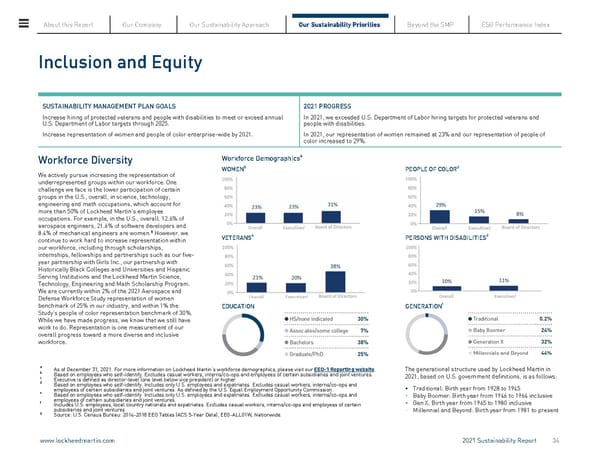
Inclusion and Equity SUSTAINABILITY MANAGEMENT PLAN GOALS Increase hiring of protected veterans and people with disabilities to meet or exceed annual U.S. Department of Labor targets through 2025. Increase representation of women and people of color enterprise-wide by 2021. 2021 PROGRESS In 2021, we exceeded U.S. Department of Labor hiring targets for protected veterans and people with disabilities. In 2021, our representation of women remained at 23% and our representation of people of color increased to 29%. Workforce Diversity We actively pursue increasing the representation of underrepresented groups within our workforce. One challenge we face is the lower participation of certain groups in the U.S., overall, in science, technology, engineering and math occupations, which account for more than 50% of Lockheed Martin’s employee occupations. For example, in the U.S., overall, 12.6% of aerospace engineers, 21.6% of software developers and 8.4% of mechanical engineers are women. g However, we continue to work hard to increase representation within our workforce, including through scholarships, internships, fellowships and partnerships such as our five- year partnership with Girls Inc., our partnership with Historically Black Colleges and Universities and Hispanic Serving Institutions and the Lockheed Martin Science, Technology, Engineering and Math Scholarship Program. We are currently within 2% of the 2021 Aerospace and Defense Workforce Study representation of women benchmark of 25% in our industry, and within 1% the Study’s people of color representation benchmark of 30%. While we have made progress, we know that we still have work to do. Representation is one measurement of our overall progress toward a more diverse and inclusive workforce. Workforce Demographics a WOMEN b VETERANS e EDUCATION PEOPLE OF COLOR d PERSONS WITH DISABILITIES d GENERATION f a As of December 31, 2021. For more information on Lockheed Martin's workforce demographics, please visit our EEO-1 Reporting website . b Based on employees who self-identify. Excludes casual workers, interns/co-ops and employees of certain subsidiaries and joint ventures. c Executive is defined as director-level (one level below vice president) or higher. d Based on employees who self-identify. Includes only U.S. employees and expatriates. Excludes casual workers, interns/co-ops and employees of certain subsidiaries and joint ventures. As defined by the U.S. Equal Employment Opportunity Commission. e Based on employees who self-identify. Includes only U.S. employees and expatriates. Excludes casual workers, interns/co-ops and employees of certain subsidiaries and joint ventures. f Includes U.S. employees, local country nationals and expatriates. Excludes casual workers, interns/co-ops and employees of certain subsidiaries and joint ventures. g Source: U.S. Census Bureau: 2014-2018 EEO Tables (ACS 5-Year Data), EEO-ALL01W, Nationwide. The generational structure used by Lockheed Martin in 2021, based on U.S. government definitions, is as follows: • Traditional: Birth year from 1928 to 1945 • Baby Boomer: Birth year from 1946 to 1964 inclusive • Gen X: Birth year from 1965 to 1980 inclusive • Millennial and Beyond: Birth year from 1981 to present About this Report Our Company Our Sustainability Approach Our Sustainability Priorities Beyond the SMP ESG Performance Index www.lockheedmartin.com 2021 Sustainability Report 34
 Lockheed Martin Sustainability Report Page 33 Page 35