

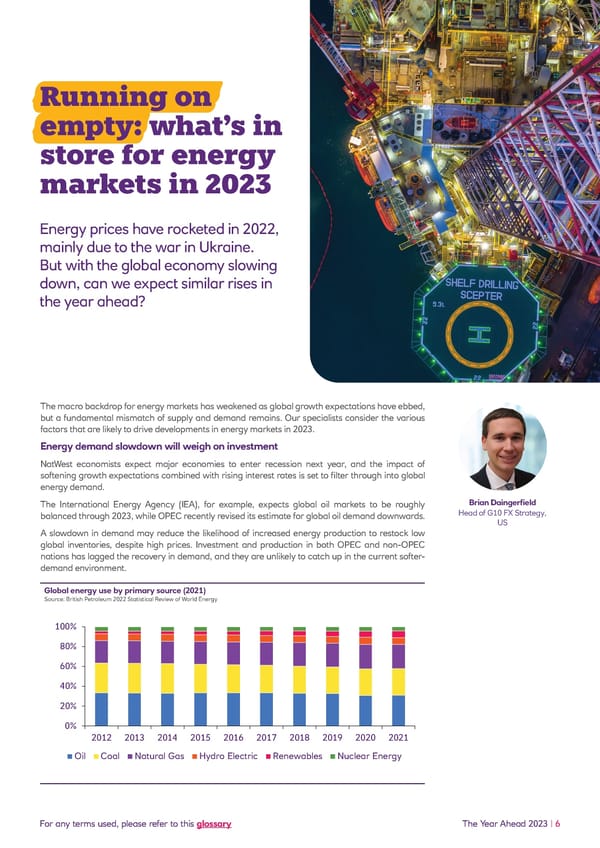
Running on empty: what’s in store for energy markets in 2023 Energy prices have rocketed in 2022, mainly due to the war in Ukraine. But with the global economy slowing down, can we expect similar rises in the year ahead? The macro backdrop for energy markets has weakened as global growth expectations have ebbed, but a fundamental mismatch of supply and demand remains. Our specialists consider the various factors that are likely to drive developments in energy markets in 2023. Energy demand slowdown will weigh on investment NatWest economists expect major economies to enter recession next year, and the impact of softening growth expectations combined with rising interest rates is set to filter through into global energy demand. The International Energy Agency (IEA), for example, expects global oil markets to be roughly Brian Daingerfield balanced through 2023, while OPEC recently revised its estimate for global oil demand downwards. Head of G10 FX Strategy, US A slowdown in demand may reduce the likelihood of increased energy production to restock low global inventories, despite high prices. Investment and production in both OPEC and non-OPEC nations has lagged the recovery in demand, and they are unlikely to catch up in the current softer- demand environment. Global energy use by primary source (2021) Source: British Petroleum 2022 Statistical Review of World Energy 100% 80% 60% 40% 20% 0% 2012 2013 2014 2015 2016 2017 2018 2019 2020 2021 Oil Coal Natural Gas Hydro Electric Renewables Nuclear Energy For any terms used, please refer to this glossary The Year Ahead 2023 | 6
 NatWest Year Ahead 2023 Page 5 Page 7