

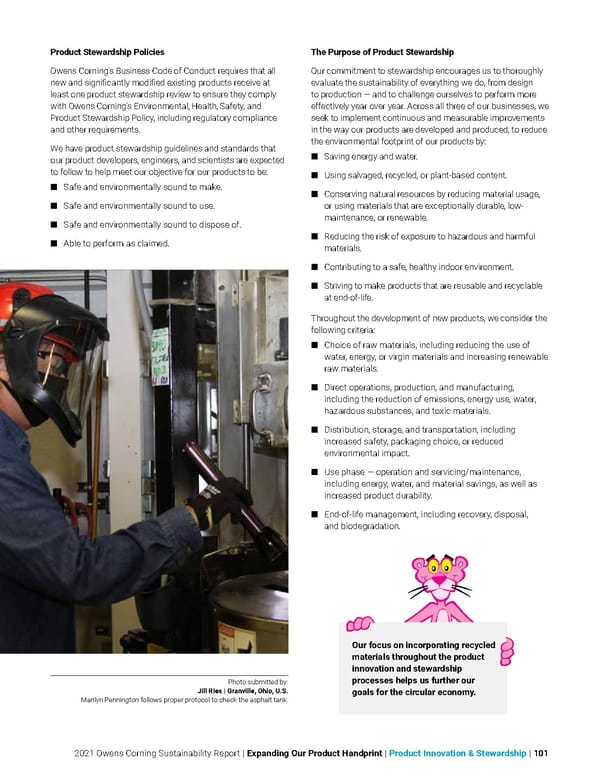
2021 Owens Corning Sustainability Report | Expanding Our Product Handprint | Product Innovation & Stewardship | 101 Photo submitted by: Jill Ries | Granville, Ohio, U.S. Marilyn Pennington follows proper protocol to check the asphalt tank. Product Stewardship Policies Owens Corning’s Business Code of Conduct requires that all new and significantly modified existing products receive at least one product stewardship review to ensure they comply with Owens Corning’s Environmental, Health, Safety, and Product Stewardship Policy, including regulatory compliance and other requirements. We have product stewardship guidelines and standards that our product developers, engineers, and scientists are expected to follow to help meet our objective for our products to be: ■ Safe and environmentally sound to make. ■ Safe and environmentally sound to use. ■ Safe and environmentally sound to dispose of. ■ Able to perform as claimed. The Purpose of Product Stewardship Our commitment to stewardship encourages us to thoroughly evaluate the sustainability of everything we do, from design to production — and to challenge ourselves to perform more effectively year over year. Across all three of our businesses, we seek to implement continuous and measurable improvements in the way our products are developed and produced, to reduce the environmental footprint of our products by: ■ Saving energy and water. ■ Using salvaged, recycled, or plant-based content. ■ Conserving natural resources by reducing material usage, or using materials that are exceptionally durable, low- maintenance, or renewable. ■ Reducing the risk of exposure to hazardous and harmful materials. ■ Contributing to a safe, healthy indoor environment. ■ Striving to make products that are reusable and recyclable at end-of-life. Throughout the development of new products, we consider the following criteria: ■ Choice of raw materials, including reducing the use of water, energy, or virgin materials and increasing renewable raw materials. ■ Direct operations, production, and manufacturing, including the reduction of emissions, energy use, water, hazardous substances, and toxic materials. ■ Distribution, storage, and transportation, including increased safety, packaging choice, or reduced environmental impact. ■ Use phase — operation and servicing/maintenance, including energy, water, and material savings, as well as increased product durability. ■ End-of-life management, including recovery, disposal, and biodegradation. Our focus on incorporating recycled materials throughout the product innovation and stewardship processes helps us further our goals for the circular economy.
 Owens Corning Sustainability Report Page 100 Page 102