

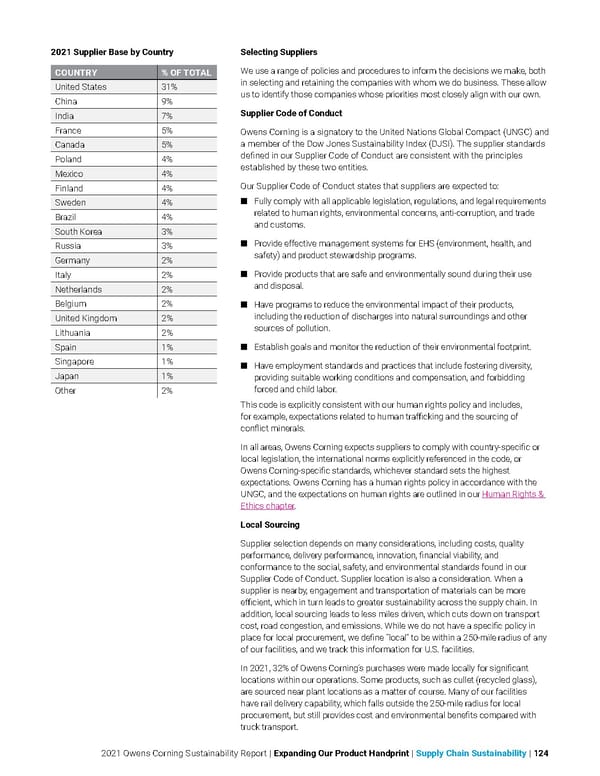
2021 Owens Corning Sustainability Report | Expanding Our Product Handprint | Supply Chain Sustainability | 124 Selecting Suppliers We use a range of policies and procedures to inform the decisions we make, both in selecting and retaining the companies with whom we do business. These allow us to identify those companies whose priorities most closely align with our own. Supplier Code of Conduct Owens Corning is a signatory to the United Nations Global Compact (UNGC) and a member of the Dow Jones Sustainability Index (DJSI). The supplier standards defined in our Supplier Code of Conduct are consistent with the principles established by these two entities. Our Supplier Code of Conduct states that suppliers are expected to: ■ Fully comply with all applicable legislation, regulations, and legal requirements related to human rights, environmental concerns, anti-corruption, and trade and customs. ■ Provide effective management systems for EHS (environment, health, and safety) and product stewardship programs. ■ Provide products that are safe and environmentally sound during their use and disposal. ■ Have programs to reduce the environmental impact of their products, including the reduction of discharges into natural surroundings and other sources of pollution. ■ Establish goals and monitor the reduction of their environmental footprint. ■ Have employment standards and practices that include fostering diversity, providing suitable working conditions and compensation, and forbidding forced and child labor. This code is explicitly consistent with our human rights policy and includes, for example, expectations related to human trafficking and the sourcing of conflict minerals. In all areas, Owens Corning expects suppliers to comply with country-specific or local legislation, the international norms explicitly referenced in the code, or Owens Corning-specific standards, whichever standard sets the highest expectations. Owens Corning has a human rights policy in accordance with the UNGC, and the expectations on human rights are outlined in our Human Rights & Ethics chapter . Local Sourcing Supplier selection depends on many considerations, including costs, quality performance, delivery performance, innovation, financial viability, and conformance to the social, safety, and environmental standards found in our Supplier Code of Conduct. Supplier location is also a consideration. When a supplier is nearby, engagement and transportation of materials can be more efficient, which in turn leads to greater sustainability across the supply chain. In addition, local sourcing leads to less miles driven, which cuts down on transport cost, road congestion, and emissions. While we do not have a specific policy in place for local procurement, we define “local” to be within a 250-mile radius of any of our facilities, and we track this information for U.S. facilities. In 2021, 32% of Owens Corning’s purchases were made locally for significant locations within our operations. Some products, such as cullet (recycled glass), are sourced near plant locations as a matter of course. Many of our facilities have rail delivery capability, which falls outside the 250-mile radius for local procurement, but still provides cost and environmental benefits compared with truck transport. COUNTRY % OF TOTAL United States 31% China 9% India 7% France 5% Canada 5% Poland 4% Mexico 4% Finland 4% Sweden 4% Brazil 4% South Korea 3% Russia 3% Germany 2% Italy 2% Netherlands 2% Belgium 2% United Kingdom 2% Lithuania 2% Spain 1% Singapore 1% Japan 1% Other 2% 2021 Supplier Base by Country
 Owens Corning Sustainability Report Page 123 Page 125