

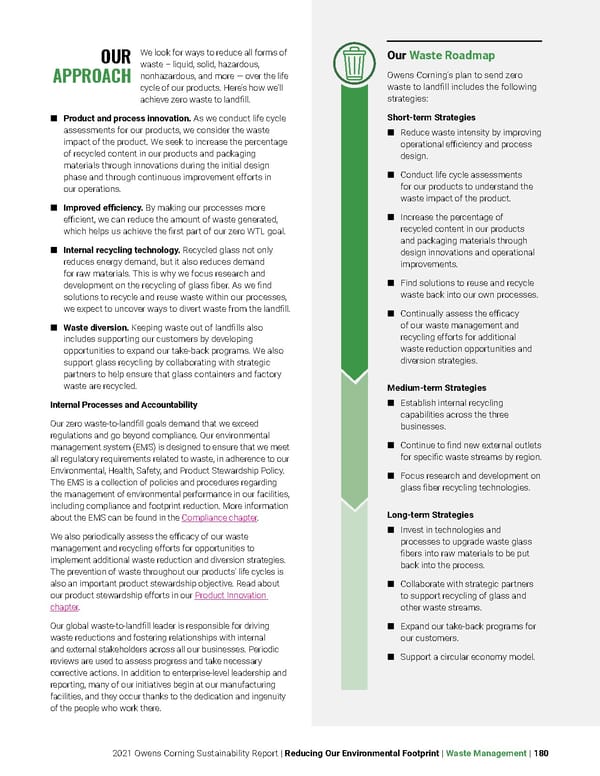
2021 Owens Corning Sustainability Report | Reducing Our Environmental Footprint | Waste Management | 180 Our Waste Roadmap Owens Corning’s plan to send zero waste to landfill includes the following strategies: Short-term Strategies ■ Reduce waste intensity by improving operational efficiency and process design. ■ Conduct life cycle assessments for our products to understand the waste impact of the product. ■ Increase the percentage of recycled content in our products and packaging materials through design innovations and operational improvements. ■ Find solutions to reuse and recycle waste back into our own processes. ■ Continually assess the efficacy of our waste management and recycling efforts for additional waste reduction opportunities and diversion strategies. Medium-term Strategies ■ Establish internal recycling capabilities across the three businesses. ■ Continue to find new external outlets for specific waste streams by region. ■ Focus research and development on glass fiber recycling technologies. Long-term Strategies ■ Invest in technologies and processes to upgrade waste glass fibers into raw materials to be put back into the process. ■ Collaborate with strategic partners to support recycling of glass and other waste streams. ■ Expand our take-back programs for our customers. ■ Support a circular economy model. We look for ways to reduce all forms of waste – liquid, solid, hazardous, nonhazardous, and more — over the life cycle of our products. Here’s how we’ll achieve zero waste to landfill. ■ Product and process innovation. As we conduct life cycle assessments for our products, we consider the waste impact of the product. We seek to increase the percentage of recycled content in our products and packaging materials through innovations during the initial design phase and through continuous improvement efforts in our operations. ■ Improved efficiency. By making our processes more efficient, we can reduce the amount of waste generated, which helps us achieve the first part of our zero WTL goal. ■ Internal recycling technology. Recycled glass not only reduces energy demand, but it also reduces demand for raw materials. This is why we focus research and development on the recycling of glass fiber. As we find solutions to recycle and reuse waste within our processes, we expect to uncover ways to divert waste from the landfill. ■ Waste diversion. Keeping waste out of landfills also includes supporting our customers by developing opportunities to expand our take-back programs. We also support glass recycling by collaborating with strategic partners to help ensure that glass containers and factory waste are recycled. Internal Processes and Accountability Our zero waste-to-landfill goals demand that we exceed regulations and go beyond compliance. Our environmental management system (EMS) is designed to ensure that we meet all regulatory requirements related to waste, in adherence to our Environmental, Health, Safety, and Product Stewardship Policy. The EMS is a collection of policies and procedures regarding the management of environmental performance in our facilities, including compliance and footprint reduction. More information about the EMS can be found in the Compliance chapter . We also periodically assess the efficacy of our waste management and recycling efforts for opportunities to implement additional waste reduction and diversion strategies. The prevention of waste throughout our products’ life cycles is also an important product stewardship objective. Read about our product stewardship efforts in our Product Innovation chapter . Our global waste-to-landfill leader is responsible for driving waste reductions and fostering relationships with internal and external stakeholders across all our businesses. Periodic reviews are used to assess progress and take necessary corrective actions. In addition to enterprise-level leadership and reporting, many of our initiatives begin at our manufacturing facilities, and they occur thanks to the dedication and ingenuity of the people who work there. OUR APPROACH
 Owens Corning Sustainability Report Page 179 Page 181